
President Donald Trump has implemented a comprehensive
series of trade deals during his second term, focusing on bilateral
negotiations, reciprocal tariff structures, and protections for key U.S.
industries to address persistent trade imbalances. These agreements, rolled out
progressively from early 2025 onward, leverage executive authority to secure
market access for American exports while imposing calibrated duties on imports
from over 20 trading partners.
The approach aims to reduce the annual U.S. goods trade
deficit, which exceeded $1 trillion in recent years, by prioritizing fair
reciprocity over traditional multilateral frameworks like the WTO.
This strategy continues and expands upon first-term
initiatives, marking a fundamental shift in global trade dynamics with
measurable impacts on manufacturing, agriculture, and supply chains.
Origins and
Philosophical Underpinnings
Trump’s trade philosophy emphasizes economic nationalism,
viewing chronic deficits as threats to national security and worker
livelihoods. During his 2017-2021 presidency, this manifested in Section 232
tariffs on steel (25%) and aluminum (10%), affecting $48 billion in imports and
spurring retaliatory actions totaling $75 billion from partners including the
EU, Canada, Mexico, and China.
The United States-Mexico-Canada Agreement (USMCA), effective
July 2020, replaced NAFTA with stricter rules of origin requiring 75% North
American content for automobiles and enhanced labor provisions, credited with
creating or preserving 176,000 U.S. jobs according to U.S. International Trade
Commission assessments.
The Phase One agreement with China in January 2020 committed
Beijing to purchasing $200 billion worth of U.S. goods over two years across
agriculture ($50 billion), manufactured products ($77 billion), and energy ($52
billion), although actual compliance hovered around 58% by 2021 amid pandemic
disruptions. These experiences shaped the second-term playbook, beginning with
a national emergency declaration under the International Emergency Economic
Powers Act (IEEPA) on April 2, 2025.
This enabled broad tariff authority without immediate
congressional oversight, establishing baseline rates such as 25% on Mexico and
Canada (suspended for USMCA-compliant items), 20% on China linked to fentanyl
concerns, and 25% on non-North American automobiles starting May 3.
Reciprocity serves as the core principle: nations imposing
high barriers on U.S. products face equivalent duties, while cooperative
partners receive exemptions, reductions, or zero-tariff access. Steel and
aluminum tariffs doubled to 50% by mid-2025, extending to derivatives like
copper to safeguard $300 billion in domestic sectors.
Early 2025 Tariff
Impositions and Market Reactions
The administration’s initial moves set the stage for
negotiations. Fentanyl-related tariffs on Mexico and Canada pressured border
security commitments, while Chinese duties effectively reached 60% on $500
billion in imports by July through layered applications.
Automotive tariffs exempted compliant parts from allies
agreeing to baseline payments, with two-year rebate mechanisms for high-volume
producers. Commerce Department data indicated a 12% narrowing of the Q2 2025
goods deficit, from $310 billion to $273 billion, as imports declined and
selective exports grew.
These actions disrupted global supply chains temporarily,
with automobile prices rising 7% and steel costs increasing 15%, but proponents
argue they incentivized reshoring and investment in U.S. facilities.
Western Hemisphere
Negotiations and Agreements
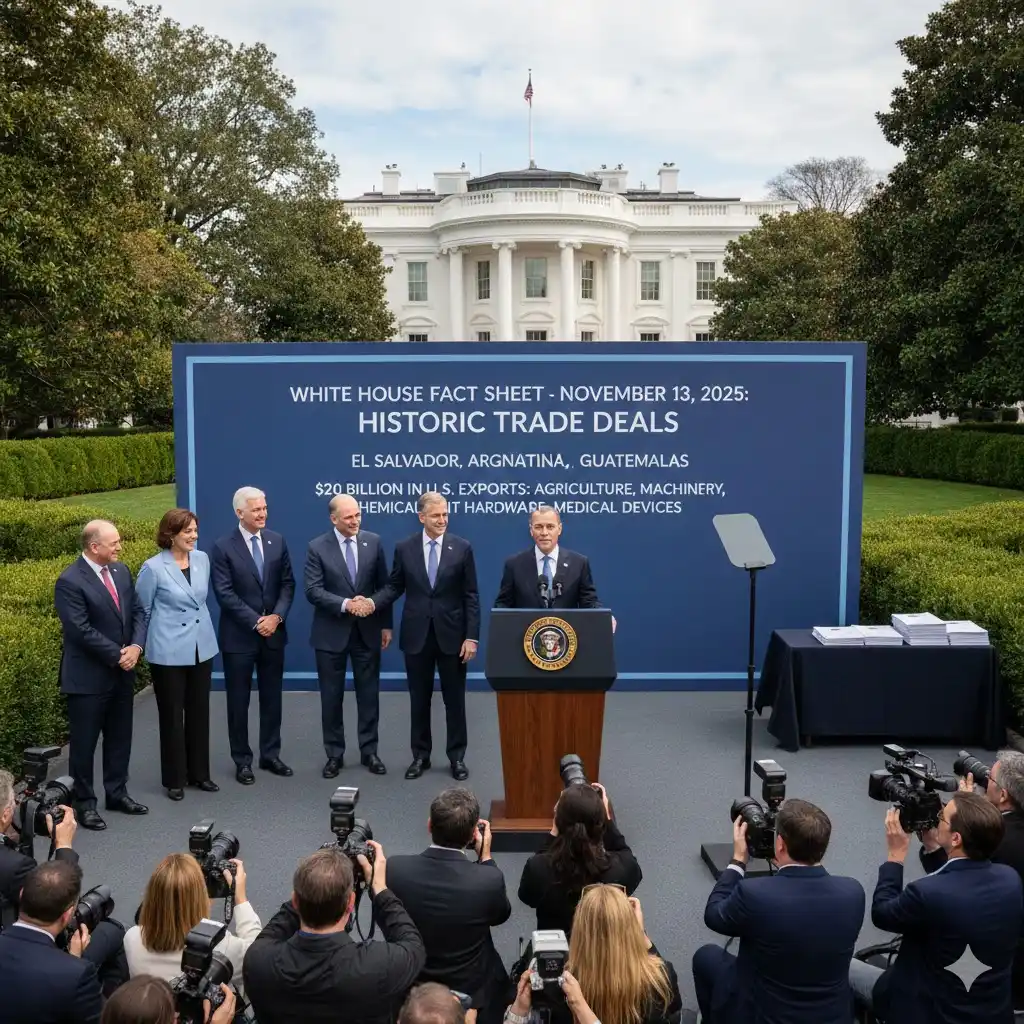
A major milestone occurred on November 13, 2025, when the
White House released a fact sheet announcing historic deals with El Salvador,
Argentina, Ecuador, and Guatemala. These pacts eliminated key non-tariff
barriers and secured preferential market access for approximately $20 billion
in annual U.S. exports across agriculture, machinery, chemicals, IT hardware,
and medical devices.
Argentina, a significant soy and beef exporter, pledged zero
tariffs on U.S. chemicals and agricultural products while committing to resolve
longstanding U.S. Trade Representative (USTR) Special 301 intellectual property
concerns, including patent backlogs that had delayed $2 billion in
pharmaceutical approvals annually.
Ecuador dismantled its Andean Price Band system, which had
imposed variable duties up to 45% on wheat, tree nuts, wine, and spirits,
unlocking $500 million in U.S. opportunities previously constrained.
Guatemala and El Salvador extended most-favored-nation
treatment to non-textile goods under enhancements to the Dominican
Republic-Central America Free Trade Agreement (DR-CAFTA), facilitating shifts
in apparel production to U.S. hubs in the Carolinas and projecting 50,000 new
jobs.
These agreements include enforceable roadmaps for IP
protection, labor audits, and customs digitization, with full ratifications
completed by December 2025 to bolster supply chain resilience, particularly for
critical minerals like lithium from Argentina.
Asia-Pacific
Bilateral Frameworks and Expansions
In July 2025, announcements via social media platforms
detailed reciprocal arrangements with Vietnam, the Philippines, Malaysia, and
Cambodia, followed by frameworks for Thailand and Indonesia. Vietnam agreed to
a 20% tariff reduced to 10% upon compliance, pledging $15 billion in purchases
of U.S. machinery and semiconductors to curb transshipment of Chinese goods
evading prior duties.
The Philippines eliminated 17% duties on aircraft parts and
medical devices, opening a $4 billion services market previously restricted by
local content rules.
Malaysia and Cambodia addressed non-tariff barriers such as
discriminatory standards and forced labor in textiles, while Japan and South
Korea secured reductions to 15% on automobiles tied to $30 billion in U.S.
plant investments, offsetting their combined $70 billion trade surpluses. These
deals, emphasizing zero-tariff U.S. access in exchange for moderated baselines,
project $100 billion in export gains by 2027, significantly rerouting
electronics and apparel supply chains away from China.
European Union
Comprehensive Trade Agreement
The August 2025 EU-U.S. pact represented a transatlantic
cornerstone, with the European Commission committing to zero-for-zero tariffs on
$500 billion in industrial goods, $750 billion in liquefied natural gas and
energy purchases over a decade, and €40 billion in artificial intelligence
chips and semiconductors. In return, the U.S. set duties at 15% on EU
automobiles, pharmaceuticals, and semiconductors down from threatened 30%
levels and expanded tariff-rate quotas for American beef (90,000 tons
annually), poultry, and dairy products. Cooperation on critical minerals,
including EU supplies of cobalt and nickel for U.S. battery production, further
solidified the framework.
Implementation through 2026 executive orders stabilized
bilateral trade volumes at $1.3 trillion annually, preventing an estimated 20%
contraction from escalating tariff wars.
United Kingdom
Automotive and Post-Brexit Framework

December 2025 brought a targeted deal with the United
Kingdom, establishing an annual quota of 100,000 vehicles at a 10% tariff rate,
with standard duties applying beyond that threshold. Exemptions for electric
vehicles linked to UK investments in U.S. battery facilities navigated the
broader Section 232 automotive hikes, providing $10 billion in export
predictability for British manufacturers adjusting to post-Brexit realities
under the Labour government.