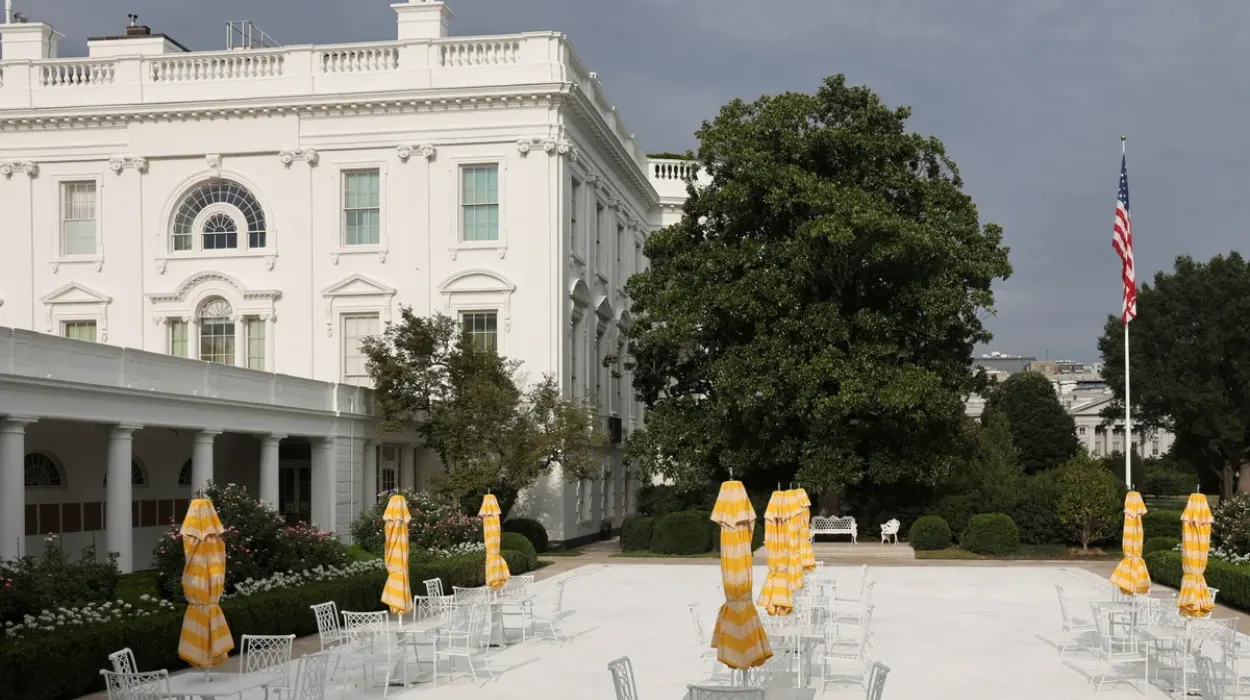

- Trump’s
White House ballroom plans not unique. - Longest-serving
chief usher Gary Walters confirms. - Served
Reagan, Bush, Clinton, Bush over 20 years.
Even before he entered politics, President Trump had long
talked about creating a ballroom in the White House.
The White House revealed in July that a 90,000-square-foot
area, estimated to cost $200 million, would be constructed on the east side of
the building to house 650 seated visitors. According to President Trump,
private donations, including his own, would be used to finance it.
Later, the Republican president increased the planned
ballroom’s capacity to 999, and by October, he had destroyed the White House’s
two-story East Wing in order to construct it there. He doubled the first
estimate to $400 million in December.
Historians, preservationists, and others were shocked to see
images of the East Wing being demolished, but Walters explained that there is a
long history of projects on campus, from the addition of the East Wing itself
during World War II to provide workspace for the first lady, her staff, and
other White House offices to the demolition of conservatories, greenhouses, and
stables to build the West Wing in 1902.
“So there’s always been construction going on around the
White House,”
Walters said.
According to Walters, one of the first things he discussed
with the incoming president, first lady, and their social secretary during his
tenure was the size of the White House’s largest public rooms.
According to Walters, the State Dining Room can accommodate
roughly 130 guests when it is set up for a state supper. Each of the 13 round
tables has ten seats. About 300 chairs can fit in the East Room; this number
may drop if more room is required for TV cameras.
Trump frequently laments how small both rooms are.
Additionally, he has expressed dissatisfaction with the usage of enormous tents
on the south grounds, which is the primary solution for major events like
opulent state banquets for foreign dignitaries. The tents had problems,
according to Walters.
Walters said he had happy personal memories of the East Wing
and acknowledged that it was a little startling to see it demolished.
“When it rained, the water flows downhill and the grass
became soggy, no matter what we tried to do,”
Walters said.
“We dug
culverts around the outside of the tent to try and get the water.”
Tents damaged the grass, requiring more work to reseed it, he said.
“I met my wife at the White House and she worked in the
East Wing, so that was a joy for me,”
said Walters, 79.
During the administrations of Gerald Ford and Richard Nixon,
his wife, Barbara, worked as a receptionist at the visitors office. The pair
just commemorated their 48th wedding anniversary.
Usher’s career path is altered by broken bones
Walters’ unfortunate fractured ankle is the reason he is the
longest-serving White House chief in history.
Early in 1970, at the age of 23, he was honorably discharged
from the Army and seeking employment that would enable him to complete his
college education at night. He was hired and accepted by the Executive
Protective Service, which was the forerunner of the U.S. Secret Service.
However, Walters suffered an ankle break while playing
football just prior to the graduation ceremony.
“This injury also changed the course of my career,”
Walters
wrote in his memoir,
“White House Memories: 1970-2007: Recollections of the
Longest-Serving Chief Usher.”
He gained an ”in-depth knowledge of the ways
and security systems of the White House that would ultimately greatly benefit
me in my future role in the Usher’s Office.”
He found out about a position at the Usher’s Office a few
months after receiving a promotion to sergeant in 1975. Early in 1976, he
applied and started working as an assistant.
Ten years later, Reagan promoted him to chief usher, giving
Walters the most important position in the residence, supervising food service,
building and remodeling projects, maintenance, and administrative, financial,
and personnel tasks. About ninety butlers, housekeepers, cooks, florists,
electricians, engineers, plumbers, and other workers were under his
supervision.
After 37 years in the White House, including a record 21
years as chief usher, Walters retired in 2007. From Nixon to George W. Bush, he
worked for seven different presidents.
Walters witnessed a wide range of presidential events during
that period, including the only president to resign, the only president to be
impeached and remain in office, a father and son becoming president, and the
Supreme Court ruling on the most hotly contested presidential election in
American history.
“Without hesitation, I say it is getting to know and
interact directly with the president, first lady, and other members of their
family,”
he responds when asked what he enjoys most about his job.
Getting to know them with my own eyes and ears was an honor, Walters wrote.
How have past presidents used the White House ballroom
spaces?
Once chairpersons have acclimated White House spaces for
chamber- such as amusing without devoted formal lyceums, counting on
multi-purpose apartments amid growing event demands.
Truman( 1945- 1953) hosted large receptions in the East
Room( capacity 200 for feasts) and State Dining Room, using temporary canopies
on the South Field for overflow state feasts with 100 guests.
Kennedy( 1961- 1963) expanded the East Room for festivals
via Jacqueline Kennedy’s refurbishments, emphasizing artistic events like the
1962 ingenue ball.
Nixon( 1969- 1974) and Ford( 1974- 1977) added basement
installations( bowling alley, press room) for informal gatherings, while
Reagan( 1981- 1989) and Clinton( 1993- 2001) constantly erected lavish canopies
for 500- 1,000 person events, going $500,000 each, pressing the need for
endless capacity addressed in Trump’s offer.