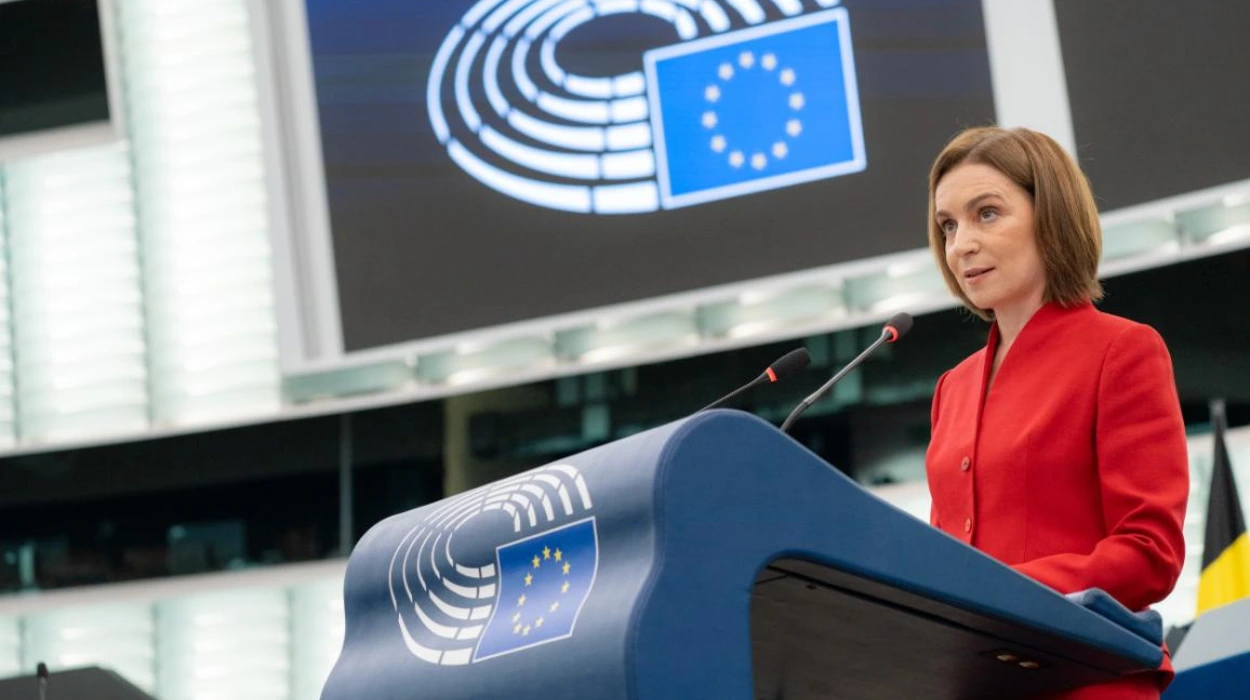

Moldovan President Maia Sandu has delivered a candid warning
to European lawmakers and the international community, asserting that Russia is
seeking to undermine Moldova’s sovereignty by turning it against Europe.
Speaking before the European Parliament in Strasbourg on September 8, 2025,
Sandu highlighted Moldova’s strategic importance as a frontier of European
democracy threatened by Moscow’s hybrid tactics.
She explained that Russia’s aim is not just to control
Moldova, but to use the country as a platform to weaken the European Union and
destabilize regional security. According to Sandu,
“Moldova was just a platform from which Russia could
harm the European Union,”
underscoring Moscow’s broader geopolitical designs.
Sandu described the upcoming parliamentary elections in
Moldova as the most consequential in the country’s history, framing them as a
pivotal battle between democratic consolidation and Russian attempts to pull
Moldova away from Europe. The president warned, “If our democracy cannot
be protected, then no democracy in Europe is safe.”
Russia’s Hybrid War Strategy Unveiled
President Sandu outlined what she called Russia’s “unlimited
hybrid war” against Moldova, deploying an array of destabilization tools
including disinformation campaigns, cyberattacks, vote buying, provocations,
and intimidation. She stated that Moscow’s goal is to capture power in Chisinau
through elections manipulated to install loyalists who would serve Russian
interests.
This hybrid warfare operates on a scale unprecedented before
the full-scale invasion of Ukraine, according to Sandu. She lamented that
Moldova is positioned as a testing ground for these tactics.
“The Kremlin’s goal is clear: to capture Moldova
through the ballot box, to use us against Ukraine, and to turn us into a
launchpad for hybrid attacks on the European Union,”
she told lawmakers.
Sandu’s message was supported by EU Parliament President
Roberta Metsola, who praised Moldova’s determination and solidarity with
European democratic values. Metsola underscored,
“We stand united in our support for Moldova and its
democratic path to European Union membership.”
Resisting Russian Pressure: Energy and Sovereignty
Since the onset of the war in Ukraine, Moldova has faced
attempts by Russia to exert pressure by leveraging its energy supply. However,
Sandu emphasized that Moldova has successfully reduced its dependence on
Russian gas. Key
infrastructure projects, such as the Chisinau-Vulcanesti power line from
Romania, provide alternative energy sources, weakening Moscow’s capacity to use
energy as a geopolitical weapon.
“Russia cannot shut off our gas, and soon we will put
the Chisinau-Vulcanesti power line into operation, which offers us
alternatives,”
Sandu remarked confidently. Moldova’s market, she said, is
no longer dependent on the Russian Federation.
This energy diversification is a cornerstone of Moldova’s
broader strategy to strengthen sovereignty and align more closely with European
institutions, amidst ongoing Russian attempts to maintain influence.
Political Context: Recent Elections and Russian Interference
Moldova’s recent parliamentary elections, held on September
28, 2025, were heavily contested and marked by allegations of Russian
interference. Sandu’s Party of Action and Solidarity (PAS) secured a decisive
victory, strengthening pro-European forces despite intensive efforts by
Russia-backed political factions to sway the vote.
Experts describe the interference as sophisticated, ranging
from misinformation campaigns propagated through social media networks to
cyber-attacks aimed at disrupting democratic processes. Federal Security
Service (FSB)-linked operatives and a Moldovan billionaire with ties to Russia
reportedly orchestrated much of the subversion attempts.
Sandu remarked on the resilience of Moldovan voters who
delivered an “honest and courageous” mandate, signaling rejection of external
meddling. She expressed hope that Moldova’s example could inspire other
post-Soviet states facing similar threats.
EU Accession: A Race Against Time
For President Sandu and Moldova’s government, the drive
toward European Union accession is a critical priority. Having formally applied
for membership in 2022, Moldova’s accession process has made important strides,
including receiving a negotiation framework from Brussels in mid-2024. Yet,
progress faces obstacles—not only from Russian interference but also from some
EU member states reluctant to rapidly admit new members amid internal EU
challenges.
Sandu described the accession effort not as a bureaucratic
formality but a “race against time” to embed Moldova’s fragile democracy within
European frameworks capable of protecting it from external threats. She
insisted that future EU members were not perfect democracies at the time of
joining, but they persevered through solidarity and reform.
“None of them did it alone. That is the lesson for
Moldova, and the warning for Europe,” Sandu said, reinforcing her call for
sustained EU support and unity.
Regional and Global Implications
Moldova’s struggle against Russian influence highlights a
broader geopolitical contest in Eastern Europe. As a small and resource-limited
country bordering Ukraine, Moldova’s fate resonates across the continent as a
symbol of resistance against authoritarian expansionism.
Security analysts caution that Moldova’s stability is a
litmus test for European democratic resilience, with failure potentially
opening a western front for Russia’s destabilization efforts in Ukraine and
beyond.
Maia Sandu’s presidency embodies this defiant stance,
combining anti-corruption reforms, energy diversification, and a pro-European
foreign policy to break from the post-Soviet legacy of dependence and division.
Challenges Ahead
Despite the electoral victory and progress toward EU
integration, Moldova faces ongoing challenges, including economic hurdles,
entrenched oligarchic networks, and constant threats from Russian-supported
separatists in the breakaway region of Transnistria.
President Sandu emphasizes her administration’s commitment
to peaceful domestic governance with leaders “loyal to this country.” She
insists on defending Moldova’s democratic gains fiercely and calls for Europe
to strengthen its own resilience.
“We want to live freely. We want small countries, like
Moldova, to matter,”
Sandu affirmed, denouncing Russia’s narrative that only
major powers hold significance.
President Maia Sandu’s message to Europe illuminated
Moldova’s difficult geopolitical reality, caught between Russian aggressions
and aspirational European unity. Her firm warning that Russia seeks to turn
Moldova against Europe underscores the stakes of democratic survival in Eastern
Europe.
Moldova’s recent electoral victory and energy
diversification efforts offer hope that even small nations can resist coercion
and assert sovereignty in a challenging geopolitical landscape.
Sandu’s plea for European solidarity and timely support
serves as both a call to action and a reminder that the fate of Moldova is
inexorably linked to the future of democracy in Europe.