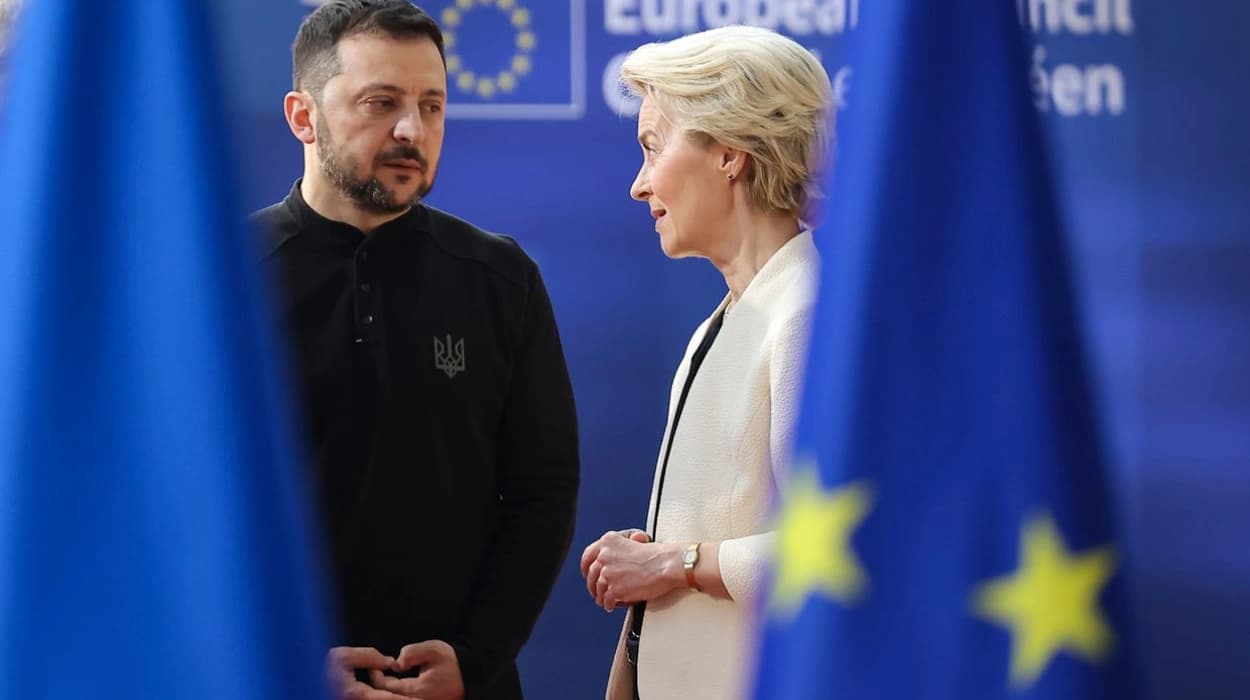
- EU Commission advances Ukraine membership technically.
- Bypasses Hungary's block on official accession talks.
- Unprecedented move despite political opposition from Hungary.
According to the new strategy, technical progress entails Kyiv moving forward with the reforms required to satisfy EU eligibility requirements, and EU employees will evaluate Ukraine's compliance with EU standards and legislation in areas such as judicial independence. Budapest's veto on starting formal negotiations is circumvented in this way.
Marta Kos, the EU's enlargement commissioner, told DW that during an unofficial meeting in Lviv earlier this week, European affairs ministers gave her "clear instructions" to move Ukraine's request forward.
"I'm very, very happy and encouraged to go even faster in this process,"
she told DW.
Any final membership decisions will still need Hungary's consent, and any new nations wishing to join the union must have the unanimous agreement of all current members.
"At some point, we will have to find unanimity,"
Kos acknowledged when pressed on the feasibility of the plan.
"But for the time being, for the technical part, we can go on,"
she said on Friday.
"Ukraine doesn't need Hungary to do the reforms. It is a transformational process for the benefit of the whole country,"
she added.
Moldova, a neighbor of Ukraine whose membership application has also been mired in the EU internal impasse, will be subject to the same procedure by the European Commission.
Following media reports that EU entry as early as 2027 is being explored as part of a US peace plan for Ukraine, Kos was cautious not to commit to any timetables.
"I'm very happy that this peace plan speaks about EU accession of Ukraine. This is now the first draft. We will see what will come out at the end,"
Kos told DW.
When exactly that is remains to be seen, she continued.
"It also depends on how quick Ukraine will be in the reforms. And it is also connected to what our member states will say, when we will be ready to accept Ukraine."
Earlier this week, the European Commission and Ukraine collaborated to develop a strategy for anti-graft reforms, with fighting corruption being viewed as a major obstacle for Kyiv on its EU route.
Kos listed strengthening judicial screening as well as increasing the resources and autonomy of Ukraine's anti-corruption organizations as potential areas for development. Kyiv's fresh membership proposal from the European Commission follows a corruption crisis in the nation that made headlines across the globe.
In 2022, Hungary approved Ukraine's official candidacy for EU membership, but since then, Budapest has prevented Kyiv's bid from moving forward.
Hungarian Prime Minister Viktor Orban frequently uses the unfavorable outcome of a non-binding referendum on Ukraine's EU membership when publicly opposing Ukraine's progress.
According to experts, the EU itself must undergo internal reforms in order to accept Kyiv and other prospective members. Vetoes by individual members can frequently cause EU decision-making to move slowly. The bloc's ability to operate could be further hampered by the inclusion of other nations.
"Why should our people have to suffer the consequences of someone else's war? We feel for the Ukrainian people and recognise their hardships but we will not share a fate that is not ours,"
Orban wrote on social media platform X in October.
"There are also a variety of political debates around — and, rather legitimate concerns, I would say — about the impact of Ukraine's potential accession on the EU's budget, on cohesion policy, also on its common agricultural policy,"
researcher Teona Lavrelashvili told DW earlier this week.
"So unless these concerns are addressed by Brussels, also institutionally, I think that the debates will persist — and not only Hungary, but also other member states, will not fully embrace Ukraine's EU accession,"
Lavrelashvili, an analyst with the center-right Wilfred Martens Centre think tank in Brussels, said.
Kos said the European Commission would present an assessment on the EU's readiness to accommodate new members and "what needs to be done" in March next year.
How will this affect Ukrainians travel and trade with the EU?
The specialized advancement of Ukraine's EU accession process, including prioritized clusters and the upgraded DCFTA, promises gradational advancements to Ukrainians' trip and trade with the EU, though full benefits await class.
The modernized Deep and Comprehensive Free Trade Area, effective October 2025, expands tariff-free access for Ukrainian goods especially non-agricultural while adding safeguards for sensitive EU sectors like husbandry, boosting exports and integrating Ukraine into the Single request over time.
Ukrainians formerly enjoy visa-free short stays, and accession progress reinforces this via aligned norms; no immediate visa changes do, but deeper alignment could ease long- term mobility, work permits, and conveyance through systems like NCTS for goods.