
Summary
- Chicago
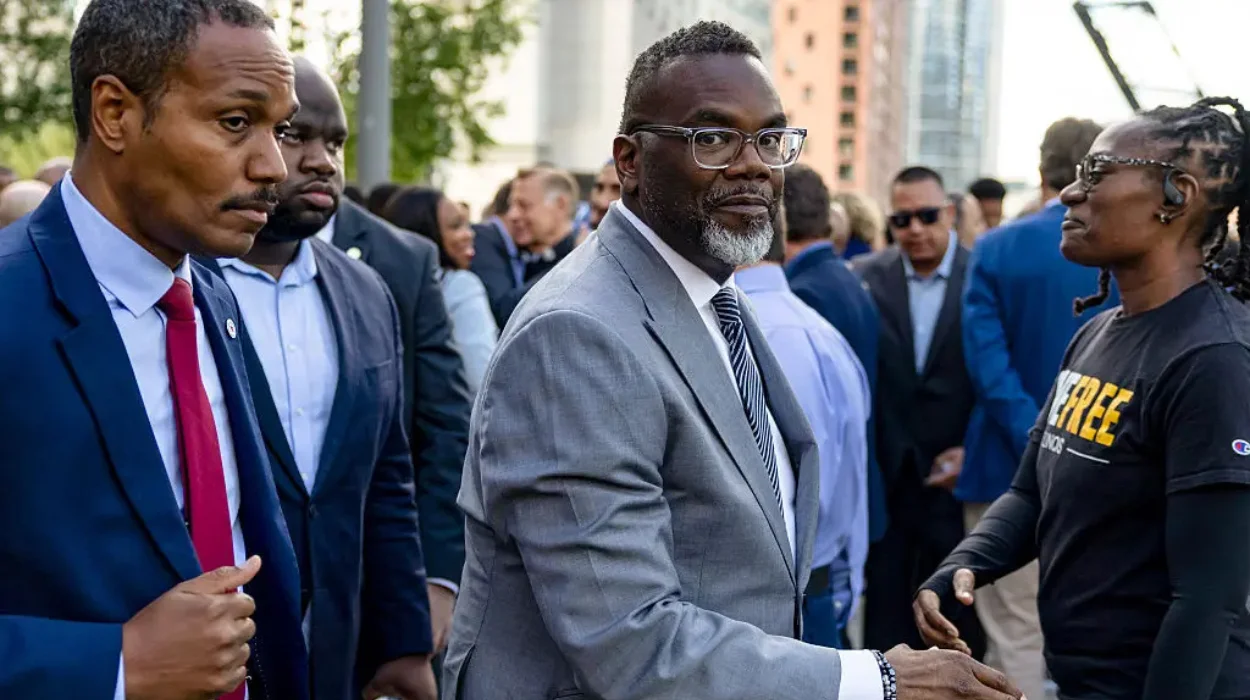
Mayor Brandon Johnson signed an executive order Saturday. - The
order calls on Trump not to deploy troops to the city. - Directs
city departments to refuse collaboration with federal agents. - Police
instructed to clearly differentiate from federal enforcement.
In addition, Chicago Police were instructed not to
“collaborate with federal agents on joint law enforcement patrols, arrest
operations, or other law enforcement duties including civil immigration
enforcement,” wear identification, and refrain from donning masks.
“The City of Chicago Mayor Johnson demands that President
Donald J Trump and any agents acting under his authority stand down from any
attempts to deploy the U.S. Armed Forces—including National Guard—in Chicago,”
the order said.
However, it is forbidden for any city department to take
part in any enforcement activities that violate the rights of Chicagoans to
peacefully assemble and demonstrate.
The city
“will pursue all available legal and
legislative avenues to counter coordinated efforts from the federal government
that violate the rights of the City and its residents, including the
Constitutional rights to peacefully assemble and protest and the right to due
process,”
the mayor’s order further stated.
“We will protect our constitution. We will protect our city.
And we will protect our people. We do not want to see tanks in our streets. We
do not want to see families ripped apart,”
Johnson said at the city hall press
event to announce the order.
“Protecting Chicago will ensure that every
Chicagoan knows their rights, that every single family is prepared, and every
part of city government is directed to protect the people of Chicago from
federal action.”
The directive coincides with reports that Trump is
considering sending National Guard troops to Chicago in a similar manner to the
operation he carried out in Los Angeles earlier this summer, when he dispatched
700 U.S. Marines and about 4,000 California National Guard soldiers to put an
end to demonstrations against ICE raids in the city.
As early as the end of next week, Johnson stated on
Saturday, he has heard many reports that the Trump Administration intends to
send militarized action to Chicago, possibly in the form of active-duty
military forces, National Guard soldiers, or federal agents. Although he
believed he did not have the “luxury” of time, he stated that he was
collaborating with the city council to develop legislation in order to get
ready for any deployment.
In recent weeks, Trump has increased his threats against
cities that are controlled by Democrats, threatening to send National Guard
troops to “address crime” in Oakland, Baltimore, and Chicago.
Although many of Trump’s moves are being contested in court, he has capitalized
on the precedent set by his militaristic takeover of Washington, D.C., where
the president has some control over local police during emergencies.
The president deployed over 2,000 National Guard troops and
federal officers to the capital as part of what he says is a crackdown on
crime.
Although Trump has not announced
that he is deploying troops to Chicago, he has hinted that the Midwestern city
is next.
“After we do this, we’ll go to another location and we’ll
make it safe also,”
Trump told reporters on Aug. 22.
“Chicago is a mess. You
have an incompetent mayor, grossly incompetent, and we’ll straighten that one
out, probably next.”
Even while city police statistics indicate that crime in
Chicago, like that in Washington, D.C., has decreased recently, Trump has
consistently attacked the city’s leadership for years and during his first
term. According to city police data, there has been a 15% fall in crime since
2023, and shootings, both fatal and nonfatal, have dropped by over 38% this
year compared to the previous one.
How would Chicago Police refusal to collaborate affect
federal operations?
Without local police cooperation, federal agents could lose
critical on-the-ground support such as local intelligence, backup, crowd
control, and logistical assistance, making federal operations less effective
and more dangerous.
Chicago police wearing identifiable uniforms and not
collaborating with anonymous or masked federal agents helps residents
distinguish between local law enforcement and federal personnel, protecting
community trust and reducing confusion during enforcement actions.
City departments refusing to assist federal immigration
enforcement hinder the implementation of enforcement actions requiring local
resources, such as setting up traffic perimeters or providing access to
detention facilities.