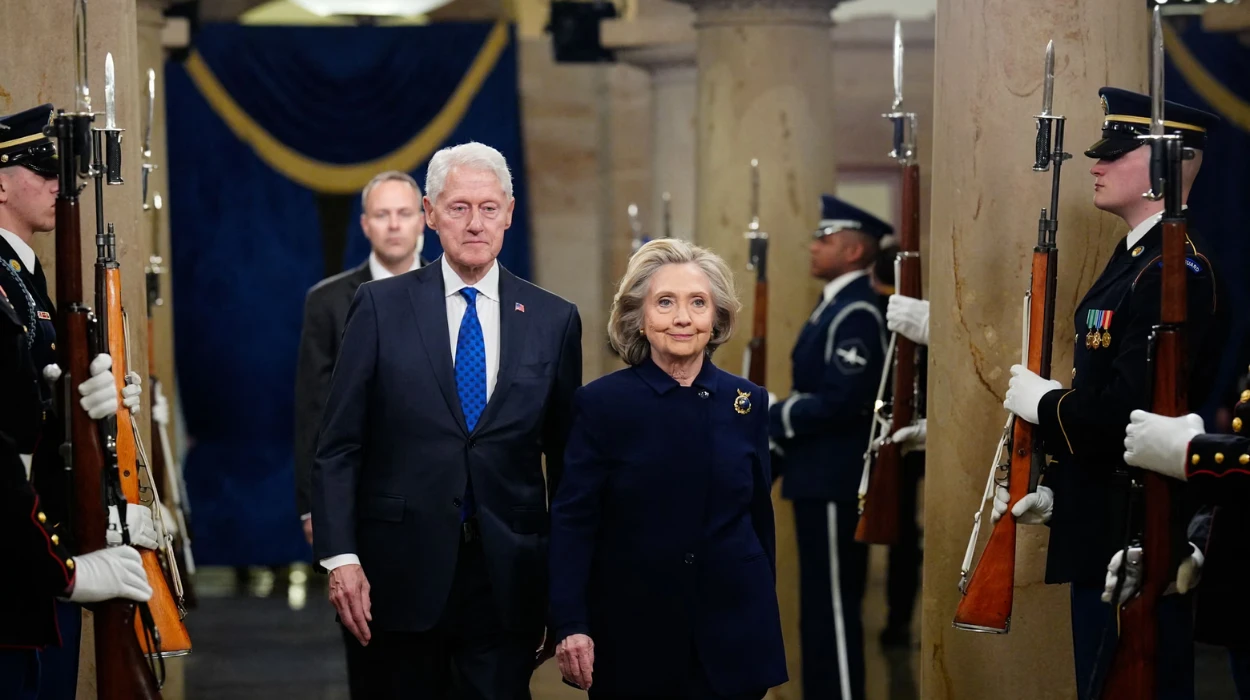

- Bill, Hillary Clinton decline House
testimony request - Refusal
tied to ongoing Epstein investigation - House
committee sought details on Epstein contacts
The former president and first lady were subpoenaed by the
Republican-led House oversight committee in August after James Comer, the
committee’s chair, declared the committee would examine how the government
handled Epstein, a convicted sex offender who committed suicide while awaiting
trial in 2019.
The Clintons’ lawyers described the subpoenas as
“invalid and legally unenforceable, untethered to a valid legislative
purpose, unwarranted because they do not seek pertinent information, and an
unprecedented infringement on the separation of powers” in a letter to
Comer dated Monday.
They wrote that the request for testimony “runs afoul
of the clearly defined Congress’ investigative power propounded by the Supreme
Court of the United States” and that “it is clear subpoenas
themselves – and subsequent attempt to enforce them.”
Hillary Clinton was subpoenaed to testify by Wednesday, and
Bill Clinton was required to appear by Tuesday. Comer informed Capitol
reporters that he would file a motion to hold the former president in contempt
the following week after he failed to appear.
“I think it’s important to note that this subpoena was
voted on in a bipartisan manner by this committee. This wasn’t something that I
just issued as chairman of the committee,”
Comer said.
“No one’s accusing Bill Clinton of anything, any
wrongdoing. We just have questions, and that’s why the Democrats voted along
with Republicans to subpoena Bill Clinton.”
Prior to the financier’s 2008 guilty plea to state charges
of soliciting prostitution and soliciting prostitution with a minor in Florida,
Clinton was known to be friendly with Epstein in the late 1990s and early
2000s.
Survivors of Epstein’s abuse have not accused Trump of any
wrongdoing, and the former president has denied knowing about his crimes.
Sara Guerrero, a spokesperson for Democrats on the oversight
committee said,
“Cooperating with Congress is important and the committee
should continue working with President Clinton’s team to obtain any information
that might be relevant to our investigation.”
The Clintons attacked Comer’s handling of the investigation
in a different statement, claiming that it had “prevented progress in
discovering the facts about the government’s role.” They pointed out that
despite having subpoenas for seven former high-ranking government officials,
the committee has only conducted interviews with two individuals as part of its
investigation: former labor secretary Alexander Acosta and former attorney
general William Barr.
The president’s pardoning of January 6 insurrectionists, the
recent shooting of a US citizen in Minnesota by an Immigration and Customs
Enforcement agent, and Republicans’ compliance with the president’s program
were all criticized.
“Bringing the Republicans’ cruel agenda to a standstill
while you work harder to pass a contempt charge against us than you have done
on your investigation this past year would be our contribution to fighting the
madness,”
the Clintons wrote.
In the months that followed, a bipartisan group of House
legislators forced a vote on legislation to reveal all government data
pertaining to Epstein, which was passed in November over Trump’s and Congress’s
Republican leaders’ resistance.
Clinton appears in a number of photos, including one of the
former president swimming in a pool and in a hot tub, that were made public
when the justice department started releasing batches of papers in December,
despite the fact that some documents were blacked.
Despite the law’s requirement that the Justice Department
provide all of the Epstein papers by December 19th, the department is still
releasing them. A federal judge was urged by lawmakers last week to designate a
special master to order the production of information pertaining to the
deceased financier.
How does a contempt citation get enforced by the Justice
Department?
A House disdain citation against numbers like the Clintons
triggers a statutory process where enforcement relies on the Justice
Department( DOJ) executing under 2 U.S.C.§ 192.
Post-vote( simple maturity in Oversight Committee, also full
House), the Speaker certifies the citation and forwards it to the U.S. Attorney
for D.C., calling grand jury donation for charge on misdemeanor charges maximum
one time jail and$ 100,000 forfeiture. The DOJ retains prosecutorial
discretion, historically declining high- profile cases( e.g., no action on
previous superintendent declinations).
DOJ pursued 11 disdain referrals since 1980( e.g., Eric
Holder’s 2012 citation dropped via impunity), with only four trials success
rate under 40. Bannon’s 2022 conviction( 4 months served) exemplifies
enforcement when process defiance lacks honor claims, unlike Clintons’
superintendent separation argument.