
- Russian
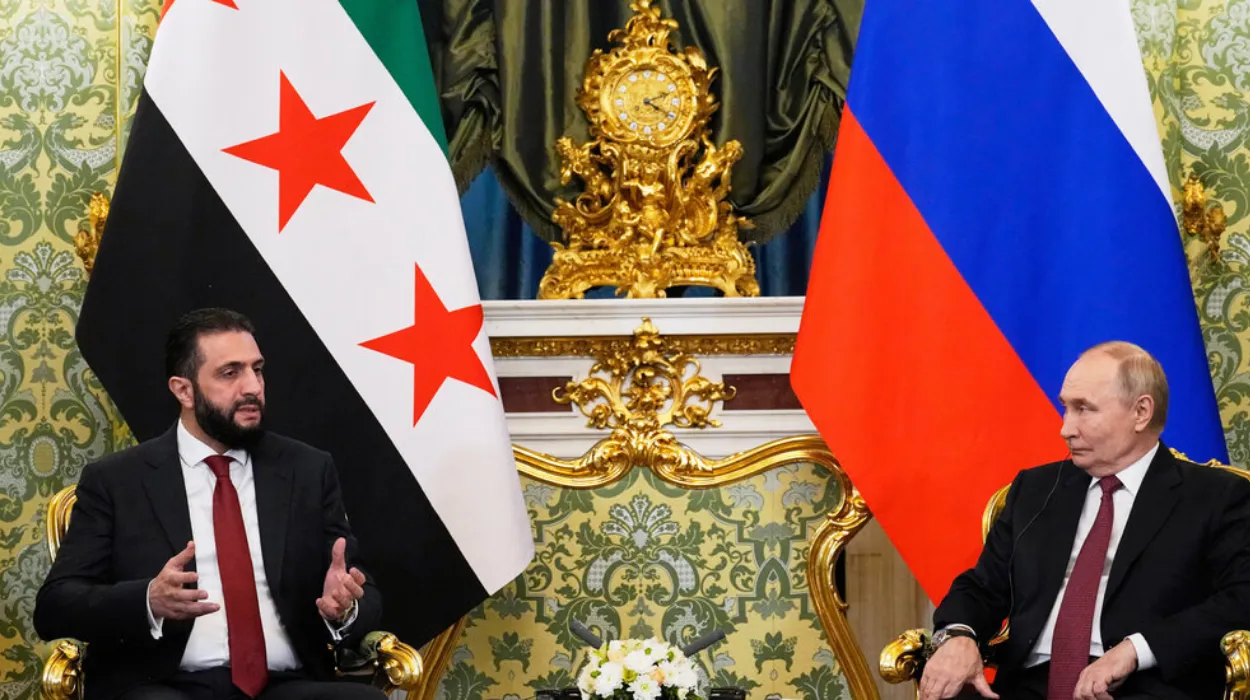
President Vladimir Putin hosted Syria’s new President Ahmed al-Sharaa in
Moscow for talks on bilateral ties and Middle East issues, marking
al-Sharaa’s second visit since Assad’s ouster. - Discussions
focused on securing Russia’s military bases at Hmeimim airbase and Tartus
naval facility amid troop withdrawals from northeastern Syria. - Putin
continues sheltering exiled Bashar al-Assad in Moscow since his December
2024 flight, despite al-Sharaa’s calls for accountability. - Kremlin
confirmed agenda included economic cooperation, reconstruction aid, and
regional stability, building on prior October 2025 meeting. - Meeting
signals Russia’s pragmatic shift to engage HTS-led government while
retaining strategic influence post-Assad regime collapse.
Moscow (Washington Insider Magazine) 28 January 2026 –
Russian President Vladimir Putin met with Syria’s new President Ahmed al-Sharaa
during his visit to Moscow. The leaders discussed building bilateral ties
following the fall of Russia-backed Bashar al-Assad. Putin continues to harbour
Assad in Russia, while engaging the new Syrian leadership.
President Vladimir Putin welcomed Syrian President Ahmed
al-Sharaa to the Kremlin for talks aimed at establishing relations between
Russia and the new Syrian government. The meeting occurred as Syria transitions
following the ouster of former President Bashar al-Assad, whom Moscow has
sheltered since his December 2025 flight from Damascus. Al-Sharaa, formerly a
rebel commander, now leads Syria’s interim administration after rebel forces
captured the capital.
The two presidents held closed-door discussions at the
Kremlin’s Andrei Andreyev Hall, followed by a working lunch. Russian state
media reported the agenda covered economic cooperation, security arrangements,
and Syria’s potential role in regional stability. Al-Sharaa arrived in Moscow
on a chartered flight from Damascus, marking his second official visit since
assuming power.
Details of the Kremlin Meeting
Putin greeted al-Sharaa with a handshake and traditional
Russian protocol, including the playing of both nations’ anthems. Kremlin
spokesman Dmitry Peskov confirmed the leaders signed a memorandum on mutual
consultations, focusing on trade and energy sectors. Syria seeks Russian
technical aid for rebuilding infrastructure damaged in the civil war.
Al-Sharaa thanked Putin for past support to Syria, despite
the leadership change, and expressed interest in maintaining military ties,
including the Russian base at Tartus naval facility and Hmeimim airbase. Putin
reaffirmed Russia’s commitment to Syrian sovereignty, stating Moscow recognises
the new government’s authority over state institutions. No immediate decisions
emerged on Assad’s status during the public portions of the talks.
Russian Foreign Minister Sergey Lavrov attended, alongside
Syrian Foreign Minister Asaad al-Shaibani. The delegation discussed lifting
Western sanctions on Syria and potential debt relief from Moscow’s wartime
loans. State news agency TASS reported plans for a Russian-Syrian business
forum scheduled for March 2026 in St Petersburg.
Assad’s Presence in Moscow
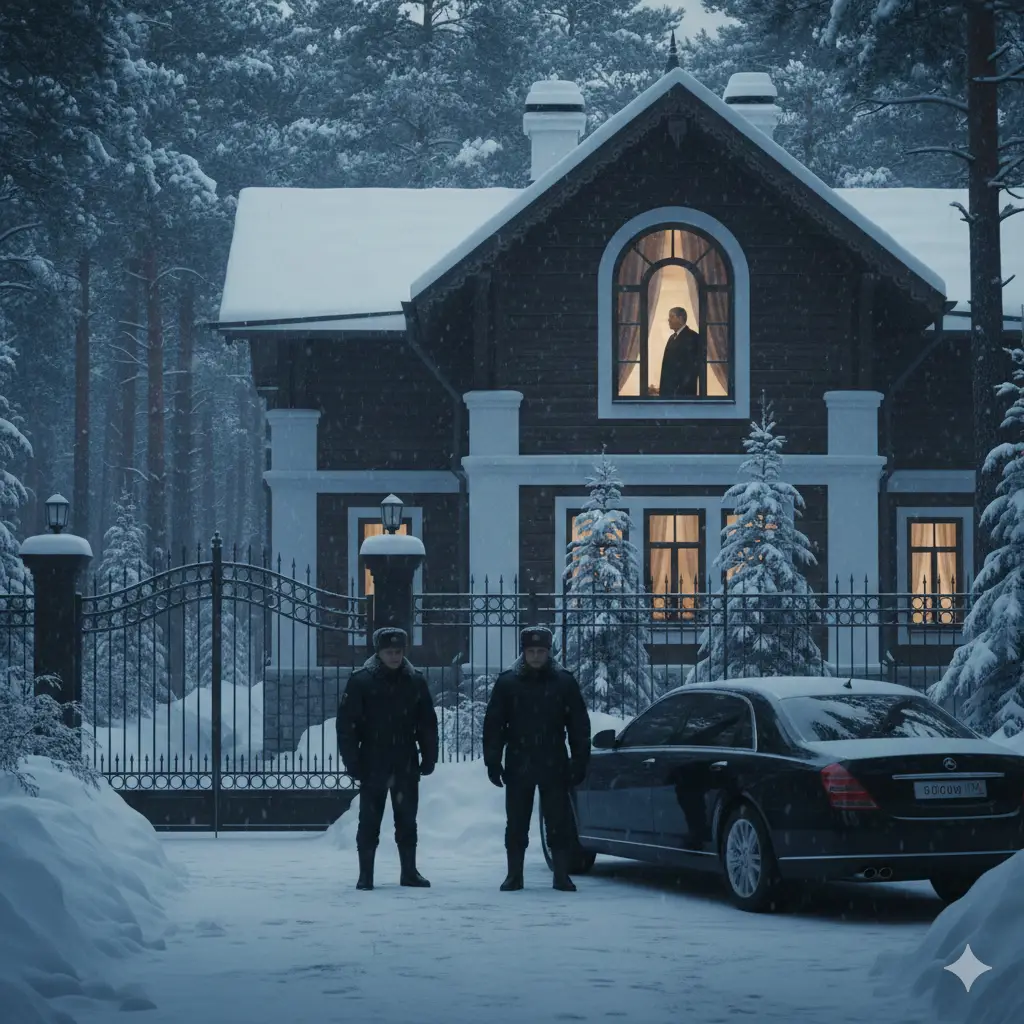
Bashar al-Assad resides in Moscow under Russian protection
since fleeing Syria on 8 December 2025, after HTS-led rebels overran Damascus.
Russian authorities granted him asylum on humanitarian grounds, citing his
family’s long-standing ties to Moscow. Assad has made no public appearances
since arrival, residing in a state-provided dacha outside the capital.
Kremlin officials confirmed Assad remains in Russia but
declined to disclose his exact location or activities. Putin previously
described Assad as a “guest” of the Russian Federation, emphasising
non-interference in Syrian internal affairs. Al-Sharaa raised the issue of
Assad’s extradition during preliminary talks, though no Syrian arrest warrant
has been issued as of 28 January 2026.
Western diplomats noted the duality of Russia engaging both
the exiled leader and his successor, viewing it as a hedging strategy amid
Syria’s uncertain transition. UN envoy Geir Pedersen welcomed the Moscow
dialogue as a step toward inclusive negotiations.
Background on Syria’s Leadership Transition
Ahmad
al-Sharaa officially appointed as transitional president of Syria – Türkiye
Today
Ahmed al-Sharaa, also known by his nom de guerre Abu
Mohammed al-Jolani, led Hay’at Tahrir al-Sham (HTS) forces that toppled Assad
after a 13-year insurgency. HTS rebranded as a political entity post-victory,
dissolving its al-Qaeda links in 2016. Al-Sharaa was sworn in as president on
29 December 2025 by a rebel transitional council in Damascus.
The new leadership controls 90% of Syrian territory,
including major cities Aleppo, Homs, and Latakia. Assad’s regime collapse
followed Russian troop withdrawals from key fronts and Iranian proxy retreats.
Turkey-backed factions ceded ground to HTS, consolidating power under
al-Sharaa’s command.
Syria’s economy contracted 80% during the war, with 16
million people requiring aid per UN estimates. Al-Sharaa prioritises
repatriation of 6.8 million refugees and reconstruction costing $400 billion.
His Moscow visit seeks investment from Russian firms like Gazprom and Rosneft.
Statements from Both Leaders
Putin stated:
“Russia stands ready to cooperate with the legitimate
Syrian authorities on equal terms.”
He highlighted 10,000 Russian troops stationed in Syria since
2015, now reduced to 4,000 for base security. Al-Sharaa replied: “We value
Russia’s historical role and look forward to a strategic partnership.”
In a televised address post-meeting, al-Sharaa called for
normalisation with all nations respecting Syria’s independence. Putin praised
the new leadership’s pledges to combat terrorism and protect minorities,
including Syria’s Christian and Alawite communities. No joint press conference
occurred, with statements released separately.
Peskov noted discussions touched on Israel’s strikes near
the Golan Heights and US troop presence in eastern Syria. Both sides agreed to
quarterly high-level meetings.
Regional and International Reactions
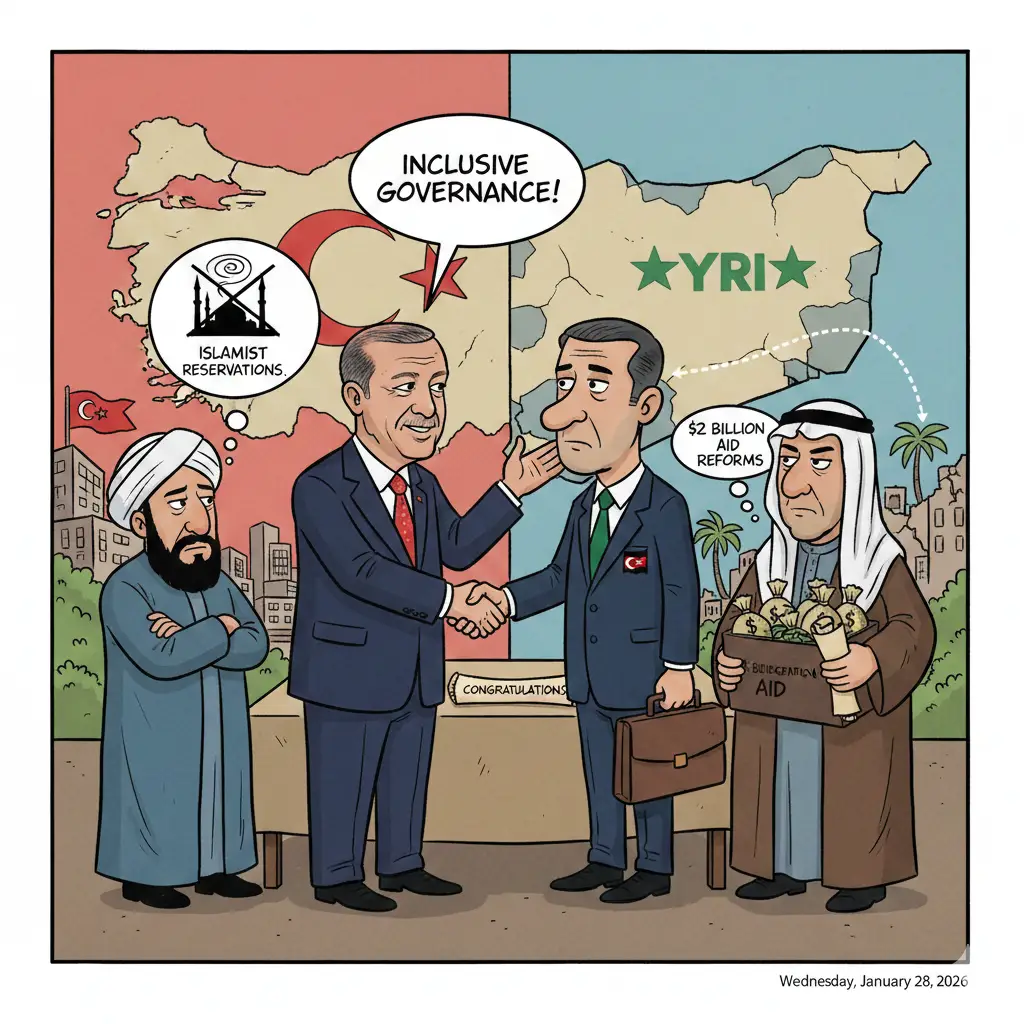
Turkey’s President Recep Tayyip Erdogan congratulated
al-Sharaa on the visit, urging inclusive governance. Iran, a former Assad ally,
expressed reservations about HTS’s Islamist roots. Saudi Arabia offered $2
billion in aid conditional on democratic reforms.
The United States maintains 900 troops in Syria for ISIS
containment, with envoy Thomas Barrack meeting al-Sharaa in Ankara last week.
EU foreign ministers discussed easing sanctions if HTS distances from
extremism. Jordan hosted a summit of 10 Arab states pledging $5 billion for
Syrian stabilisation.
UN Security Council resolution 2254, adopted in 2015,
remains the framework for political transition, though unimplemented until now.
Astana process guarantors—Russia, Turkey, Iran—scheduled trilateral talks for
February 2026 in Sochi.
Russian Strategic Interests in Syria
Russia intervened in Syria in 2015, preserving Assad and
securing Mediterranean ports vital for Black Sea Fleet projection. Tartus
handles 20 Russian warships annually, while Hmeimim supports air operations
across the Middle East. Post-Assad, Moscow negotiated lease extensions with HTS
for 49 years at nominal rent.
Economic ties include $1.5 billion in Syrian oil concessions
to Russian firms since 2018. Assad’s ouster prompted Russia to evacuate 20,000
citizens from Syria in December 2025. Putin framed the engagement as pragmatic
diplomacy, avoiding power vacuums.
Syria supplies 30% of Russia’s citrus imports, with trade
volume at $250 million pre-war. Reconstruction contracts awarded to Russian
companies total $3 billion, focusing on power grids and railways.
Assad’s Exile and Legal Status
Assad faces International Criminal Court referral threats
over war crimes allegations, though Russia vetoed UNSC action. Syria’s new
justice minister announced plans for a truth commission excluding foreign
extraditions initially. Assad’s wife Asma holds British citizenship,
complicating repatriation.
Russian media portray Assad as resting privately, with
unconfirmed reports of medical treatment in Moscow clinics. Al-Sharaa’s
government revoked Assad’s citizenship and seized $1.2 billion in regime
assets. No direct contact between the two Syrians has occurred in Russia.
Human Rights Watch documented 500,000 deaths under Assad,
with HTS promising accountability trials.
Future Bilateral Engagements
Al-Sharaa
extended an invitation for Putin to visit Damascus in summer 2026, pending
security clearances. A joint military commission convenes next month to assess
base operations. Economic pacts target wheat supplies and phosphate exports
from Syria.
Moscow hosts 200,000 Syrian students and refugees, with
repatriation grants of $1,000 per family. Both leaders endorsed the 2026 Arab
League summit in Damascus. Follow-up visits by Russian deputy prime ministers
are confirmed for March.
The Moscow engagement signals Russia’s pivot to the new
reality, balancing legacy commitments with forward-looking diplomacy. Ongoing
talks address debt restructuring from $4 billion in Syrian liabilities to
Russia.