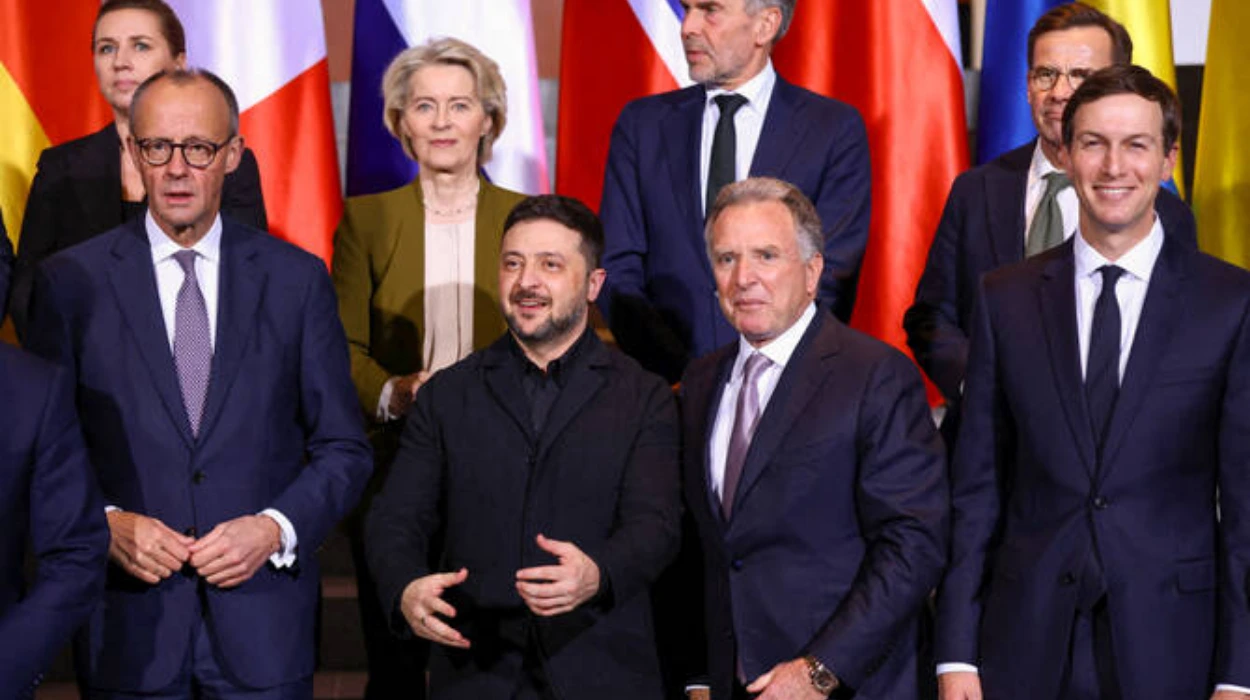

Europe (Washington Insider) – European leaders in The
Hague launched an International Claims Commission for Ukraine, with Kaja Kallas
supporting compensation using €260–280bn frozen Russian assets, mostly held at
Euroclear Belgium.
As Melike Pala on AA Europe reported, European leaders met
in The Hague on Tuesday, Dec 16, 2025, to start an International Claims
Commission for Ukraine. They mentioned that the goal is to help Ukraine get
compensation for the damage caused by Russia’s invasion.
The conference was co-hosted by the Netherlands and the
Council of Europe, which has 46 member countries. Senior officials attended,
including EU foreign policy chief Kaja Kallas. The meeting took place while the
United States and other countries continue diplomatic efforts to end the
war.
The commission will work under the Council of Europe
framework. It will examine claims for destroyed homes, businesses, and public
buildings. It will also cover injuries to people and economic losses caused by
the fighting.
How will Europe use
frozen Russian assets to compensate Ukraine?
The commission will also review claims linked to alleged war
crimes, including sexual violence, forced deportations, and other human rights
violations. It will calculate the losses and decide on fair compensation. The
initiative aims to support both material recovery and justice for
victims.
At a signing ceremony for the International Claims
Commission, EU foreign policy chief Kaja Kallas called the destruction in
Ukraine “unimaginable.” She said that damage to buildings and property is only
a small part of the suffering faced by Ukrainians.
“We have formally adopted the Convention
establishing the Claims Commission. I’m pleased to announce that the European
Union will provide up to 1 million euros to pay for the preparatory work. In
the meantime, Ukrainians can keep submitting claims to the register of
damages,”
Chief Kaja Kallas said.
“Russia is no less liable for the damage in Ukraine
than Iraq was for the damage in Kuwait, but Russia will never voluntarily pay
for the damage it has done. We already see the attempts to exclude reparations
and, in fact, any form of accountability from the potential peace agreement.
And this puts a huge responsibility on the international community,’’
Chief Kaja Kallas
added.
She spoke about the challenge of funding compensation.
Kallas noted that between €260 and €280 billion of Russian assets are frozen
abroad, which could be used to help pay for reparations to Ukraine.
In the European Union, roughly €210 billion ($246 billion)
of Russian assets are currently frozen.
EU leaders have suggested using this money to support Ukraine and cover war
damages. Most of the frozen assets are held by Euroclear, a bank in Belgium.
Belgium has repeatedly raised concerns about using the funds, citing legal and
procedural difficulties.
“We are at a point where our Belgian colleagues are
under a lot of pressure from different sides. My feeling is, the sooner we do
this European solution, the sooner the pressure from Belgium will be actually off, because then it will be a Belgian solution,
which means that, if you are not happy with the solution, you can go to court
against the European Union,”
she said during the joint press conference with Council of
Europe Secretary-General Alain Berset.
After the Russian invasion of Ukraine on February 24, 2022,
which resulted in widespread destruction throughout the country, the worldwide
community began making international efforts to create compensation for
Ukraine.
In 2022, Western countries placed sanctions on Russia and
seized hundreds of billions of euros’ worth of Russian state assets. In May
2023, the Council of Europe established a Register of Damages for documenting
losses incurred as a result of the war.
Discussions would continue throughout 2023 and 2024
regarding the use of frozen Russian assets for compensation and reconstruction,
with estimates indicating that reconstruction costs will exceed $400 billion
dollars.