
The Insurrection Act of 1807 is a significant piece of
United States federal legislation that grants the president the authority to
deploy the U.S. military domestically in specific circumstances. Its origins
lie in the early years of the republic, following key events such as the
passage of the Militia Acts of 1792 and the Burr Conspiracy. The U.S.
Constitution initially left the power to use military force within states
ambiguous, prompting Congress to pass the Militia Acts, which granted the
president authority to call forth state militias for federal service under
certain conditions. Notably, the Militia Act of 1795 made this power permanent.
The Insurrection Act was enacted under President Thomas Jefferson in 1807,
catalyzed by concerns over Aaron Burr’s alleged plans to seize Mexican
territories, providing the president a legal framework to deploy forces for
suppressing insurrections or enforcing federal law. Over time, the Act has been
amended, including provisions post-Civil War that allow presidential deployment
of troops without state consent when constitutional rights are at risk, and
clarifications for use in natural disasters. Today, the Act serves as an
important exception to the Posse Comitatus Act, which generally prohibits
military involvement in civilian law enforcement.
Legal scope and conditions for invocation
The Insurrection Act empowers
the president to use U.S. military and to federalize the National Guard in
cases of insurrection, rebellion, or obstruction of federal law when state
authorities either request assistance or fail to maintain public order and
protect constitutional rights. The Act requires that before troops are
deployed, the president issues a proclamation ordering those engaged in
unlawful activities to disperse. Unlike the Posse Comitatus Act, which limits
military involvement in civilian law enforcement, the Insurrection Act provides
statutory authority to override those restrictions under specific conditions.
Amendments following the Civil War notably enabled the president to act
unilaterally in situations where states infringe upon civil rights. Moreover,
attempts to expand the Act’s application to natural disasters were constrained
after states objected to ceding control, reflecting the balance between federal
power and state sovereignty. Historically, the Act has been invoked sparingly
but crucially, including during Nat Turner’s rebellion suppression in 1831, the
Civil War period under Lincoln, and to combat Ku Klux Klan violence during
Reconstruction.
Donald Trump and the insurrection act discussions in 2025
In 2025, President Donald Trump has frequently referenced the
Insurrection Act amid turbulent political and civil unrest contexts. While the
Act had not been invoked since the 1992 Los Angeles riots, Trump’s
administration considered its use multiple times in response to protests,
particularly focusing on demonstrations related to immigration enforcement such
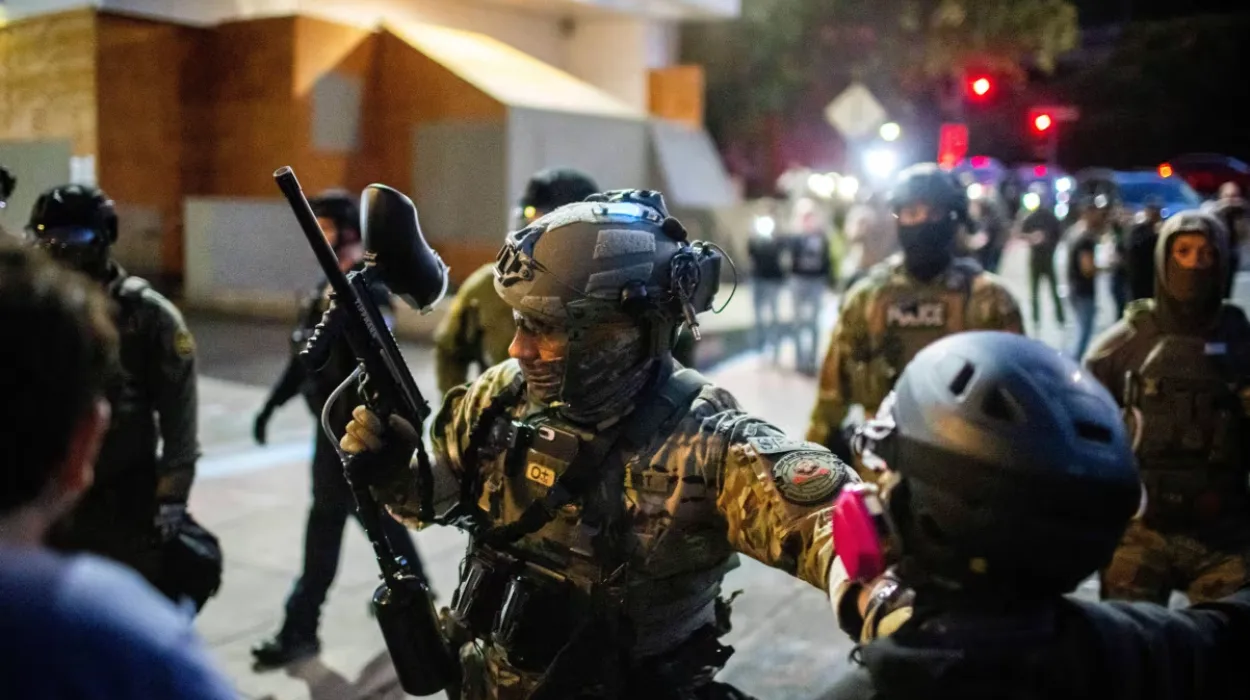
as those in Portland and other cities. Trump authorized deployment of thousands
of National Guard troops and several hundred Marines to manage unrest; however,
the Posse Comitatus Act restricts active-duty military from engaging in law
enforcement without Insurrection Act activation. Trump openly floated the
possibility of invoking the Act to escalate federal military presence despite
opposition from state governors and critics warning of constitutional overreach.
The President also issued a national emergency declaration at the southern
border and directed cabinet members to assess whether the Act’s powers were
needed to achieve operational control. Defense and Homeland Security officials
advised against invoking the Act citing declining border crossings and
effective policies, but political discourse and conservative media amplified
calls for more aggressive use of military authority under the Act.
Historical usage and modern significance
The Insurrection Act, enacted in 1807, is a critical and
historic law underpinning the United States’ ability to respond to domestic
uprisings, insurrections, and civil unrest with federal military force.
Throughout its more than two centuries of existence, it has been activated
sparingly—only in a few notable cases—reflecting the gravity and exceptional
nature of invoking military power within the nation’s borders. The history of
its application underscores the complex balance the Act maintains between
federal authority and the sovereignty of state governance, as well as the
constitutional safeguards designed to protect democratic principles and
individual freedoms. Over time, this narrow use demonstrates how it serves as a
last resort mechanism in scenarios where local law enforcement proves
insufficient, or where state governments fail or decline to enforce federal
laws, maintain public order, or protect civil rights.
One of the earliest significant uses of the Insurrection Act
came during the Nat Turner slave rebellion in 1831. Nat Turner, an enslaved
African American preacher, led a violent uprising in Southampton County,
Virginia, which resulted in dozens of deaths and widespread fear among white
slaveholders. In response, President Andrew Jackson invoked federal troops under
the Insurrection Act to suppress the revolt and restore order. This marked one
of the first instances where the federal government deployed military forces to
quell a domestic uprising, providing a legal framework to coordinate federal
and state military efforts. Jackson’s use of the Act highlighted the federal
government’s willingness to assert authority when state mechanisms struggled
with large-scale violence or unrest, although it also reflected the prevailing
racial and power dynamics of the era.
The American Civil War presented perhaps the most expansive
application of the Insurrection Act, when President Abraham Lincoln invoked its
provisions broadly to compel rebellion suppression and maintain national unity.
Lincoln’s administration took unprecedented steps, often bypassing state
consent, to deploy federal troops in Southern states rebelling against the
Union. The Act’s authority empowered Lincoln to address the existential threat
posed by the Confederacy, unify military command structures, and support
emancipation policies. The wartime context fundamentally expanded the
traditional interpretation of the Act, allowing intervention without state
approval, a significant shift given the constitutional principles of
federalism. This wartime invocation remains an exemplar of the balance between
the president’s constitutional war powers and the need for domestic peace
enforcement under domestic law.
During the Reconstruction era, the Insurrection Act was used
under President Ulysses S. Grant to combat the Ku Klux Klan’s widespread terror
campaigns, particularly in South Carolina and other Southern states. The Klan’s
violent intimidation sought to undermine African American enfranchisement and
maintain white supremacy in the post-Civil War South. In response, President
Grant deployed federal troops under the Enforcement Acts and the Insurrection
Act to enforce civil rights legislation and protect voting rights. This
deployment addressed local governments’ unwillingness or inability to suppress
anti-civil rights violence by providing military backing to uphold federal
laws. The use during Reconstruction represents how the Act functioned not
merely for traditional law enforcement but as a tool for enforcing
constitutional rights during periods of profound social upheaval and
transformation.
In more modern history, the Insurrection Act played a
central role during the enforcement of school desegregation in the 1950s and
1960s. Following the Supreme Court’s landmark decision in Brown v. Board of
Education (1954), many Southern states resisted desegregation orders. President
Dwight D. Eisenhower notably invoked the Act in 1957 to deploy federal troops
to Little Rock, Arkansas, to enforce the integration of Central High School
after Arkansas Governor Orval Faubus opposed it. This deployment was a powerful
reinforcement of federal authority and civil rights protection against state
defiance. Presidents John F. Kennedy and Lyndon B. Johnson similarly invoked or
threatened the Insurrection Act to support civil rights enforcement across the
South, underpinning federal commitment to racial equality and the rule of law.
These uses illustrated the Act’s role not just in quelling riots but in
advancing constitutional protections and ensuring government compliance with Supreme
Court mandates.
The most recent invocation occurred during the 1992 Los
Angeles riots, which erupted after the acquittal of police officers involved in
the brutal beating of Rodney King. The violence, looting, and civil disorder
overwhelmed local law enforcement. President George H.W. Bush invoked the
Insurrection Act on May 1, 1992, to authorize the deployment of federal troops
and the National Guard to restore order and protect property and lives. The
response helped to quell the widespread unrest but also raised questions about
military involvement in civilian affairs. This event underscored that the
Insurrection Act remains a tool reserved for extraordinary civil disruptions
where local communities face overwhelming challenges. It also highlighted the
complexities of balancing military intervention with the preservation of civil
liberties and public trust.
The rarity of the Insurrection Act’s invocation—the
relatively few occasions spanning over 200 years—emphasizes its extraordinary
nature. The Act effectively creates a legal threshold for federal military
involvement in domestic affairs, preserving state autonomy as an overarching
principle. Its deliberate design requires the exhaustion of local resources and
cooperation from state officials before federal intervention is warranted,
aligning with constitutional federalism and separation of powers. This balance
is crucial for protecting against executive overreach and safeguarding against
militarization of civilian governance, ensuring that military force complements
rather than replaces civil authority.
In contemporary political and legal discourse, the
Insurrection Act has gained renewed attention amid rising concerns about civil
unrest, mass protests, and political polarization. Debates often focus on the
scope of presidential authority, the process and conditions for invoking the
Act, and its compatibility with constitutional rights and democratic norms.
Scholars, legal experts, and policymakers stress the need for rigorous checks
and balances, including clear proclamations that order dispersal before
military deployment, strong oversight by Congress and the judiciary, and
ongoing cooperation with state governors. These safeguards are viewed as
essential to prevent misuse of the Act as a political tool or as a means of
suppressing lawful dissent.
Constitutional implications and future outlook
The Insurrection Act sits at the complex crossroads of
constitutional law, civil-military relations, and federalism, highlighting
tensions inherent in balancing national security and individual freedoms. Its
authorization for domestic military deployment raises fundamental questions of
executive authority, especially in the context of contemporary political
polarization and mass protests. Legal analyses stress that while the Act
provides a statutory exception to the Posse Comitatus Act, it requires cautious
and transparent application consistent with constitutional provisions.
Executive overreach risks undermining civil liberties and democratic norms. Conversely,
insufficient federal action in face of insurrections or lawlessness threatens
public order. President Trump’s 2025 statements about utilizing the Act reflect
these ongoing national debates, with implications for future presidencies and
governance.
As technological, social, and political landscapes evolve,
the Insurrection Act’s framework may face renewed scrutiny and potential
legislative reform aimed at clarification or limitation of presidential powers
in domestic military deployment. Courts, lawmakers, and civil rights advocates
continue to monitor its invocation closely. Ultimately, understanding the
Insurrection Act’s historical origin, legal authority, contemporary use, and
constitutional significance remains essential in assessing its role in
preserving American democracy and rule of law.