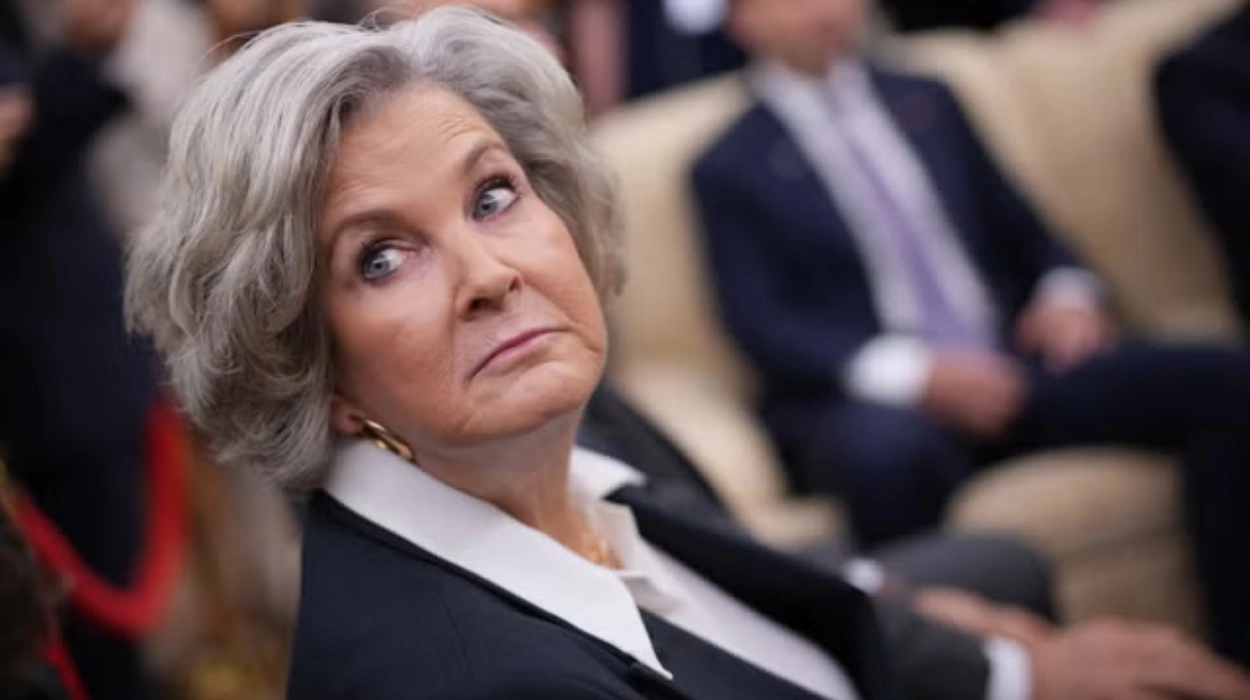

- Susie
Wiles is White House chief of staff. - Administration
plans Trump on 2026 campaign trail. - Goal:
help Republicans keep Congressional seats.
Wiles stated that they intend to refocus the president’s
attention on the forthcoming midterm elections, which will serve as a crucial
gauge of the public’s reaction to the president’s rapid policy execution and
transformation of the federal system.
In a pre-recorded episode of The Mom VIEW, a YouTube program
started by the conservative nonprofit Moms for America, Wiles stated,
“I haven’t quite broken it to him yet, but he’s
going to campaign like it’s 2024 again.”
Potential voters are more likely to cast a ballot in a local
election when Trump strongly supports a candidate, according to the White House
chief of staff, who the president dubbed “Ice Maiden.”
“Typically, in the midterms, it’s not about who’s sitting
at the White House; you localize the election. And you keep the federal
officials out of it. We’re actually going to turn that on its head and put him
on the ballot,”
Wiles said.
With in-person campaign appearances, financial support, and
other measures, the administration hopes the president can keep his party’s
hold on the House and Senate, if not increase the number of Republican seats.
Pressuring Republican-dominated states to redraw
and gerrymander their boundaries in order to aid conservative candidates in
gaining more seats is one aspect of Trump’s approach. Targeting election
regulations, like mail-in ballot voting, which is most likely to be used by
Democratic voters, is another aspect of it.
However, it is undeniable that Trump’s statements have a big
impact on prospective midterm voters who support the president. One year before
election day, he has already rattled off endorsements using his Truth Social
account.
However, the 79-year-old president may find it difficult to
make in-person campaign appearances because he will be balancing his 24-hour
role with a number of significant events in the United States next year, including
the Olympics, the FIFA World Cup, and America’s 250th anniversary.
Trump appeared to be worn out toward the end of his 2024
presidential campaign following countless rallies and media appearances. He
reportedly had to cancel numerous interviews because of exhaustion, spoke
incoherently during rally appearances, and occasionally had a raspy voice.
Despite being the oldest president ever elected, Trump’s
health is a constant source of concern. Trump has been observed with bruises on
his hands, which have been linked to frequent hand shaking and regular aspirin
use; swollen ankles, which have been linked to a diagnosis of chronic venous
insufficiency; and appearing to nod off during televised meetings.
Trump has continuously denied having any serious illnesses.
How will presidential campaigning affect localizing midterm
strategy?
Trump’s ferocious presidential campaigning for the 2026
research, as blazoned by Chief of Staff Susie Wiles, will probably nationalize
races, overshadowing original issues and forcing Democratic campaigners to
align messaging with his persona over quarter-specific strategies.
High- profile rallies and signatures prioritize turnout
among Trump’s base in swing sections, reducing emphasis on localized namer
outreach like door- knocking or community forums, potentially alienating
centrists concentrated on frugality or structure.
While boosting fundraising and media visibility, it risks
counterreaction in suburban areas where anti-Trump sentiment persists,
mirroring 2018 dynamics; campaigners may fight by hybridizing with original
advertisements on redistricting or state issues to retain autonomy.