
- Trump
warns Venezuela’s Diosdado Cabello. - Cabello
is hardline interior minister. - Support
acting president Delcy Rodríguez.
According to Reuters, US officials are “particularly
worried” that Cabello, who has long been regarded by many as the regime’s
true No. 2, could undermine Washington’s strategy to maintain important members
of Maduro’s inner circle in place in the name of stability while pursuing a
transition and unfettered access to Venezuela’s oil.
Donald Trump claimed in a post on Monday that Venezuela will
be “turning over” $2 billion worth of crude to the US as part of a
deal that would assist Venezuela avoid further production limits while
diverting supplies from China.
Speaking on Wednesday after briefing US senators, US
Secretary of State Marco Rubio stated that Washington had a three-step plan for
the South American nation, starting with stabilizing it following Maduro’s
capture.
“We don’t want it descending into chaos,”
said Rubio,
adding that the second phase would involve “ensuring that American, western and
other companies have access to the Venezuelan market in a way that’s fair”, as
well as “beginning a process of reconciliation … so that opposition forces can
be amnestied, released from prison or brought back to the country, and start
rebuilding civil society.
“And then the third phase, of course, will be one of
transition,”
he added.
The leader of the opposition
in Venezuela, María Corina Machado, has promised to return as soon as possible.
She said she expected new elections to be called soon and rejected the power of
the acting president, who is now supported by the United States.
“We
will receive over 90% of the votes in free and fair elections.”
Pete Hegseth, the defense secretary, wrote on Wednesday that
the United States “continues to enforce the blockade against all
dark-fleet vessels illegally transporting Venezuelan oil to finance illicit
activity,” following the seizure of two Russian-flagged oil tankers in the
Atlantic and the Caribbean.
Through proxies, US officials have informed Cabello that he
may suffer a fate akin to Maduro’s if he continues to act defiantly.
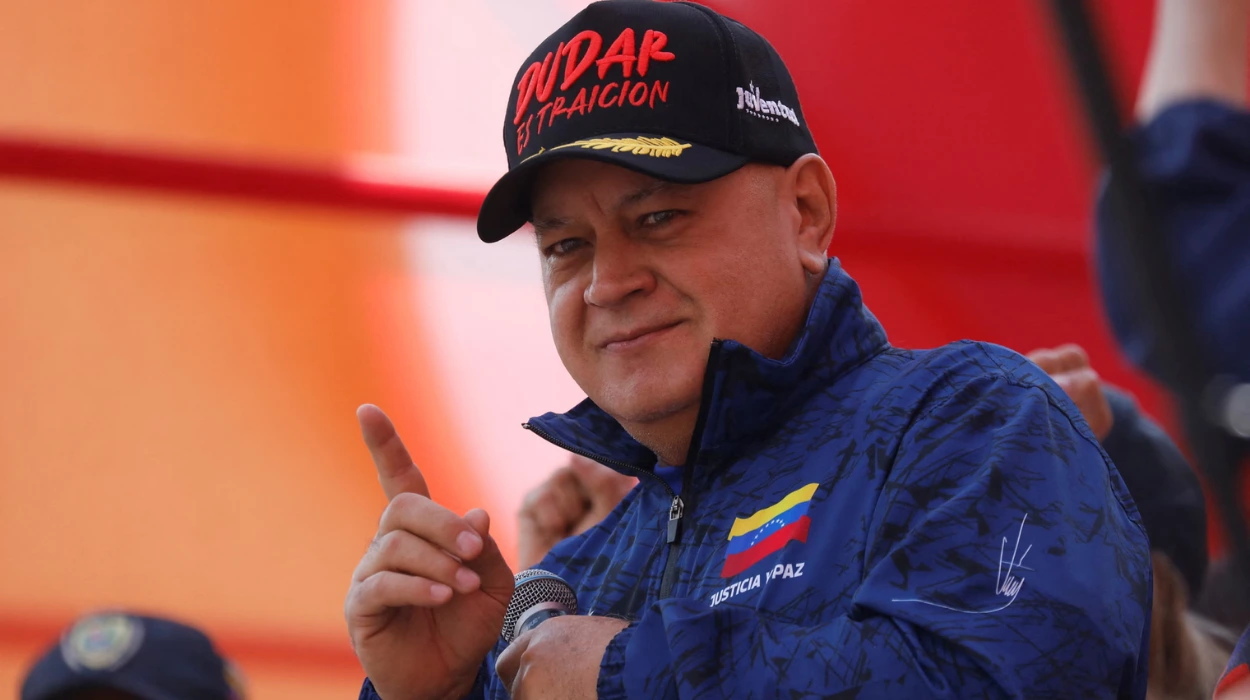
For his part, Cabello has shared videos on social media that
show him leading scores of highly armed men as they police Caracas’ streets. He
is in charge of the police, counterintelligence services, and colectivos
militias.
In addition, he can be seen taking pictures, shaking hands
with shoppers and citizens, and asking how things are over a speakerphone chat
with what looks to be another commander.
“In combat, my captain, my
commander.” “
Defending our homeland,” is the response.
In a different video, dozens of armed men cry, “Always
loyal, never traitors!” while posing for the camera with their rifles
lifted and their fists clinched. and the phrase “To doubt is to
betray!” was printed on Cabello’s headgear, which he also wore to Monday’s
swearing-in event.
Cabello’s animosity with Rodriguez and her brother, Jorge
Rodriguez, the head of the Venezuelan Congress, dates back many years. Analysts
emphasize that there was no clear hierarchy, despite the fact that many saw him
as Maduro’s second most important figure in the administration. Power was split
between rival and coexisting factions, including one led by Cabello and another
by the Rodríguez siblings.
Cabello is considered a “core” Chavista because he
was one of the officers involved in Hugo Chávez’s abortive coup attempt in
1992.
More than 20,000 extrajudicial killings, enforced
disappearances, torture, and the imprisonment of political opponents are just a
few of the numerous and well-documented human rights violations committed by
the Maduro dictatorship, which are largely attributed to the interior minister.
Additionally, Maj. Gen. Javier Marcano T.”ata was
replaced as commander of the presidential honor guard by Gen. Gustavo González
López. Despite surviving the operation that resulted in Maduro’s capture, which
claimed the lives of at least 24 Venezuelan soldiers and 32 Cubans, the
majority of whom were part of Maduro’s personal security detail, Tõata’s
position was deemed untenable due to criticism over an alleged failure to stop
his leader’s capture.
In a televised speech, the acting president further
toughened her stance against Washington by declaring that “no external
agent governs Venezuela.”
She went back to using harsher rhetoric, calling the US
strike a “terrible military aggression,” in contrast to the
conciliatory tone she had taken on Sunday.
How might the military respond to a power struggle between
Maduro allies?
Venezuela’s service, tightly pious to Maduro through decades
of purges, profitable impulses like medicine trafficking gains, and Cuban-
bedded intelligence, might fracture or launch asymmetric resistance in a power
struggle among his abettors like Diosdado Cabello and Delcy Rodríguez.
Elderly officers could back Cabello’s colectivos( 220,000
paramilitaries) for civic guerrilla warfare in Caracas using” war of all
the people” tactics host rallying, reservists, and anarchization to render
home ungovernable whilemid-ranks disfigurement to Rodríguez under US pressure,
risking civil war or Libya- style chaos over oil painting fields and
structure.
Literal achievement- proofing ensures elite cohesion for
prolonged resistance but weakens conventional ops; without unified command,
coalitions might seize airfields power shops, invite Wagner delegates, or chip
into warlordism, complicating US- backed transition amid Trump’s leaguer.