
- A US
federal appeals court ruled on 28 January 2026 that Homeland Security
Secretary Kristi Noem acted illegally by terminating Temporary Protected
Status (TPS) for hundreds of thousands of Venezuelans. - The
9th Circuit Court upheld a lower court finding that Noem exceeded her
authority under the TPS statute, which provides deportation relief during
crises in designated countries like Venezuela. - The
panel affirmed TPS terminations for Venezuelans and partial cuts for
Haitians were arbitrary, with one judge citing evidence of racial and
national origin bias in Noem’s decisions. - No
immediate TPS restoration due to a prior US Supreme Court stay; the ruling
stems from a lawsuit by the National TPS Alliance challenging 2025
terminations affecting around 350,000 Venezuelans. - TPS,
enacted in 1990, prevents deportation and grants work authorisation;
Venezuela’s designation addressed political turmoil and economic collapse
since 2021
San Francisco (Washington Insider Megazine) January 29,
2026 – A federal appeals court ruled that US Homeland Security Secretary Kristi
Noem acted illegally by terminating temporary protected status (TPS) for
hundreds of thousands of Venezuelans in the United States. The 9th US Circuit Court
of Appeals upheld a lower court decision finding that Noem exceeded her
authority under the TPS statute when she ended the protections. The ruling also
affirmed the illegality of Noem’s early termination of TPS for Haitians, though
it has no immediate effect due to a prior US Supreme Court stay. The case stems
from a lawsuit filed by the National TPS Alliance and affected individuals
challenging Noem’s actions as arbitrary and unlawful.
A three-judge panel of the 9th US Circuit Court of Appeals
issued its decision late on 28 January 2026, upholding US District Judge Edward
M Chen’s prior findings in the Northern District of California. Judge Kim
McLane Wardlaw, writing for the panel, stated that the TPS statute contains
procedural safeguards to ensure stability for beneficiaries during
extraordinary conditions in their home countries. Wardlaw noted that Noem’s
actions have had real and significant consequences for Venezuelans and Haitians
relying on TPS, including risks of deportation, detention and loss of work
authorisation.
Noem terminated TPS extensions and designations in early
2025
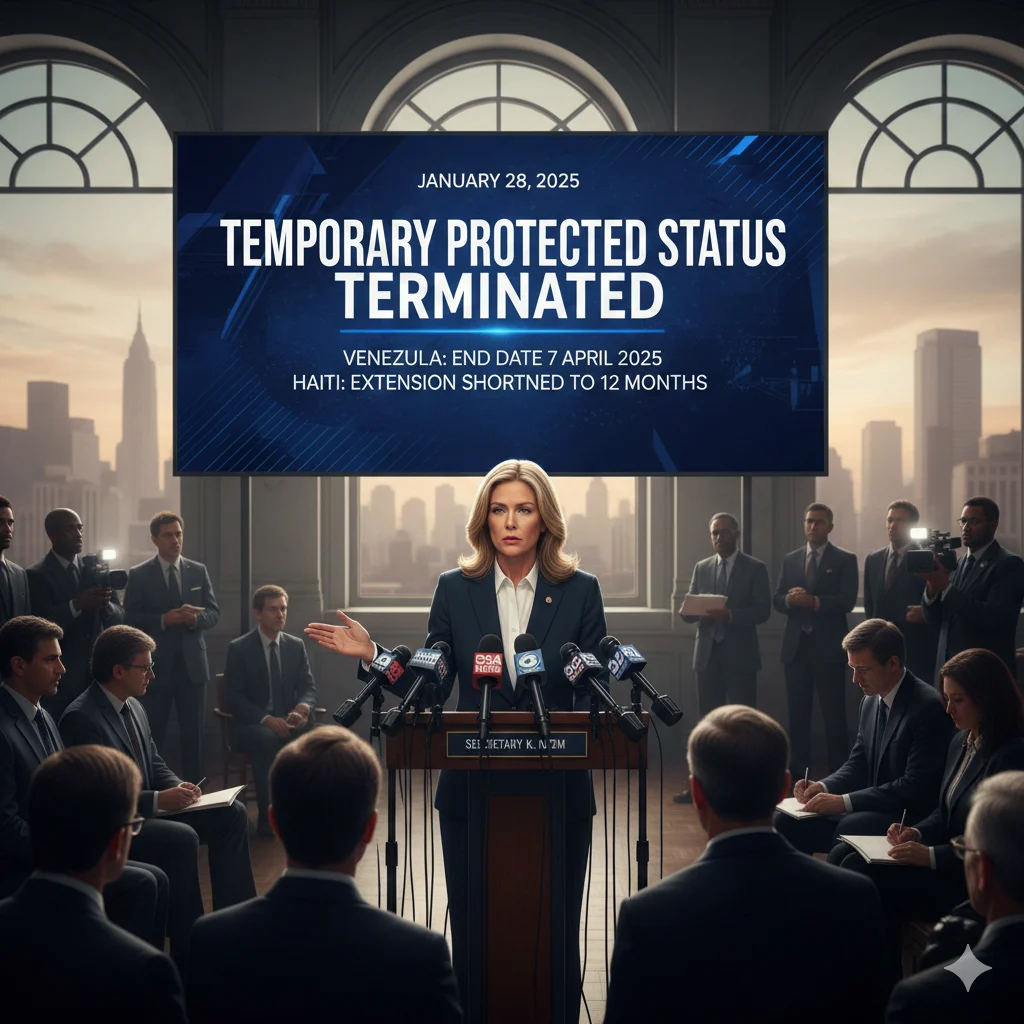
Secretary Noem announced the termination of TPS protections
for Venezuelans on 28 January 2025, cancelling extensions granted under prior
administrations. She vacated the 17 January 2025 extension of Venezuela’s TPS
designation through 2 October 2026 and fully terminated the 2023 designation,
setting an end date of 7 April 2025 for beneficiaries under that programme.
Noem determined that extending TPS was contrary to the national interest,
citing improved conditions in Venezuela and describing national interest as an
expansive standard.
For Haiti, Noem issued a partial vacatur of the 1 July 2024
extension and redesignation, shortening the period from 16 to 12 months. The
National TPS Alliance amended its complaint on 20 March 2025 to include four
Haitian TPS holders as plaintiffs and challenge the Haiti decision. Noem argued
that conditions in both countries had improved sufficiently to end the
temporary programme, which prevents deportation and allows work but offers no
path to citizenship.
Venezuela’s TPS was first designated in 2021 amid political
turmoil, hyperinflation, unemployment and hunger; millions have fled the
crisis. Haiti received TPS in 2010 after a 7.0 magnitude earthquake killed over
200,000 people and left more than a million homeless; the country faces ongoing
hunger and gang violence. Designations last 6, 12 or 18 months and can be
extended if conditions persist.
District court blocks terminations as unlawful in 2025
rulings
The National TPS Alliance and Venezuelan TPS holders filed
suit on 19 February 2025 in the US District Court for the Northern District of
California, alleging Noem’s decisions violated the Administrative Procedure Act
(APA) and were motivated by racial and national origin animus in violation of
the Fifth Amendment. On 31 March 2025, Judge Chen issued a nationwide order
postponing Noem’s cancellation of the 2021 and 2023 Venezuela TPS extensions
and the 2023 termination.
Chen found irreparable harm to hundreds of thousands of TPS
holders, including family separation, economic disruption and public health
impacts, with no countervailing government harm identified. On 5 September
2025, Chen granted partial summary judgment, ruling the Venezuela vacatur and
termination, plus Haiti’s partial vacatur, violated the APA because Noem lacked
authority to vacate or terminate TPS extensions once granted, and her reasons
were arbitrary and capricious.
The court held that Congress did not empower the secretary
to revoke existing TPS designations. Both the district court and 9th Circuit
rejected the government’s requests to stay the preliminary relief.
Supreme Court stay permits terminations to proceed
pending review
The Trump administration appealed Chen’s orders, and on 3
June 2025, the US Supreme Court stayed the district court’s postponement of
Venezuela’s TPS rescission, allowing terminations to resume. The high court’s
narrow order reversed the pause but did not address the merits; it noted
challenges to invalidating existing documents could continue.
On 19 September 2025, the government filed an emergency
Supreme Court application (No. 25A326) for a stay of Chen’s 5 September
judgment on Venezuela TPS, while the 9th Circuit appeal proceeded. The Supreme
Court granted a stay in October 2025, permitting Noem’s decision to take effect
pending final resolution. The 9th Circuit affirmed Chen’s preliminary relief on
29 August 2025 regarding nationwide scope.
Haiti’s TPS is set to expire on 3 February 2026, with a
separate challenge pending; a federal judge in Washington is expected to rule
soon on halting its termination.
Appeals court panel affirms lower court’s APA violations
The 9th Circuit panel—Judges Wardlaw (Clinton appointee),
Mendoza Jr. and Anthony Johnstone—affirmed Chen’s rulings on 28 January 2026.
Wardlaw wrote that the TPS statute’s safeguards ensure predictability for
beneficiaries during temporary crises. The panel held that nationwide relief is
required under the TPS statute’s uniform application.
Judge Mendoza concurred separately, citing ample evidence of
racial and national origin animus, stating Noem’s decisions appeared
preordained, pretextual and rooted in stereotypes of Venezuelans and Haitians
as dangerous criminals or mentally unwell, rather than substantive policy. He
noted the actions were not based on genuine differences with prior TPS
procedures.
Government attorneys argued Noem has broad, unreviewable
authority over TPS determinations and denied racial bias motives. A Department
of Homeland Security email on 28 January had no immediate response.
Impacts on TPS holders and ongoing legal challenges
TPS holders affected include parents, workers and spouses of
US citizens who pay taxes and have no criminal records but face deportation
risks post-termination. The rulings highlight harms such as detention, family
separation, job loss and psychological effects. Plaintiffs described
beneficiaries as hardworking community members unable to return safely home.
The 9th Circuit decision does not restore TPS immediately
due to the Supreme Court stay. The district court may now proceed to final
relief on remand. Separate litigation continues on humanitarian parole
terminations for Venezuelans and others.
Noem’s actions affected approximately 350,000 Venezuelans
under the challenged designations. Haiti’s partial vacatur impacted additional
holders.
Background on TPS programme and prior designations
TPS, enacted in 1990, allows
the homeland security secretary to designate countries for temporary relief
from deportation when armed conflict, environmental disasters or extraordinary
conditions prevent safe return. Beneficiaries receive work authorisation during
the period.
Venezuela’s 2023 designation covered those registering
initially that year; extensions aimed to October 2026. Haiti’s followed the
2010 earthquake and persists amid violence. Other recent terminations include
Nepal (12,700 holders), Honduras (72,000) and Nicaragua (4,000).
The lawsuit, National TPS Alliance v. Noem, represents a
member-led group of TPS holders nationwide.