
Summary
- Appeals court permits Trump to resume CFPB layoffs.
- Injunction blocking firings overturned by court.
- Unions ruled lacking legal challenge standing.
- Layoffs hitting about 90% of staff.
- Dissent cites constitutional separation of powers
concerns.
Significant personnel reductions at the Consumer
Financial Protection Bureau, a watchdog for banks and fintech firms that has
long been singled out by congressional Republicans and far-right Trump
supporters, are made possible by the decision.
A preliminary injunction granted to agency
workers by a US district judge in March was revoked by the appeals court panel
by a vote of 2-1.
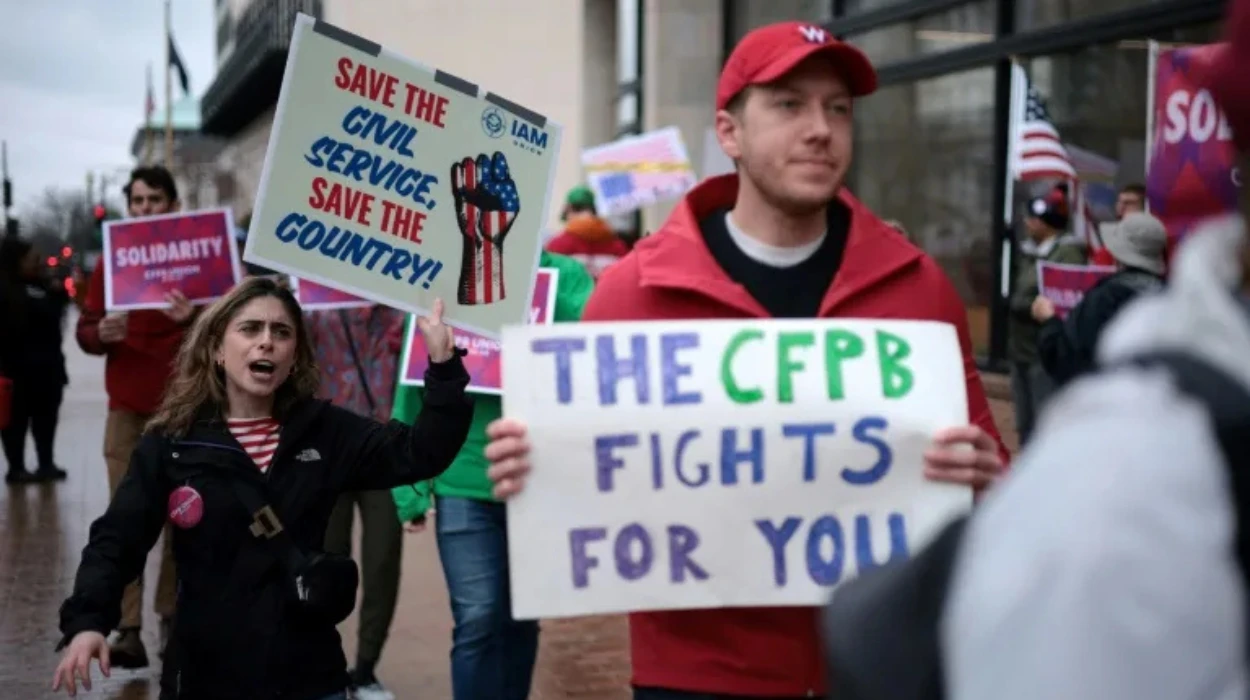
The major downsizing of the CFPB by Trump
appointees, according to labor organizations that represent CFPB employees,
effectively destroyed the agency and went beyond their constitutional powers.
“We hold that the district court lacked
jurisdiction to consider the claims predicated on loss of employment,”
said the ruling.
“Accordingly, we vacate the preliminary injunction.”
Judges Gregory Katsas and Neomi Rao, who were
appointed to the court by Trump during his first term, supported the decision.
Judge Cornelia Pillard, who was appointed by
Democrat Barack Obama in 2013, dissented, supporting the district court’s
finding that a significant reduction in the CFPB’s size amounted to the
agency’s demise.
Pillard stated that although the president has
significant control over the CFPB, the administration cannot “decide that
the country would benefit most if there was no Bureau at all,” and that
only Congress has the right to revoke the legislation that established the
CFPB.
Established in the aftermath of the global
financial crisis in 2008, the CFPB oversees a range of consumer issues in the
United States, including credit cards, debt collection, and mortgages.
Russell Vought was appointed CFPB director by
Trump in February. The conservative plan known as Project 2025, which advocated
for the agency’s dissolution, was largely conceived by Vought, who now serves
as the head of the White House Office of Management and Budget.
In support of the appeals court’s decision on Friday,
Attorney General Pam Bondi said it would allow the CFPB “to right-size
itself in accordance with the law to best serve the American people.”
“This decision could lead to widescale
firings, which would result in the cessation of the Bureau’s important work
protecting consumers,”
said NTEU president Doreen Greenwald, adding that
the CFPB has returned more than $21 billion to consumers since its
establishment in 2011.
The union can appeal Friday’s decision to the
full appeals court.
What legal arguments did the appeals court use
to approve the layoffs?
The court ruled that the district court lacked
jurisdiction to block the layoffs directly. Employment-related claims of
federal employees must be addressed through the specialized federal employee
grievance and review procedures established by the Civil Service Reform Act,
not through immediate court injunctions.
The court held that the administration’s layoff
decisions were not “final agency actions” subject to immediate
judicial review under the Administrative Procedures Act. Since the layoffs had
not been fully carried out or finalized, the courts should not intervene
preemptively.
The majority opinion emphasized respect for the
executive branch’s authority to manage agency operations and personnel
decisions without excessive judicial interference, underscoring separation of
powers principles.