
- Trump officials defend audacious military operation on Capitol Hill.
- Forcible capture of sitting head of state from capital.
- Top administration figures arrived this morning to testify.
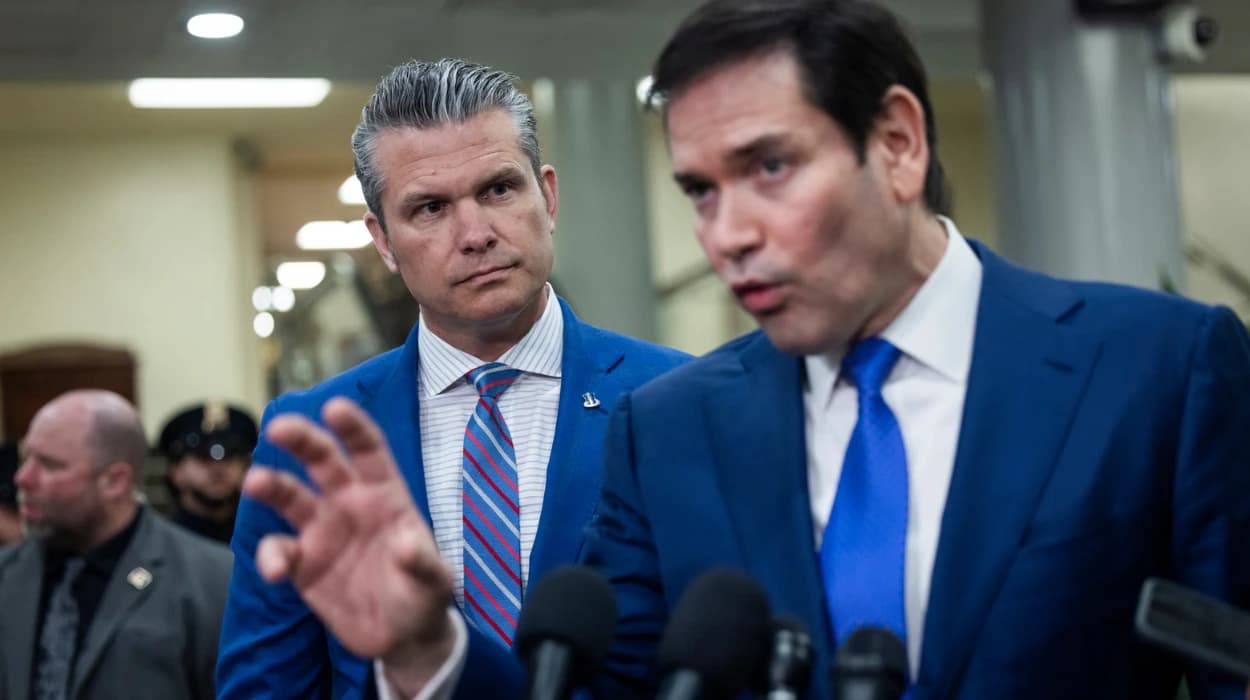
All 100 US senators were briefed on Operation Absolute Resolve, the lightning raid that took Venezuelan President Nicolás Maduro from his Caracas home and placed him in a New York City jail cell, by Secretary of State Marco Rubio, Defense Secretary Pete Hegseth, Attorney General Pam Bondi, CIA Director John Ratcliffe, and Gen. Dan Caine, chair of the joint chiefs of staff.
The attack on January 3rd, in which US special soldiers from Delta Force swooped into Venezuela before dawn to capture Maduro and his wife, Cilia Flores, is being discussed for the first time by the entire Senate.
Rubio told reporters that he presented lawmakers with a three-pronged approach to Venezuela that centered on oil: first, stabilization of the nation.
Aside from oil, the operation has created predictable divisions in Washington. Trump's description of the raid as a simple law enforcement operation to apprehend an accused drug trafficker has garnered support from Republicans. Democrats warn of an unlawful act of war that could destabilize Venezuela and create a risky precedent for presidential action taken unilaterally.
“What we did is we took out an illegitimate president,”
the Republican senator Markwayne Mullin said after the briefing.
“He was never duly elected, so there can’t be regime change if he should have never been put in place to begin with.”
Early on Saturday morning, special operations forces attacked several locations in northern Venezuela, apprehended Maduro and Flores from their residence, transported them to the USS Iwo Jima, transported them to the Stewart Air National Guard facility, and finally transported them to New York. A few days later, Maduro appeared in US court and entered a not guilty plea on charges of guns, cocaine importation, and "narco-terrorism" conspiracy resulting from a 2020 indictment.
The public's general discomfort with the operation is reflected in the push. According to a Washington Post poll published on Sunday, over six out of ten Americans think it should have needed congressional approval. Roughly 75% of respondents to a different Reuters/Ipsos study are worried that the US will get too involved in Venezuela. According to a Reuters survey, roughly one-third of respondents support the operation, one-third oppose it, and one-third are unsure, reflecting the party divide on Capitol Hill.
“Across America, people are just saying what the hell is going on?”
the Senate minority leader, Chuck Schumer, said.
“We need answers as to how long this is going to last. We need answers to how many troops, how much money, are there guardrails, things we don’t do, and a number of things that we had talked about were very troubling.”
However, it's still uncertain what will happen in Venezuela next. Trump has stated that the United States will "run" the nation for an indeterminate amount of time, and he has permitted Delcy Rodríguez, the country's hand-picked and alleged Maduro loyalist vice president, to continue in a leadership capacity for the time being.
There has been quick international censure. The operation has been condemned by Brazil, Chile, China, France, Iran, Mexico, Russia, and Spain. While the US characterized the action as targeted law enforcement, Chinese and Russian delegates at the UN Security Council on Sunday called for Maduro's immediate release.
In the sake of national security, Republican politicians and US authorities are also focusing on Greenland.
Trump has maintained a naval squadron off the coast of Venezuela, and the US Coast Guard detained two oil ships connected to Venezuela this morning in separate operations, indicating that the administration has no intention of reducing pressure on the dictatorship.
“Our military is prepared to continue this,”
Hegseth told reporters.
“The president, when he speaks, he means it. He’s not messing around, we are an administration of action to advance our interests, and that is on full display.”
What legal justification did the administration present for the operation?
The Trump administration justified Operation Absolute Resolve as a law enforcement action under Composition II powers, targeting criminated narcoterrorists Nicolás Maduro and Cilia Flores on US medicine trafficking charges without taking congressional authorization.
Officers like Marco Rubio cited presidential authority for extraterritorial apprehensions, drawing on a 1989 William Barr memo from the Panama Noriega operation asserting that similar raids indeed involving military force fall under essential commander- in- principal powers and do n't violate UN Charter Article 2( 4) asnon-self-executing, framing it as police action rather than war.
They invoked the 2001 AUMF against terrorism for Maduro's Tren de Aragua links and public security pitfalls from Venezuelan oil painting- funded smuggling, rejecting corruption markers amid critics' claims of lacking statutory base or tone- defense under transnational law.