
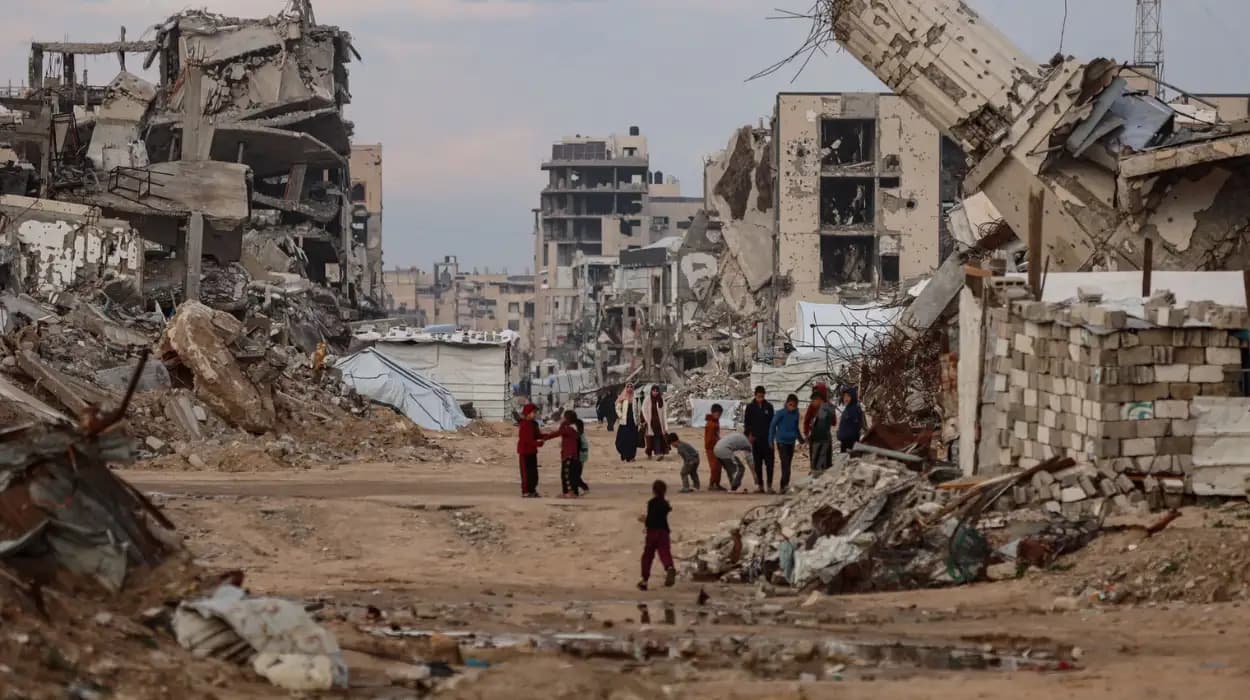
- US starts Gaza ceasefire second phase
- Forms Palestinian technocrats committee for transition
- Technocrats handle day-to-day Gaza running
Steve Witkoff, Donald Trump's special envoy, made the announcement on social media, but it was devoid of any information or names of possible members of the
"national committee for the administration of Gaza."
It is anticipated that the group won't start working until a Trump-chaired "peace board" is established.
The "complete demilitarization and reconstruction of Gaza, primarily the disarmament of all unauthorized personnel" would start the second phase, according to Witkoff.
The exchange of Israeli hostages held by Hamas and its allies for Palestinian captives held by Israel marked the start of the first phase of the ceasefire agreement on October 10. The majority of the land remained under Israeli control when their forces retreated to a yellow truce line.
Although it has decreased, Israel's shelling of Gaza has not stopped. Since the start of the ceasefire, some 450 Palestinians have died. The disarmament of Hamas has not been agreed upon.
“The US expects Hamas to comply fully with its obligations, including the immediate return of the final deceased hostage,” Witkoff said. “Failure to do so will bring serious consequences.”
The US was asked by two organizations representing Israeli former captives and their relatives to hold off on announcing the commencement of the second phase of the truce until Hamas had returned the remains of Ran Gvili, the final hostage still missing. According to Hamas, Gvili's body has not yet been located.
The Egyptian foreign minister, Badr Abdelatty, declared a few hours earlier that an agreement had been reached on all 15 members of the proposed Palestinian temporary committee, despite Witkoff's failure to provide any information.
Although it is anticipated that the members will be technocrats rather than politicians, some are thought to be affiliated with the Fatah party, which controls the Palestinian Authority. Ali Shaath, a former Palestinian Authority deputy minister of planning, and Majed Abu Ramadan, the PA health minister, are two contenders mentioned as possible leaders.
Diplomats in the area claim that Nickolay Mladenov, a seasoned Bulgarian and UN diplomat who has been visiting the area and having discussions with Israeli and Palestinian officials, will be in charge of the Palestinian transitional committee's activities.
Mladenov is well-liked throughout the region and was the UN ambassador for the Middle East peace process from early 2015 to the end of 2020.
Which countries might contribute to the international stabilization force?
Egypt, Qatar, the United Arab Emirates, Turkey, Pakistan, Indonesia, Azerbaijan, Australia, Malaysia, Canada, France, Cyprus, Bangladesh, and Ethiopia are among the countries reportedly interested or approached to contribute colors or support to the International Stabilization Force( ISF) for Gaza.
Egypt, Turkey, and Azerbaijan have gestured amenability to share, potentially leading or furnishing significant contingents given their indigenous propinquity and political places. Pakistan and Indonesia, the world's largest Muslim- maturity nations, are seriously considering deployment contingent on Arab nation blessing and Israel's concurrence, viewing it as solidarity with Palestinians.
The US State Department approached over 70 countries including France, Italy, El Salvador, Malta, and sought backing from UAE and Saudi Arabia, with 19 expressing some amenability for logistics, or equipment.