
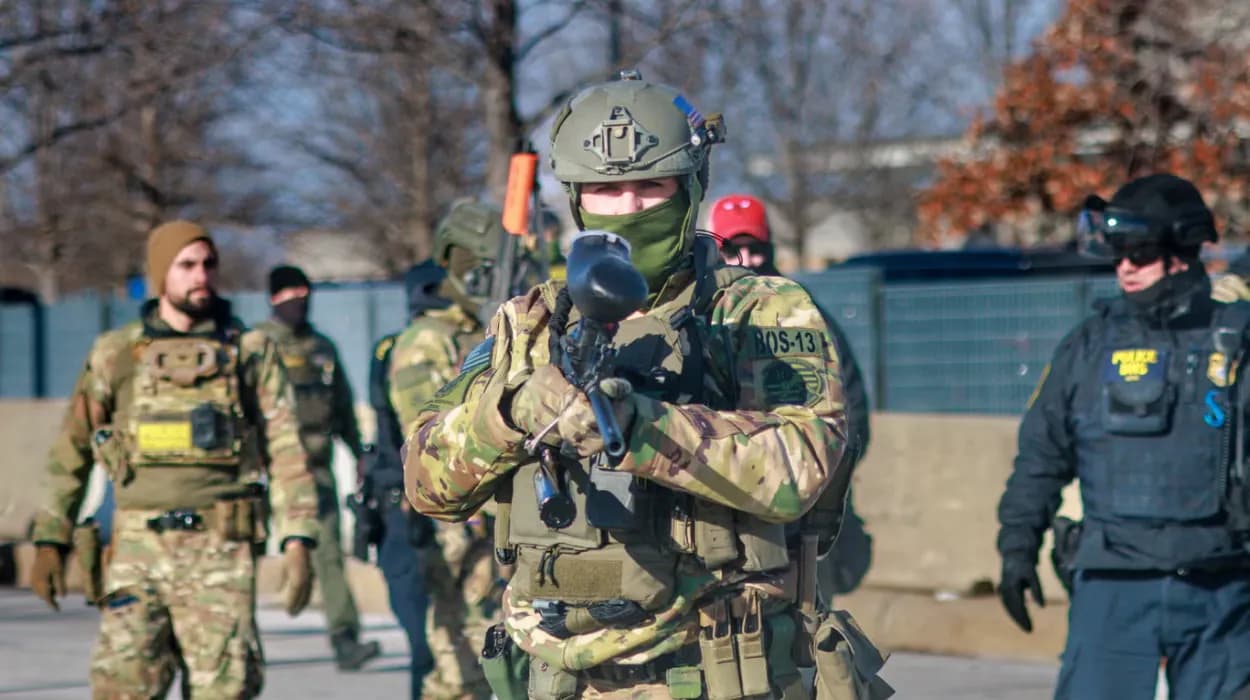
- Trump presidency: federal officers fired 12+ times on people.
- Incidents killed at least four individuals.
- Seven others suffered injuries.
The death of Renee Good in Minneapolis last week, when an Immigration and Customs Enforcement officer fired three shots into her car at close range, striking her in the face and sparking protests across the nation, is one of at least 16 shooting incidents by federal officers in the past year.
Numerous riot control weapons, including rubber bullets, pepper balls, and chemical sprays, have been used, sometimes at close range, and federal immigration police have held people at gunpoint in at least 15 other incidents without firing.
The Trace's study and an examination of federal statistics probably constitute an undercount because thousands of officers are still being added to places that are predominantly run by Democrats.
“This makes us all less safe,”
according to gun control advocacy group Everytown for Gun Safety.
“Armed intimidation in our communities does not make anyone safer,”
added Brady, a nonprofit organization against gun violence.
“More firearms in neighborhoods already impacted by gun violence helps no one. Police violence is gun violence.”
The most recent federal statistics show that 20 persons were killed by immigration police in 2023 and 2022. According to federal data, ICE and border patrol officers, the organizations responsible for the Trump administration's most recent round of federal law enforcement actions used lethal force against 19 individuals during that period, while a Coast Guard member was accountable for one death.
According to ICE's annual report, the internal guns and use of force committee looked at three instances in which an officer used a firearm during the 12 months ending in September 2024.
A 2024 investigation by The Trace, Type Investigations, and Business Insider found that ICE agents were accountable for 59 shootings during the six-year period between 2015 and 2022.
The first fatal shooting by immigration officials in the second Trump administration occurred in September when Silverio Villegas Gonzalez, a 38-year-old Mexican parent and cook, was shot at "close range" while reportedly attempting to escape ICE officers during a traffic check in Chicago.
According to the agency, a border patrol officer in Rio Grande City, Texas, shot a 31-year-old Mexican national three times last month while attempting to apprehend him. About an hour after the incident was reported, he was declared dead.
In Los Angeles, California, an off-duty ICE agent shot and killed 43-year-old Keith Porter on New Year's Eve.
Porter, a father of two, was apparently celebrating the New Year by firing a firearm into the air.
A few days prior, an American citizen in Los Angeles was shot in the shoulder by an immigration officer. Carlos Jimenez's attorneys claim that he warned the officers to leave the area because youngsters would shortly be there. He allegedly accelerated his vehicle in the direction of an officer while attempting to escape, according to federal authorities.
According to a Wall Street Journal study, immigration agents have fired on moving cars at least thirteen times in the past year. Administration officials have defended these measures against drivers who have "weaponized" their vehicles against law enforcement.
“When faced with dangerous circumstances, DHS law enforcement used their training to protect themselves, their fellow officers, and the public,”
Homeland Security spokeswoman Tricia McLaughlin told the newspaper.
Officers are not allowed to fire at a moving car unless "no other objectively reasonable means of defense appear to exist," according to Department of Justice guidelines.
“Everything about these incidents indicates that these are probably shootings that did not need to happen,”
Georgetown Law professor and former Department of Justice litigator Christy Lopez told The Trace.
Although the majority of recent shooting occurrences took place in the Chicago and Los Angeles regions, a number of them, including Good's murder, happened in and near Minneapolis.
An ICE officer opened fire on a guy in an SUV in St. Paul, Minnesota, late last month after the driver allegedly hit two officers with his vehicle. The driver did not sustain any injuries.
Additionally, the same ICE officer who shot and killed Good was hurt when he used a Taser on a driver during a traffic check in June. According to his testimony, the officer, Jonathan Ross, shot Roberto Carlos Muñoz ten times with his Taser after smashing the rear driver's side window and witnessing "the impacts on his face."
“I was fearing for my life. I knew I was going to get drug [sic],”
Ross said.
“And the fact I couldn’t get my arm out, I didn’t know how long I would be drugged. So I was kind of running with the vehicle.”
According to prosecutors, Ross claimed he was pulled over 100 yards and had 20 stitches for a cut on his right arm and 13 stitches on his left hand.
Muñoz, however, made it through the meeting. He was later found guilty by a jury of assault with a deadly and dangerous weapon and causing bodily harm.
Which agencies conducted the shootings and where did they occur?
U.S. Immigration and Customs Enforcement( ICE) and Customs and Border Protection( Border Patrol) agents conducted the maturity of the 13 blowups by civil immigration officers since January 2025, primarily targeting vehicles during expatriation operations and hobbies.
ICE agents fatally shot Renee Good in Minneapolis, Minnesota, during a road- position enforcement action, with videotape showing agent Jonathan Ross blasting as her auto moved forward DHS claims tone- defense against a" weaponized vehicle."
ICE fired on a van in Glen Burnie, Maryland( near Baltimore) on Christmas Eve 2025, injuring Portuguese motorist Alexandrea Sousa- Martins and Salvadoran passenger Antonio Serrano- Esquivel during an escape attempt original DHS narrative revised after original police disagreement on collision details.