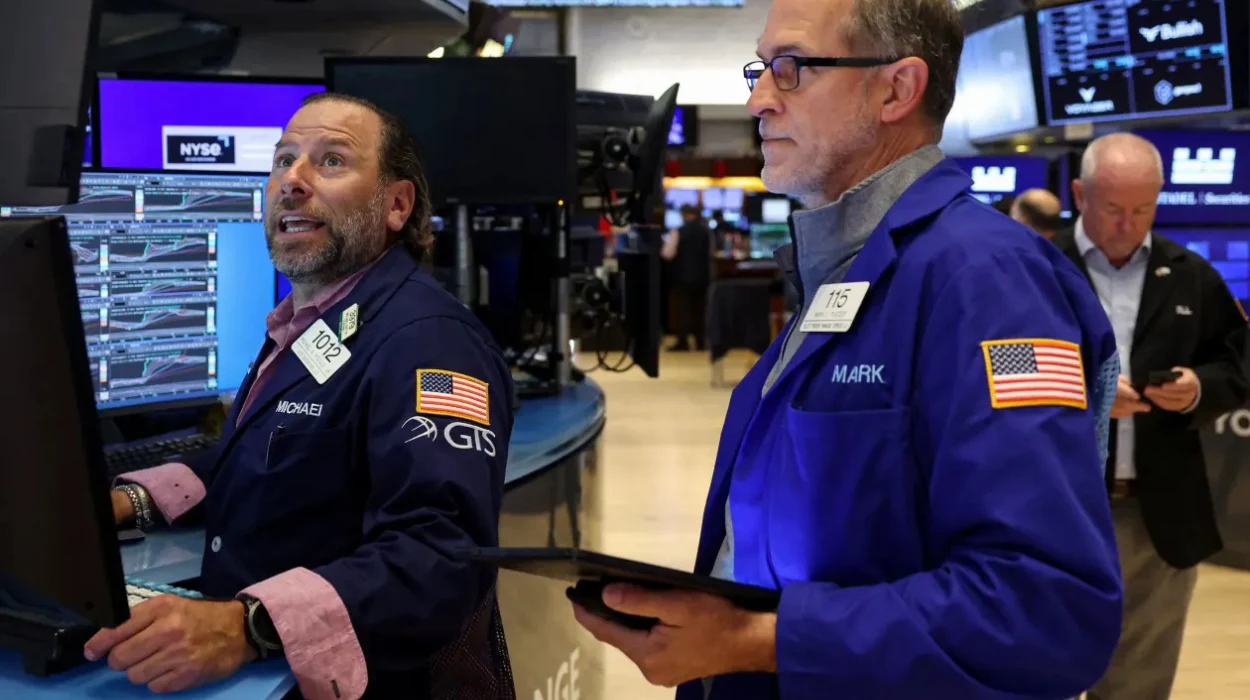

U.S. stock markets reached record highs this week, a
remarkable feat given growing concerns about the labor market and an ongoing
government shutdown that has disrupted key economic data releases. Major
indices like the Dow Jones Industrial Average, the S&P 500, and Nasdaq set
new closing records over the past several days, underscoring robust investor
confidence despite underlying economic uncertainties.
On October 2, 2025, the S&P 500 climbed approximately
0.3% to a record close, while the Nasdaq rose by 0.4%, and the Dow Jones added
43 points or 0.1%. These gains came amid optimism that a federal funding
impasse would be brief and not severely impact the broader economy. Trading on
Wall Street continued this trajectory into October 3, with futures rising amid
hopes of an imminent Federal Reserve interest rate cut, a signal that investors
expect continued support for economic growth and corporate earnings.
Government Shutdown Impact and Market Resilience
The U.S. government shutdown, entering its third day, has
stalled critical government functions, particularly delaying the release of
vital economic data such as the highly anticipated nonfarm payrolls report. The
shutdown commenced after congressional leaders failed to reach an agreement
by a funding deadline, with Democrats and Republicans exchanging blame for
the stalemate.
Despite this, the market has largely shrugged off the
shutdown’s negative implications. Financial strategist Saglimene from
Ameriprise Financial noted,
“Strong macroeconomic conditions, bolstered by vigorous
consumer activity, combined with the Fed’s potential to lower rates, have
fostered a market atmosphere where stock volatility has remained largely stable.”
This stability is attributed to solid corporate earnings,
especially in technology sectors, and investor confidence that legislative
deadlock will be short-lived.
Notable deals have also bolstered investor sentiment. One
example is Warren Buffett’s Berkshire Hathaway’s announcement to acquire
Occidental Petroleum’s petrochemical division for $9 billion, signaling
continued corporate confidence and investment activity despite wider political
gridlock.
Labor Market Concerns and Alternative Data Indicators
A substantial source of concern is the labor market, which
is showing signs of cooling off. The Labor Department announced a sharp
slowdown in job growth, with August’s figures revealing only 22,000 new jobs
added—a stark drop from expectations of 75,000. Additionally, data from payroll
processing firm ADP reported a decline of 32,000 private sector jobs in
September, the largest drop since March 2023.
The nonfarm payroll report, scheduled for early October, was
postponed due to the government shutdown, causing analysts and investors to
turn to alternative data sources to gauge the health of the labor market. The
cooling job market, while raising caution, has simultaneously fueled
speculation that the Federal Reserve could soon reduce interest rates to
support economic activity.
Mulmat, CEO of North American parent company tastytrade,
stated,
“It will require more than a single disappointing data
report to shake this market at this stage.”
This remark reflects a broader market view that current
earnings strength and consumer spending can sustain stocks through short-term
economic jitters.
Inflation Outlook Clouds Future Market Path
Looking ahead, investors are anxiously awaiting fresh
inflation data, which has been delayed due to the shutdown. The personal
consumption expenditures (PCE) price index—closely watched by the Fed—is
expected to rise moderately in its next release, sustaining concerns about persistent
inflationary pressures. Forecasts for the upcoming report predict a
month-over-month PCE increase of 0.3% and a year-over-year rise of 2.7%, with
the core index expected to follow similar trends.
Persistent inflation combined with a weakening labor market
presents a delicate balancing act for Federal Reserve policymakers. They must
weigh the benefits of potentially cutting interest rates to support growth
against risks of inflation remaining above target levels. The next Fed meeting
scheduled for late October is now clouded by uncertainty, as the lack of fresh
government data complicates decision-making.
Tech Sector Leads Amid AI Optimism
Despite the broader macroeconomic concerns, technology
stocks have shone brightly, driving much of the market’s record highs. The rise
of artificial intelligence (AI) investments and innovations has injected strong
momentum into the sector, with companies like Nvidia reaching historic market
capitalizations—recently hitting $4.5 trillion, a first for any company.
Even as some tech stocks experienced minor pullbacks—for
example, Nvidia closed slightly lower on October 2 after consecutive gains—the
sector’s overall strength remains a critical underpinning of market optimism.
Analyst commentary suggests that AI innovation continues to fuel investor
enthusiasm and offset worries stemming from other economic challenges.
Market Outlook: Cautious Optimism Despite Risks
As Wall Street heads into the coming week and month, the
dominant sentiment remains a mixture of cautious optimism and close monitoring.
The current bull market rally shows signs of resilience, sustained by strong
corporate earnings, significant technology sector advances, and anticipation of
accommodative monetary policy. Nevertheless, the shadow of the government
shutdown, labor market softness, and inflation uncertainties temper this
confidence.
Investors are increasingly attentive to how the duration of
the government shutdown will impact economic data flow and Federal Reserve
decision-making. Market watchers emphasize that while stocks have historically
weathered shutdowns without major disruption, the present environment is
uniquely challenging due to several overlapping economic conditions.
As one strategist bluntly summarized,
“Stocks have typically glided by previous shutdowns —
but this one could be riskier given the slew of economic conditions at
play.”
This statement underscores the need for vigilance as
policymakers and market participants navigate the evolving economic landscape.
U.S. stocks have impressively closed at record highs despite
the backdrop of job market worries and an ongoing government shutdown that has
delayed crucial inflation data. Investors’ hopes are pinned on potential
Federal Reserve interest rate cuts and the resilience of key economic sectors,
especially technology. However, the challenges of a slowing labor market,
inflation pressures, and political uncertainties remain significant headwinds.
The coming weeks will test how far this optimism can sustain itself as economic
data returns and policymakers confront complex decisions.