
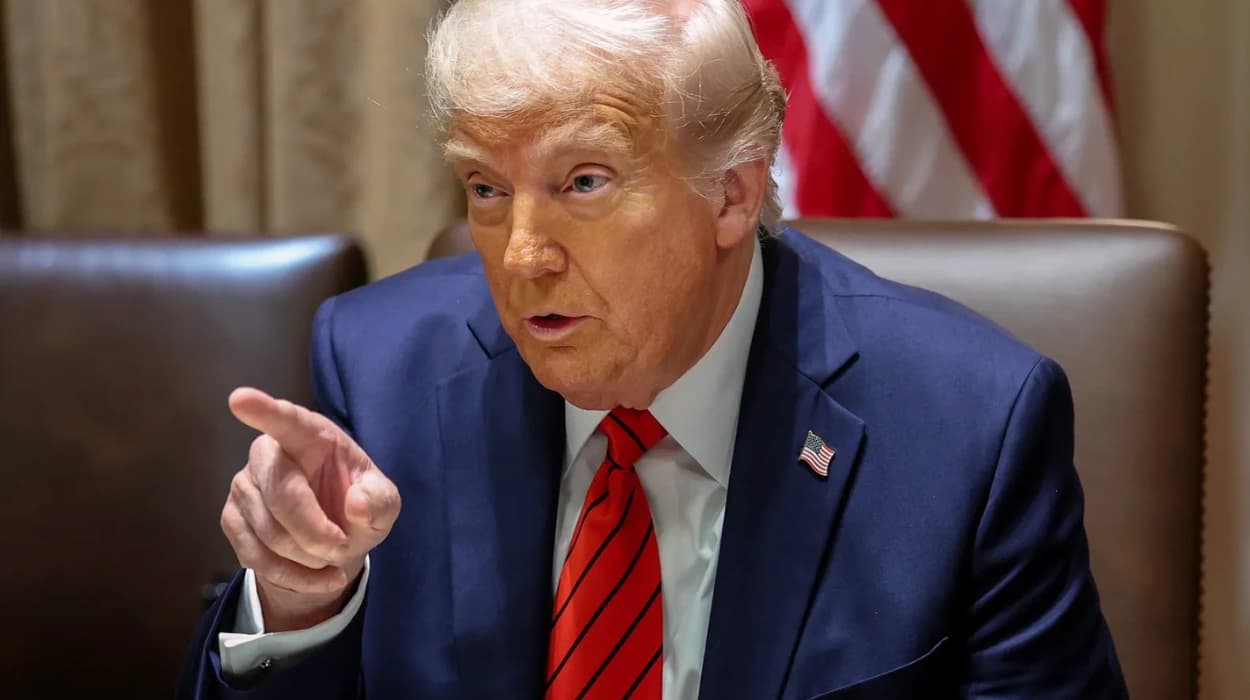
- Trump warns Supreme Court against aiding foreign tariffs.
- Claims court should not serve hostile foreign interests.
- Criticizes justices for challenging his tariff powers.
The president boasted that the "full benefit" of the tariffs he imposed on imports from almost every American trading partner "has not yet been calculated" in an early-morning Truth Social post published hours before dawn on Monday. This is because many importers decided to hoard inventory this past spring in order to avoid having to pass costs on to consumers.
“That heavy inventory purchase is now, however, wearing thin, and soon Tariffs will be paid on everything they apply to, without avoidance, and the amounts payable to the USA will SKYROCKET, over and above the already historic levels of dollars received,”
Trump said.
Additionally, he blasted those who have opposed his use of a Carter-era law to justify applying the tariffs as foreign puppets and asserted that the "RECORD SETTING" tax collections would place the United States on a "new and unprecedented course" if allowed to stand.
“Those opposing us are serving hostile foreign interests that are not aligned with the success, safety and prosperity of the USA. They couldn’t care less about us,”
he said, adding later that he looks “so much forward” to the high court’s upcoming ruling in his administration’s appeal of a court decision striking down the tariffs as unlawful.
Almost three weeks have passed since the justices heard arguments in the case before Trump's early-morning rant.
The main question for the nine-member high court was whether Trump could legally use the 1977 International Emergency Economic Powers Act to impose import fees. Congress is the only body with this authority under the U.S. Constitution and U.S. law, unless certain conditions are met.
When a national emergency is declared, the Carter-era law does allow the president to regulate commerce in "unusual and extraordinary" situations; nevertheless, the legislation's wording notably makes no mention of tariffs.
A third of the Supreme Court's bench is composed of Trump's first-term selections, Justices Neil Gorsuch, Brett Kavanaugh, and Amy Coney Barrett, who have steered the court in a considerably more conservative path than it has in the past.
As he pointed out that tariffs, even when used for foreign affairs, are considered "taxes on Americans," which has "always been a core power of Congress," Chief Justice John Roberts, a longtime supporter of strong executive authority who has led the court in extending Trump's executive authority this year, appeared reluctant to let Trump have his way on this specific issue.
Concerns with the administration's interpretation of the 1977 law were also voiced by Gorsuch, who Trump appointed shortly after taking office to replace the late Justice Antonin Scalia.
During his interrogation of Sauer, he pointed out that the court's approval of "a one-way ratchet toward the gradual but continual accretion of power in the executive branch" could result from accepting the Solicitor General's stance.
How would a Supreme Court decision against the tariffs affect US import prices?
It would probably lead to a significant reduction in U, If the Supreme Court rules against the tariffs assessed under Trump's administration.S. import prices, as the average effective tariff rate presently is about 14.4 overall, with further than half due to these tariffs would roughly halve overnight.
Still, the ruling may introduce short- term request queries, including questions about whether the U.S. government must repay billions collected from import levies. There's also the possibility that the administration could seek to reimpose tariffs using indispensable legal tools similar to the 301 or 122 vittles.
A decision vacating the tariffs would reduce costs for importers and consumers, potentially lowering consumer prices and easing inflationary pressures tied to import duties. Yet, it might also beget some dislocation in transnational trade relations and domestic diligence counting on tariff protections.