
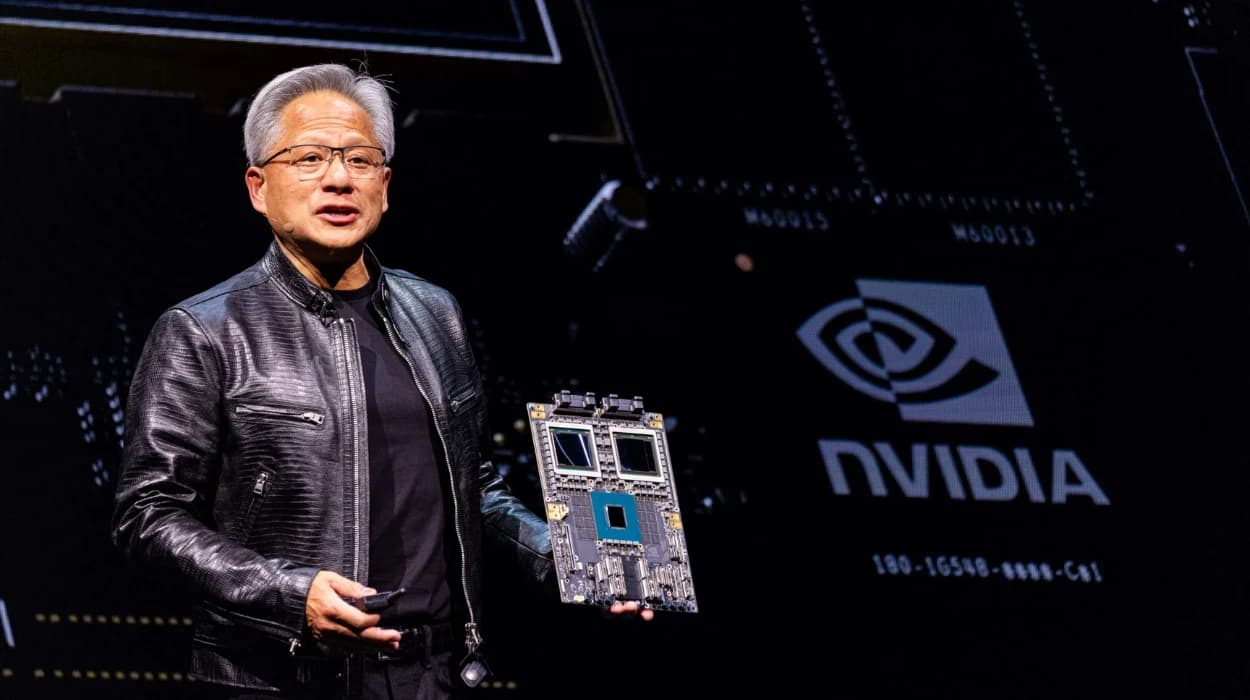
- Bipartisan US bill targets Nvidia chip sales.
- Aims to restrict advanced tech to China.
- Focuses on critical AI-related technologies.
The commerce secretary would be required by the Secure and Feasible Exports Chips Act to refuse advanced chip export licenses to China for a period of thirty months. The measure would prohibit Nvidia from shipping its most cutting-edge chip, Blackwell, and the H200 to China.
It occurs as the White House considers whether to permit Nvidia to ship the H200 to China; some officials are concerned about this potential.
The US is ahead of China in the race for artificial intelligence, according to Pete Ricketts, the Republican chair of the Senate Foreign Relations East Asia subcommittee, who co-sponsored the legislation with Chris Coons, the top Democrat on the panel. This is primarily due to the US's "dominance of global compute power."
“Denying Beijing access to these chips is therefore essential,”
Ricketts said.
“Codifying President Trump’s current AI chip limitations on Communist China as US chip companies continue to rapidly innovate will allow us to widen our compute lead exponentially.”
Coons said:
“The rest of the 21st century will be determined by who wins the AI race, and whether this technology is built on American values of free thought and free markets or the values of the Chinese Communist party.”
The bill is also being sponsored by Democrats Jeanne Shaheen and Andy Kim and Republicans Tom Cotton and Dave McCormick.
The bill comes at a time when Washington's China hawks worry that Donald Trump is neglecting security concerns in order to maintain the economic agreement he made with Chinese President Xi Jinping in October.
The US Treasury had postponed plans to impose sanctions on China's Ministry of State Security spy agency for "Salt Typhoon," a huge cyber penetration of US telecom companies, according to an FT article on Wednesday.
According to US sources, the administration does not currently intend to impose any significant new export restrictions on China.
“Unfettered access to the H200 would allow China to build frontier-scale AI supercomputers to develop the most powerful AI systems,
just at a moderately higher cost relative to cutting-edge Blackwell chips,”
said Khan, a former White House and commerce department official.
“It would also arm Chinese cloud providers to compete globally with US hyperscalers.”
Jensen Huang, the head of Nvidia, met with Trump and Republican senators on the banking committee on Wednesday while in Washington. Prior to the committee meeting, he stated that US companies should be allowed to export their most competitive chips to China and that Beijing would not accept deteriorated chips.
Reporters were informed by John Kennedy, a Republican senator on the committee, that Huang was not a "credible source" regarding US exports to China.
The US shouldn't be sending cutting-edge semiconductors to China, according to Steve Bannon, a former White House adviser in the first Trump administration and a key figure in the Maga movement. This is especially true given that Chinese firms like DeepSeek have made significant advancements in artificial intelligence.
“If this is in fact a ‘Sputnik Moment’ because of DeepSeek then we should ban all chip sales, especially high-end, but also stop all financial support —
no access to debt or equity capital markets, no training, no Chinese students — just like in the cold war about nuclear weapons,”
Bannon said.
Additionally, he attacked Huang and David Sacks, the White House AI adviser who supports supplying China high-end chips as part of an AI "action plan" to force nations to rely on the American "technology stack."
“David Sacks has acted as the agent for the Chinese Communist party and Jensen Huang is the arms merchant,”
Bannon said.
Nvidia stated that the AI action plan "wisely recognizes non-military businesses everywhere should be able to choose the American technology stack, promoting US jobs and promoting national security" in response to a question regarding the bill.
In response to Bannon’s comment, the company said:
“AI is not an atomic bomb. No one should have an atomic bomb. Everyone should have AI.”
How will a US ban on Nvidia advanced chips affect China's AI industry?
A US ban on Nvidia's advanced AI chips will pose significant challenges to China's AI assiduity but could also accelerate its domestic chip development and invention drive. Chinese AI enterprises lose access to Nvidia's top models( e.g., H100, H200, Blackwell), limiting their capability to make frontier- scale AI supercomputers and emplace advanced AI systems effectively at scale.
Chinese AI providers face backups in conclusion capacity, potentially raising costs and decelerating AI relinquishment across diligence. The trade restrictions incentivize China to expand its domestic AI chip sector with companies like Huawei and Cambricon ramping up investments to fill the void, pursuing" tone- sovereignty" and reducing US dependence.
The ban may boomerang by prodding faster progress in China's semiconductor ecosystem, challenging US AI leadership in the medium- to-long term.