
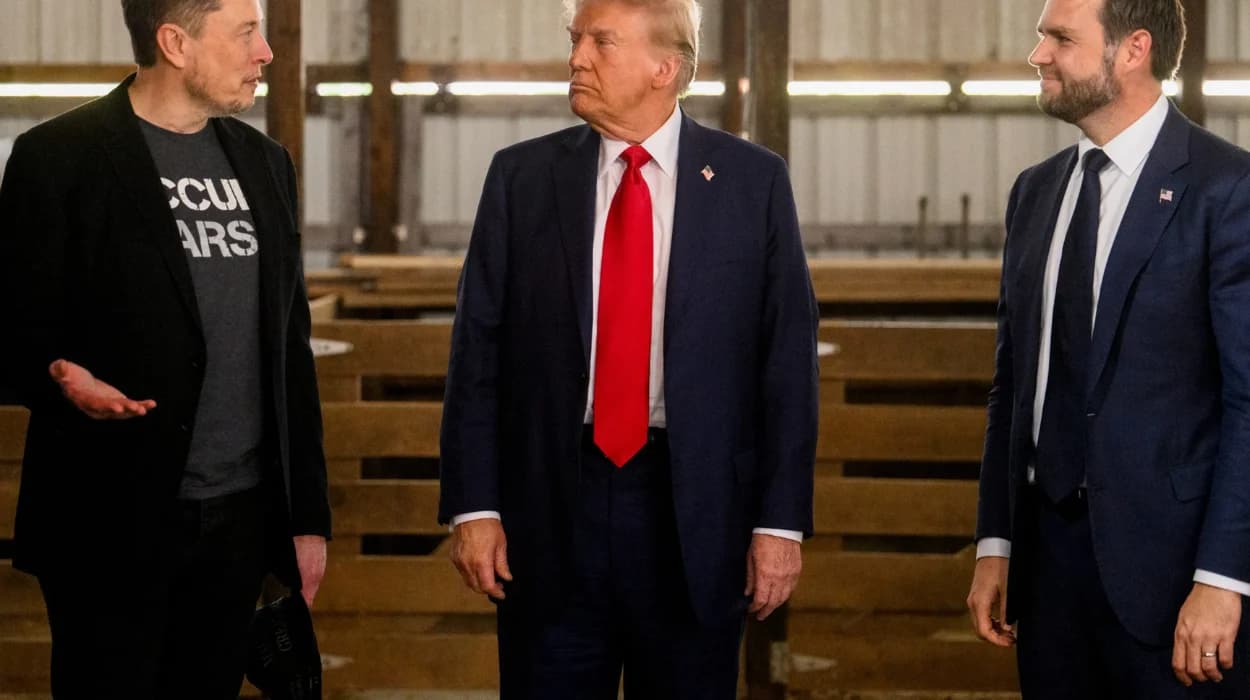
- Elon Musk predicts great 12-year US span.
- Trump's second term starts the era.
- Followed by two JD Vance terms.
According to Politico, the world's richest man made the forecast during a video appearance to a group of approximately 150 DOGE veterans at the Boring Bodega in Bastrop, Texas, on November 22. He also restated his aim of establishing an inhabitable colony on Mars.
He apologized to participants for not being able to address them in person at the pre-Thanksgiving feast, but stated that he believes he is one of the top assassination targets in the United States, which apparently left some of his guests "underwhelmed" with the event.
The billionaire's prediction appears to align with current Republican thinking about Trump's most likely successor, putting Vance in poll position despite the president's apparent reluctance to anoint him and frequent hints that he may seek to run for an unprecedented third term.
Jonathan Karl, an ABC News journalist and seasoned Trump watcher, feels the president and his former White House chief strategist Steve Bannon are simply laughing at the vice president's expense.
“I do think that the reason why he keeps bringing up Trump 2028 – he’s got the hats he shows everybody… It is absolutely trolling,”
Karl said during a Thanksgiving guest spot on MS Now’s Morning Joe.
“And frankly, Steve Bannon, who was the one that really started to get this going, is trolling not just Trump’s critics and Democrats;
he’s also trolling JD Vance. Bannon, privately, not a big JD Vance fan at all.”
Meanwhile, Secretary of State Marco Rubio has publicly stated that he believes Vance is the front-runner. The president's eldest son, Donald Trump Jr., has just trimmed the vice president's 20-point lead in the polls to 18.
The Trump Organization executive remains a popular figure among MAGA supporters and has managed to stay away from the Washington "swamp" throughout his father's two-term reign, leaving him relatively untarnished by unwanted political affiliations.
Vance has hinted to Fox News commentator Sean Hannity that he will not consider the subject until after the November 2026 midterm elections.
“I try to put it out of my head and remind myself the American people elected me to do a job right now,”
the VP told Hannity, before conceding that, after the midterms,
“I’m going to sit down with the president of the United States and talk to him about it.”
Musk has mainly kept out of politics since last year, when he helped fund Trump's 2024 presidential campaign, founded DOGE to reduce wasteful federal spending, and then left the administration in explosively unpleasant fashion in early June.
He and Trump engaged in a furious social media feud after a disagreement over the president's "One Big Beautiful Bill," in which the tech executive accused the commander-in-chief of delaying to release the Department of Justice's Jeffrey Epstein files because he was included in them.
Musk has now attempted to strike a more amiable tone, meeting briefly with Trump at a Charlie Kirk memorial in Arizona in September and again at a Saudi Investment Forum at the Kennedy Center in Washington last month.
The president has stated that he believes he will "always like" Musk, but has generally been less conciliatory, remarking at the latter event:
“You are so lucky I am with you, Elon. Has he ever thanked me properly?”
The SpaceX and Tesla CEOs did so on X.
What legal or constitutional risks arise from extended one‑party control?
Extended one- party control pitfalls weakening separation of powers, as unified superintendent/ legislative branches could pass laws bypassing judicial review or minority rights protections. In the US, this might lead to challenges under Composition I( legislative authority) or the 10th Correction( federalism), with courts striking down overreaches as seen in gerrymandering cases like Rucho v. Common Beget( 2019).
Dragged dominance fosters despotism, suppressing dissent and enabling rights abuses without opposition responsibility. Constitutions like Pakistan's or Liberia's explicitly ban one- party countries to help this; US pitfalls include First Amendment challenges if party control stifles speech or voting rights( e.g., Shelby County v. Holder fallout).
Without competition, corruption thrives via blurred state- party lines and reduced oversight. Judicial review could bring executive Procedure Act violations or equal protection claims if programs favor patriots, as in patronage cases like Elrod v. Burns( 1976).