
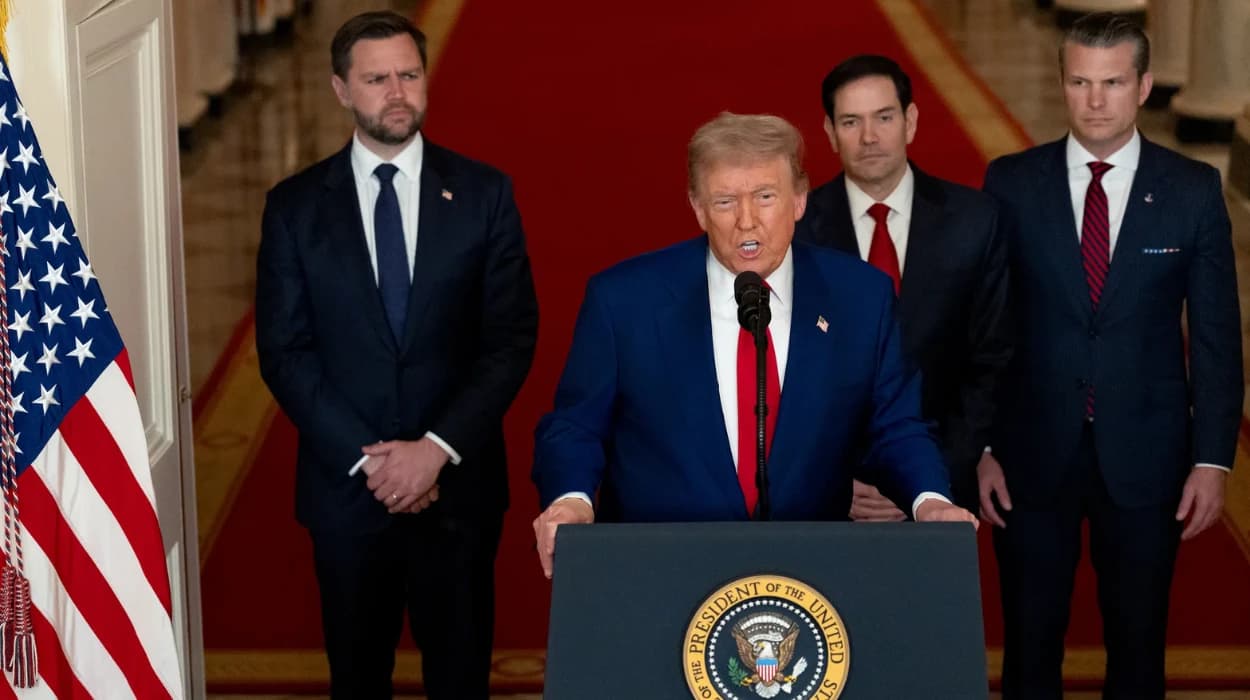
President Donald Trump ordered U.S. military strikes on Iranian nuclear facilities in June 2025 as part of Operation Midnight Hammer, targeting sites at Fordow, Natanz, and Isfahan. These actions responded directly to Iran's accelerated nuclear program and followed Israeli military operations against Tehran. The strikes aimed to neutralize what U.S. intelligence described as an imminent threat of Iran achieving weapons-grade uranium enrichment.
Historical Tensions
U.S.-Iran relations deteriorated sharply after the 1979 Islamic Revolution, which overthrew the U.S.-backed Shah and led to the hostage crisis holding 52 Americans for 444 days. Decades of sanctions, proxy conflicts in Iraq, Syria, and Yemen, and Iran's support for groups like Hezbollah deepened animosity.
The 2015 Joint Comprehensive Plan of Action (JCPOA) under Obama temporarily curbed Iran's nuclear activities in exchange for sanctions relief, but Trump withdrew in 2018, citing the deal's flaws in preventing long-term weaponization.
Post-withdrawal, Iran resumed enrichment, surpassing JCPOA limits by 2021. By 2024, IAEA reports confirmed Iran stockpiling 60% enriched uranium, close to the 90% needed for bombs. Trump's 2025 reelection brought renewed "maximum pressure" via sanctions, aiming to force negotiations, but Iran's program advanced amid economic woes fueling domestic protests.
Nuclear Threat Escalation
The immediate trigger occurred in June 2025 when the International Atomic Energy Agency (IAEA) declared Iran violating nonproliferation commitments, estimating Tehran was two weeks from weapons-grade uranium. This assessment followed satellite imagery showing expanded centrifuges at Fordow, a deeply buried facility designed to withstand conventional attacks. U.S. intelligence corroborated that Iran had enough material for multiple bombs if further enriched.
Israeli Prime Minister Benjamin Netanyahu launched preemptive strikes on June 13, 2025, targeting nuclear sites and Iranian military leaders, prompting Trump to shift from diplomacy. Despite recent U.S.-Iran talks on halting enrichment, Trump authorized B-2 stealth bombers with bunker-buster bombs and submarine-launched cruise missiles on June 22.
The operation sought to set back Iran's program by years, though later assessments indicated only months' delay as Iran had evacuated some materials.
Strategic Calculations
Trump's national security team weighed options amid divided counsel. Pro-strike advocates, including allies like Israel and Gulf states, argued inaction risked a nuclear-armed Iran destabilizing the Middle East. Trump framed the strikes as advancing "vital U.S. national interests and collective self-defense of Israel," notifying Congress on June 23.
Critics within his administration cautioned against escalation, fearing Iranian retaliation via proxies or Strait of Hormuz disruptions affecting global oil.
Public rhetoric played a role: Trump had threatened strikes since January 2025 over Iran's protest crackdowns, killing thousands. Backing down risked credibility loss, echoing his past criticisms of Obama's Syria "red line." Polls showed 70% U.S. opposition to intervention for protesters, but nuclear threats garnered broader support.
Israeli Alliance Dynamics
The U.S.-Israel partnership proved pivotal. Netanyahu's June 13 operation aligned with long-standing intelligence sharing, including U.S. provision of Massive Ordnance Penetrators for Fordow. Trump, who moved the U.S. embassy to Jerusalem in 2018 and brokered Abraham Accords, viewed Iran's nuclear capability as an existential threat to Israel.
Strikes followed Iran's missile barrages on Israeli targets earlier in 2025, part of the broader Iran-Israel war.
Post-strike, Trump claimed the facilities were "completely obliterated," bolstering Netanyahu's position amid his domestic challenges. Joint U.S.-Israeli operations underscored a doctrine of preemption, contrasting Biden-era restraint.
Domestic Political Pressures
Trump's second term emphasized America First, yet Middle East security remained central. Strikes occurred amid 2025 protests in Iran over economic collapse hyperinflation exceeding 100%, youth unemployment at 40% which Trump amplified via social media, urging "regime change." His administration briefed Congress minimally, invoking war powers under the 1973 War Powers Resolution.
Opposition Democrats decried unilateralism, but Republican hawks praised decisive action. The strikes diverted attention from U.S. border debates and economic recovery, reinforcing Trump's strongman image ahead of midterms.
Operational Execution
Operation Midnight Hammer involved precision strikes: B-2 bombers from Diego Garcia dropped 30,000-pound GBU-57 bombs on underground sites, while Tomahawks hit surface infrastructure. Iran reported minimal casualties, claiming preemptive evacuations, but acknowledged damage. U.S. forces faced no losses, with carrier groups like USS Abraham Lincoln positioned defensively.
Intelligence confirmed partial success: Natanz's above-ground halls destroyed, Fordow's ventilation sealed, delaying cascades by 6-12 months per U.S. estimates. Iran vowed rebuilding, accelerating covert sites.
Regional Repercussions
Strikes spiked oil prices 15% to $90/barrel, straining global economies. Iran retaliated via Houthi attacks on Saudi facilities and militia strikes on U.S. bases in Iraq, killing 12 service members. Gulf allies hosted U.S. forces, fearing escalation, while Russia and China condemned the action, supplying Iran air defenses.
Protests in Iran intensified briefly, with 12,000-20,000 deaths estimated from regime crackdowns, though unrest predated U.S. involvement. Sanctions tightened, targeting Revolutionary Guards assets.
International Reactions
The UN Security Council convened emergently; U.S. vetoed a censure resolution. EU nations urged de-escalation, while 60+ countries backed Israel's self-defense. IAEA inspections post-strike verified setbacks but warned of opacity.
China increased Iranian oil purchases, circumventing sanctions, while Qatar mediated backchannels. Trump's team pursued no full invasion, prioritizing containment.
Preceding Iranian Actions
Iran's provocations mounted: 2024 drone supplies to Russia for Ukraine, cyberattacks on U.S. grids, and proxy escalations. The October 2024 seizure of Venezuelan leader Nicolás Maduro allegedly with Iranian ties further irked Trump. Enrichment surges violated NPT obligations, with 142kg of 60% uranium by May 2025.
Soleimani's 2020 assassination set precedent; 2025 strikes extended this to infrastructure.
Trump cited Article II commander-in-chief powers and UN Charter Article 51 for collective defense. No AUMF existed specifically for Iran, unlike Iraq, but precedents from Clinton's Iraq strikes and Obama's Libya supported limited actions. Critics argued congressional approval needed for sustained campaigns.
Long-Term Nuclear Implications
Strikes delayed but did not end Iran's program, spurring covert advances. Trump pushed "Libya model" talk full dismantlement for relief but Tehran rejected, citing broken promises. By January 2026, IAEA noted reconstitution efforts.
Economic Warfare Context
Pre-strike sanctions crippled Iran: GDP shrank 20% since 2018, reserves depleted. Trump layered secondary sanctions on Chinese banks, halving oil exports to 500,000 bpd. U.S. posture included 40,000 troops regionally, F-35 deployments, and THAAD in Israel. Iran's aging air force posed limited threat, enabling low-risk strikes.
Daily briefings from January 2025 protests evolved: Trump threatened intervention January 2 if killings continued. By June, nuclear intelligence tipped scales. Allies urged restraint fearing chaos, but Trump prioritized threats.
Trump declared victory, though intelligence tempered claims. Iran enriched anew by September 2025. No war ensued, validating limited strike advocates.