Washington (Washington Insider Megazines) January 24, 2026 – Podcasts, social media influencers and other new media platforms have become central channels for political communication in Washington, changing how candidates, officials and voters interact. Surveys and industry research indicate that podcast audiences are highly politically engaged, while a growing share of Americans now receive news from online personalities rather than traditional outlets. Data from the 2024 US election show that these formats provided key exposure for presidential candidates, with appearances on popular shows reaching millions of viewers and listeners. Researchers and polling firms say these shifts are influencing campaign strategies, audience targeting and perceptions of political power in the nation’s capital.
Podcasts have moved from niche format to central political stage
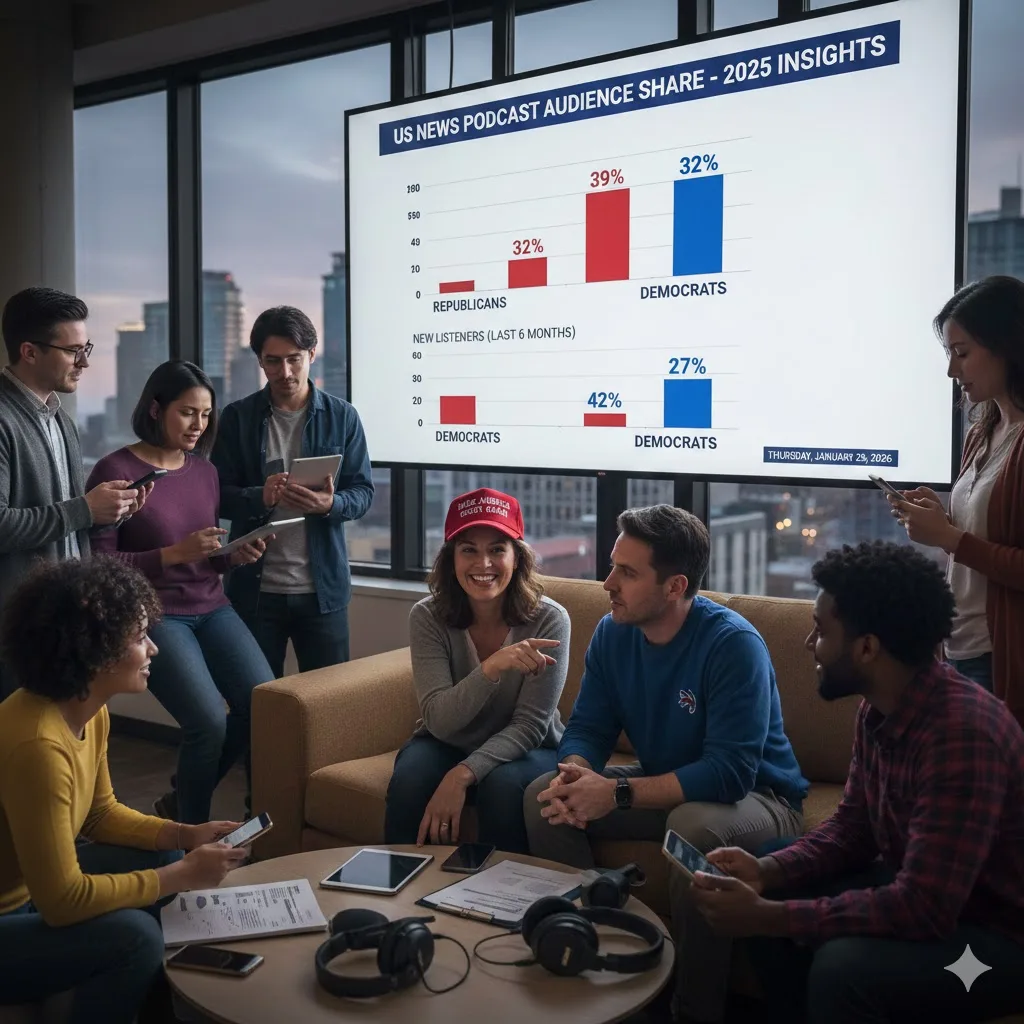
Political and news-oriented podcasts now attract a substantial share of the US audience, with multiple studies indicating rapid growth and high engagement levels. Research by Signal Hill Insights in 2025 reported that Republicans accounted for 39% of the news podcast audience, compared with 32% identifying as Democrats, reflecting a notable shift from earlier years when Democrats formed a larger share.
The same research found that, among people who had started consuming podcasts within the last six months, 42% of the news podcast audience identified as Republican and 27% as Democrat, suggesting recent growth skewed towards Republican‑leaning listeners.
Industry analysis from Triton Digital of the US podcast market in September 2024 indicated that downloads of Democrat‑leaning political podcasts were still roughly twice those of Republican‑leaning shows, even as Republican‑oriented programmes increased their share of total political podcast downloads from 23% to 28% year‑on‑year.
Democrat‑leaning podcasts in that ranking saw their portion of political downloads edge down from 58% to 56% over the same period. Triton’s demographic profile described political podcast audiences as older, highly educated and more affluent than the general adult population.
YouGov profiling released in December 2025 reported that 31% of US adults listened to podcasts at least once a week over the previous year, with weekly listening in the past month rising to 37%. The survey found that 42% of Democrats and 35% of Republicans had listened to podcasts weekly in the past year, underlining the medium’s reach across partisan lines.
Among weekly listeners, 39% said they always vote in elections, compared with a lower share in the general population, pointing to a politically engaged podcast audience.
Campaigns turn to podcasts as key outreach channel
Campaign consultants and polling firms have highlighted how podcast appearances featured prominently in the 2024 presidential race, influencing voter exposure and campaign strategy. Polling from podcast agency Voxtopica and Signal Hill Insights, reported by the specialist outlet Campaigns & Elections in October 2025, suggested that podcasts played what it called a “pivotal” role in shaping the last presidential contest.
That polling found that 54% of 18‑ to 34‑year‑olds who said podcasts influenced their 2024 vote backed Donald Trump, compared with 43% who voted for Kamala Harris.
The same survey reported that among Black voters who said they were influenced by podcasts, 29% supported Trump, compared with about 13% of Black voters who backed him nationally according to exit polling cited in the analysis. Voxtopica and Signal Hill Insights’ data showed that 76% of respondents said they paid “some” or “a great deal” of attention to politicians when they appeared on podcasts, a level roughly comparable to attention paid to television appearances.
Among Black and Hispanic respondents, 88% and 84% respectively said they paid at least some attention to politicians on podcasts.
During the 2024 campaign, President Trump appeared on several popular podcasts with large audiences, including shows such as “This Past Weekend with Theo Von” and “The Joe Rogan Experience,” which have significant followings among younger and male listeners.
Then‑Vice President Kamala Harris took part in an episode of “Call Her Daddy,” a podcast hosted by Alex Cooper that has built a large female audience. Public‑radio reporting in mid‑2025 noted that, even in an off‑election year, senior politicians continued to schedule podcast interviews, describing such shows as a “must‑stop” on the political circuit.
New media influencers gain formal role in political coverage
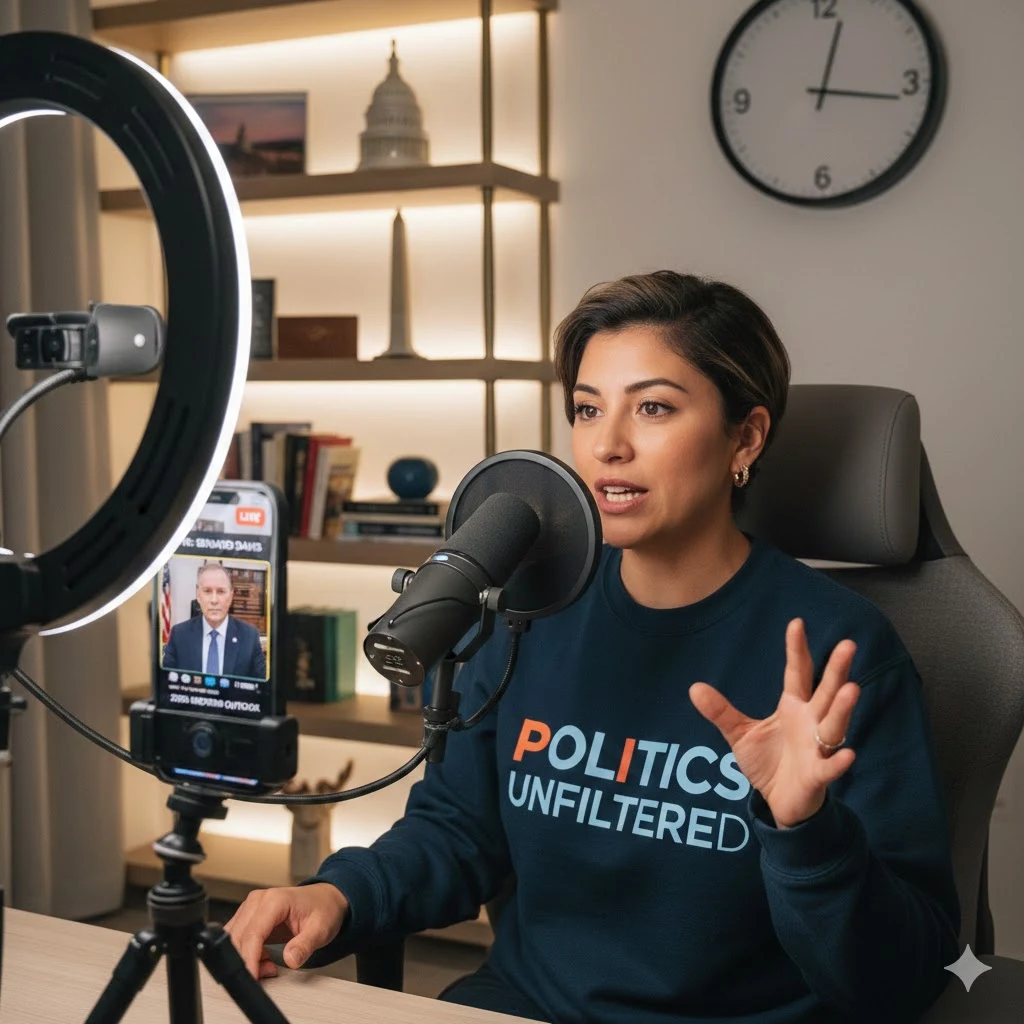
Beyond audio, social media creators operating on video and short‑form platforms have acquired a formal role in covering political events linked to Washington. A Pew Research Center survey, reported in November 2024, found that about 21% of US adults said they get their news from social media influencers, defined as content creators who present news‑related information to followers.
According to that report, influencers hosted interviews with candidates and political figures throughout the 2024 election cycle, generating hundreds of millions of views.
The Democratic National Convention in Chicago in 2024 accredited around 200 social media content creators across four days, making it, according to the Pew‑based reporting, the first convention to provide that scale of access to such figures. The Republican National Convention in Milwaukee accredited more than 70 influencers as part of a similar initiative.
The same coverage noted that some of these creators discussed topics including Project 2025, described as a conservative policy framework developed by the Heritage Foundation to prepare for a future Republican administration.
During Trump’s 2024 victory celebration, social media personalities such as Adin Ross and the hosts of “Bussin’ With the Boys” were publicly acknowledged on stage by Ultimate Fighting Championship President Dana White, illustrating the visibility of online figures within campaign‑adjacent events.
After the election, the Pew report said that discussions on the political left focused on how to better connect with younger voters via online spaces, with some commentators advocating the development of left‑leaning podcast and influencer ecosystems comparable to prominent right‑leaning shows.
Public concern rises over social media’s political power
The growth of new media’s political role has been accompanied by rising public concern about the influence of large platforms. A Pew Research study reported in April 2024 found that 78% of American adults believed social media companies wield too much political power and influence, up from 72% in a similar survey four years earlier.
The findings showed apprehension across party lines, with 84% of Republicans and 74% of Democrats saying the companies had too much political influence.
The same report said 64% of respondents viewed social media’s overall impact on US politics as mostly negative, while 10% described it as mostly positive. Within those numbers, 59% of Democrats and 71% of Republicans said social media’s impact was negative, with Republicans somewhat less negative than in 2020 but still highly critical.
Pew’s analysis noted that 93% of Republican respondents believed social media firms were censoring political viewpoints they disagreed with, compared with 74% of Democrats, up from 66% in a previous survey.
The article linked several factors to the change in views among Democrats, including debates over content moderation around the Israel‑Gaza conflict and reactions to Elon Musk’s acquisition and rebranding of Twitter as X, which some left‑leaning users associated with increased prominence for right‑wing voices. The report added that some Democratic‑leaning users were exploring alternative platforms such as Threads and Bluesky during this period.
Journalists and academics reassess media influence on politics
Academic and professional commentary has underscored how the rise of social media and podcasts is reshaping journalistic practice around Washington. A 2024 article from the University of Oregon’s School of Journalism and Communication on media influence in the 2024 election quoted experts saying political journalists increasingly use X to monitor voter opinion, even though a relatively small proportion of Americans say they regularly get news from the platform.
One scholar noted that this reliance can lead reporters to focus on a “skewed representation” of public opinion, since politically active users on X are not representative of the broader electorate.
The same analysis highlighted the shift of political advertising from traditional television to digital platforms such as YouTube, Instagram and TikTok, where candidates can target specific demographic groups more precisely. A media scholar quoted in the piece stated that social media had become an “important stage” for the political process, allowing politicians to present themselves in more personal ways to voters.
The article catalogued several 2024 trends including news fatigue, mis‑ and disinformation, and changes in polling, framing them as part of a wider transformation of the media environment.
Campaigns and Elections’ reporting on podcast polling similarly emphasised that audiences who listen to political podcasts tend to pay considerable attention to political content delivered through that medium.
In its summary of Voxtopica and Signal Hill Insights’ findings, the outlet reported that more than eight in ten respondents said hearing views they disagree with on a podcast did not affect their opinion of the advertisers appearing on that programme. Half of respondents said they had a more positive opinion of candidate adverts placed on podcasts than on other media.
Shifts in partisan balance and audience composition
Multiple datasets suggest that the partisan balance within podcast audiences is evolving. Signal Hill Insights’ 2025 update described a “flip‑flop” from the previous year: in late 2024, 44% of new entrants to the news podcast audience identified as Democrats and 26% as Republicans, while in 2025, 42% of new news‑podcast consumers identified as Republicans and 27% as Democrats.
The firm attributed the shift to demographic change among new podcast users, noting that long‑standing podcast listeners remained more likely to identify as Democrats.
At the same time, Triton Digital’s 2024 political podcast ranker showed that Democrat‑leaning shows continued to account for the majority of downloads, and also reported that Democrat‑leaning podcasts had the highest proportion of Black or African American listeners among the three political categories it tracked.
According to that dataset, about 17.4% of the audience for Democrat‑leaning political podcasts identified as Black or African American, while Republican‑leaning podcasts had the highest share of White or Caucasian listeners at 89.9%. The report added that, across all three categories, political podcast audiences were more affluent and more educated than the national adult population.
YouGov’s December 2025 findings underscored that podcasts are now part of the wider information diet for a significant slice of the electorate, noting that roughly a third of US adults listened weekly within the past year and that weekly listeners reported higher rates of consistent voting behaviour. Those figures are seen by media researchers as evidence that podcast audiences constitute a politically active cohort within the overall media landscape.
Expanded role of influencers around Washington politics
Pew’s November 2024 survey on news influencers indicated that the reach of social media content creators now extends into formally organised political events and campaign strategy discussions in and around Washington. The study reported that 21% of US adults received news at least sometimes from social media influencers, with usage particularly high among younger demographics.
It noted that during the 2024 presidential campaign, both major parties integrated influencers into their outreach plans, with hundreds of creators credentialled for party conventions and invited to produce content from the venues.
According to the same report, the integration of influencers included long‑form podcasters and short‑form video creators who conducted interviews with candidates and political figures. These segments covered policy themes, campaign narratives and controversies, generating what the report described as “hundreds of millions” of views across platforms.
The document also recorded that, after the election, there was active debate within Democratic circles about how to develop more robust influencer and podcast strategies to connect with younger voters in future cycles.
Taken together, the survey data, academic studies and industry reports describe a transformed media environment in which podcasts, social media influencers and other new digital platforms have become entrenched parts of the political communications infrastructure that surrounds Washington. These sources depict changes in how campaigns allocate their time and advertising budgets, how journalists monitor political discourse, and how voters encounter information about national politics.