
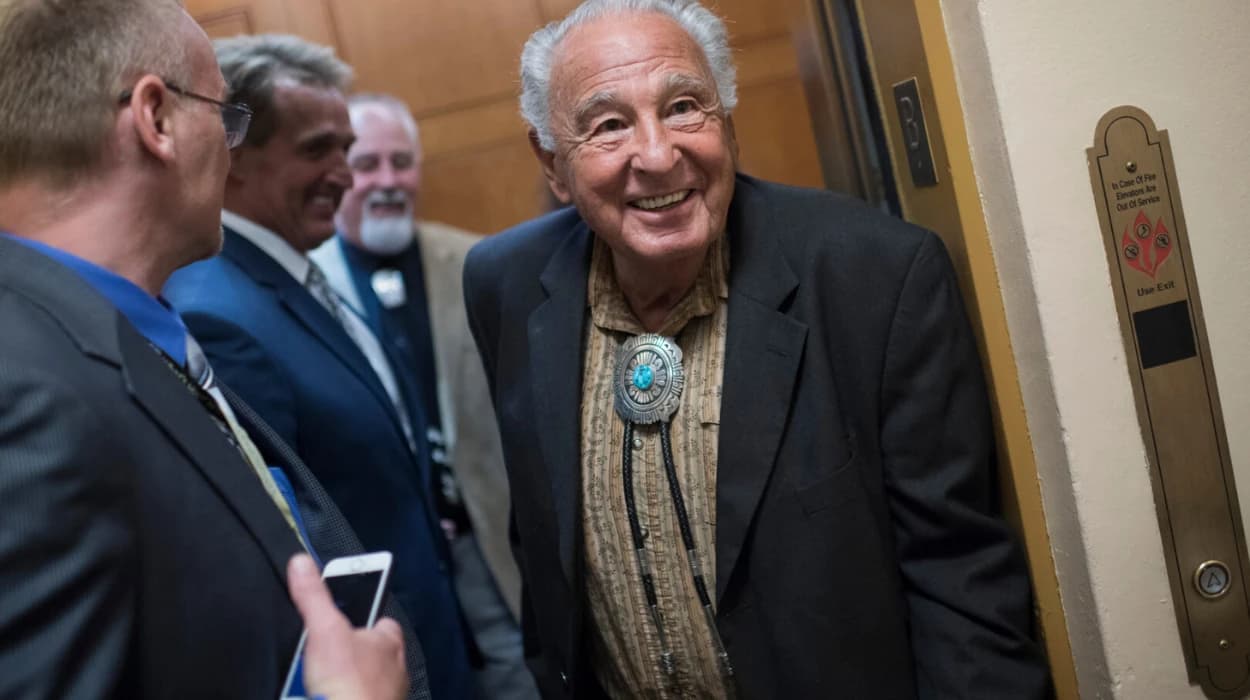
- Ben Nighthorse Campbell died at age 92.
- Former US senator from Colorado.
- Also served as US representative.
Shanan Campbell, Campbell's daughter, told The Associated Press that Campbell passed away from natural causes while surrounded by his family.
Campbell, a Democrat who shocked his party by switching to the Republican Party, was notable in Congress not just for his unusual attire (cowboy boots, bolo ties, and ponytail) but also for his support of organized labor, children's rights, and fiscal conservatism.
Campbell, a member of the Northern Cheyenne tribe, claimed that on November 29, 1864, US soldiers slaughtered around 150 Native Americans mostly women, children, and older men while they were camped under a flag of truce. The Great Sand Dunes National Monument in southern Colorado, the site of the massacre, was upgraded to a national park thanks to legislation he sponsored.
“He was a master jeweler with a reputation far beyond the boundaries of Colorado,”
said Colorado Sen. John Hickenlooper on X.
“I will not forget his acts of kindness. He will be sorely missed.”
Even before he abruptly joined the Republican Party in March 1995, furious with Democrats for rejecting a balanced-budget amendment in the Senate, the motorcycle-riding congressman and cattle rancher was regarded as a maverick. His decision infuriated Democratic leaders and was seen as a GOP coup.
Campbell, who was thought to be a lock to serve a third term in the Senate, shocked his fans by withdrawing from the contest in 2004 due to a health risk.
“I thought it was a heart attack. It wasn’t,”
said Campbell.
“But when I was lying on that table in the hospital looking up at all those doctors’ faces, I decided then, ‘Do I really need to do this six more years after I’ve been gone so much from home?’ I have two children I didn’t get to see grow up, quite frankly.”
He retired to concentrate on the Native American jewelry that contributed to his wealth and was exhibited at the National Museum of the American Indian at the Smithsonian Institution. Additionally, he worked on a range of outdoor equipment for Kiva Designs, a California-based business.
Ben Nighthorse Consultants, which Campbell formed, concentrated on federal policy, including natural resources and Native American issues. Additionally, on multiple occasions, the former senator drove the Capitol Christmas Tree across the nation to Washington, DC.
“He was truly one of a kind, and I am thinking of his family in the wake of his loss,”
said Colorado Rep. Diana DeGette on X.
He intended to ship his jewelry to California in 1982, but inclement weather caused his plane to be grounded. While passing the time in Durango, a city in southern Colorado, he attended a county Democratic convention and ended up speaking for a buddy who was running for sheriff.
During the conference, Democrats expressed interest in Campbell as a potential opponent for a GOP legislative candidate. He remarked,
"I was hooked like a fish."
Campbell remembered that Don Whalen, his opponent, was a well-liked former college president who "looked like he was out of a Brooks Brothers catalog."
"I don't believe anyone offered me a chance at all. I simply believe that I put a lot of effort into disproving them.”
Campbell set out on the streets, tearing town maps from the Yellow Pages and going door to door to strike up conversations. He remembered leaving a note at a Cortez home that was deserted when he heard a car slam into the driveway, its brakes shrieking and gravel flying.
With a tire iron in hand, the driver leaped out and yelled that Campbell was not allowed to take his furniture. The man questioned,
"Aren't you the repossession company?"
Campbell was born in Auburn, California, on April 13, 1933. He completed his bachelor's degree at San Jose State University in 1957 after serving in the Air Force in Korea from 1951 to 1953. He earned a gold medal in the Pan American Games, captained the US judo team at the 1964 Olympics, and studied at Meiji University in Tokyo from 1960 to 1964.
In order to respect the water rights of the Southern Ute and Ute Mountain Ute tribes, Campbell once referred to then-Interior Secretary Bruce Babbitt as a "forked-tongued snake" for opposing a water project close to the town of Ignacio in southern Colorado.
He disagreed with environmentalists on a wide range of issues, including national monument designation, grazing regulations, and mining laws.
Voters adored him in spite of all of this, or maybe because of it. Despite switching to the GOP, Campbell defeated Democrat Dottie Lamm, the wife of former Governor Dick Lamm, to win reelection to the Senate in 1998. At the time, he was the only Native American serving in the Senate.
He claimed that after switching parties, he was ridiculed by several newspapers and chastised as a Democrat for voting with Republicans.
“It didn’t change me. I didn’t change my voting record. For instance, I had a sterling voting record as a Democrat on labor. I still do as a Republican. And on minorities and women’s issues,”
he said.
Campbell claimed that his life had formed his ideals, which are liberal on social matters and conservative on financial ones. He was passionate about children's causes because, when his mother had illness and his father was incarcerated, he and his sister lived in an orphanage.
He supported organized labor since he was able to leave the California tomato fields by joining the Teamsters and learning how to drive a truck. He became an advocate for law enforcement during his tenure as a Sacramento County sheriff's deputy in California in the late 1960s and early 1970s.
According to Campbell, his decision to step down from politics was unrelated to claims that his former chief of staff, Ginnie Kontnik, asked another employee for a bribe and that his office pushed for a contract for a technology business connected to the former senator.
He referred the Senate Ethics Committee to both issues. Kontnik entered a guilty plea to a federal allegation of failing to disclose $2,000 in income in 2007.
“I guess there was some disappointment”
with those charges, Campbell said.
“But a lot of things happen in Washington that disappoint you. You just have to get over them because every day there’s a new crisis to deal with.”
How did his party switch in 1995 affect his career?
Ben Nighthorse Campbell's switch from Democrat to Republican in April 1995 boosted his Senate re-election prospects in conservative Colorado but strained some bipartisan connections and drew intraparty dubitation.
The move aligned him with the GOP's 1994" Contract with America" surge, securing easy renomination and palm over Democrat Tim Wirth by 13 points; as a counterculturist, it amplified his influence on Native issues via Senate Indian Affairs Committee chairmanship under Democratic majorities.
Egalitarians labeled it opportunistic amid his balanced- budget correction frustration, going side-ties, while some Republicans eyed him warily as a former Democrat; he retired in 2005 freely, conserving his heritage unscathed by primary challenges.