
- Five Stanford students charged in felony trial.
- Accused over Gaza protest activities.
- Face serious criminal charges now.
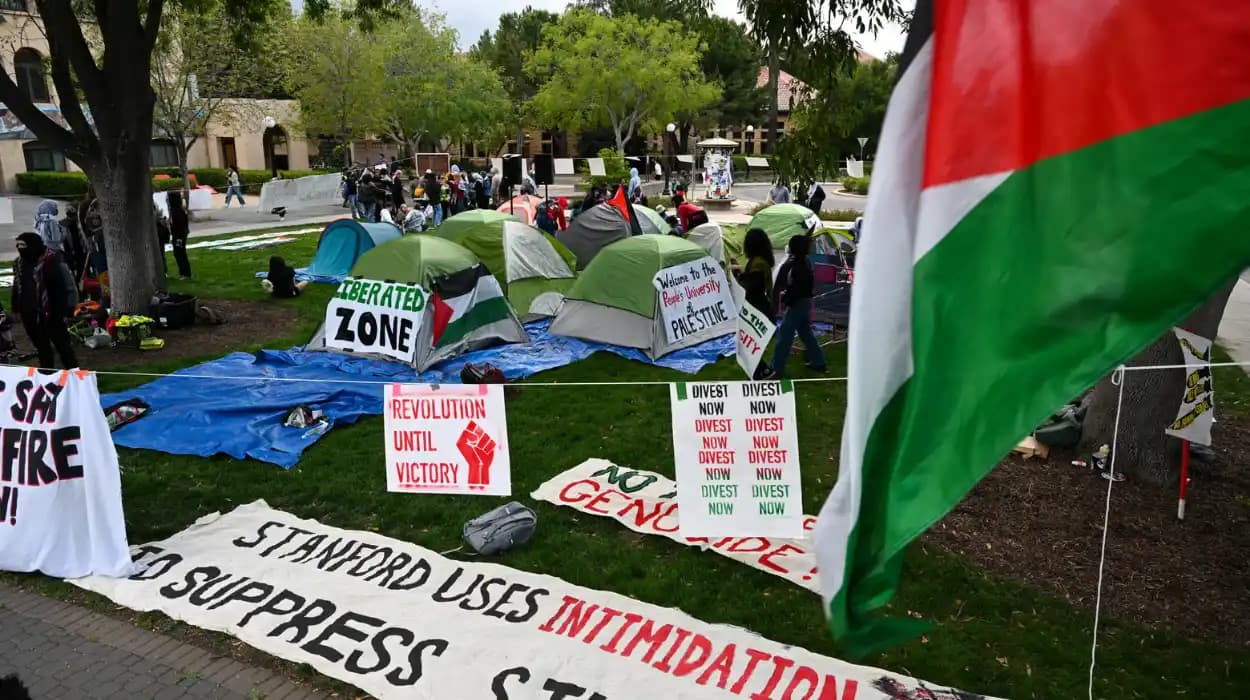
Following an hour-long occupation of the university president's office in June 2024, the twelve northern California students were charged with felony conspiracy to trespass and felony mischief. In addition to demanding that Stanford take into consideration a student resolution to divest from Israel, the group barricaded itself inside the president's office throughout the occupation.
Following similar actions at other US universities, the students in question unofficially renamed the building after Adnan al-Bursh, a Palestinian surgeon who was allegedly tortured to death while in Israeli captivity.
The students were banned and prohibited from campus for two terms after their arrest until an internal disciplinary procedure found that they had violated university regulations.
Then, in April 2025, almost a year after the demonstration, Jeff Rosen, the district attorney for Santa Clara County, announced criminal charges against the group amid a wave of prestigious US universities facing funding cuts from the Trump administration over allegations of failing to take action against antisemitism on campus.
At a press conference, Rosen declared “dissent is American, vandalism is criminal”, adding:
“What the defendants chanted as they went about those plans is legally irrelevant … Pouring invective on to social media is not against the law; pouring fake blood all over someone else’s workplace is.”
A spokesperson for Stanford referred questions about the trial to Rosen’s office.
“We believe the decision on how to proceed with the criminal cases rests with the Santa Clara county district attorney’s office based on the evidence gathered,”
the spokesperson said.
“We respect their decisions in this matter.”
Rosen’s office declined to comment on the timing of the charges and their unique severity.
“As we continue with this trial, we are solely concerned with and focused on the criminal allegations faced by the defendants,” a
spokesperson for the office said.
“It would be both unethical and unfair for us to try to prosecute our case through your story.”
Several of the students who were initially charged accepted pre-trial plea agreements or other diversionary options, and one of them cooperated with authorities and was not indicted.
Two of the five, who have entered not guilty pleas and are on trial at the Clara County Superior Court in San Jose, stated in an interview that they are trying to maintain the focus on Palestinians and what they see as "Stanford's complicity with Israel's genocide."
“It is ridiculous for me or for any of us co-defendants to be accused of property damage,”
said German Gonzalez, who was a sophomore at Stanford at the time of the protest.
“This is all just a distraction from the very real property destruction and crimes that are occurring in Gaza every day because of Stanford University’s investments and actions.”
Due to their participation in the civil riot that broke out in the spring of 2024, numerous scholars were arrested, and numerous were suspended or expelled from their universities.
However, those cases have been withdrawn due to the maturity of individuals who were also charged with crimes. Numerous researchers who had taken over a lot structure in April 2024 and formally renamed it in honor of Hind Rajab, a six-year-old girl who was abducted by Israeli dogfaces while vying for support, were not charged by New York prosecutors.
Dana Nessel, the attorney general of Michigan, dropped the charges against seven protesters who were held at a University of Michigan encampment. Her extensive ties to university regents were disclosed, necessitating her prosecution.
Additionally, the prosecutors in Los Angeles did not file charges against the majority of students detained in connection with protests at two other universities.
The Stanford gang is the only group to be charged with felonies, which are more serious violations than the misdemeanors protesters are typically charged with, and they are among the first to go to trial.
If proven guilty, they may spend more than three years in prison. The students contend that the university's demands for hundreds of thousands of dollars in compensation for alleged damage to the building during the demonstration are "completely overinflated." During the press conference outlining the claims, Rosen displayed images of a broken door frame and fake blood on documents.
Gonzalez stated that the students claimed they had already received punishment when the university suspended them from school "faster than it suspended Brock Turner," a Stanford student found guilty of sexual assault in 2016.
Gonzalez claimed that while the university demanded $329,000 in compensation from the group, which was" ten times" his family's monthly income, Gonzalez and others were forced to sleep in motorcars or in teams' lounges. He questioned Rosen's provocations, citing a September 2023 visit to the Bay Area by Israeli Prime Minister Benjamin Netanyahu, during which Rosen entered him on the field tarmac. He described the ongoing execution and its inflexibility as politically motivated and" cruel."
“It’s meant as a deterrent for future protesters,”
Gonzalez said of the prosecution.
“To say that if you decide to stand up against genocide, apartheid, illegal occupation, and continued violations of international law, then you will be punished, and you will be punished as severely as you possibly can.”
Zhai, the other defendant, claimed that because of the accusations, pro-Palestinian academics used to be reluctant to voice their opinions in class. However, individuals attending the trial, which is expected to last five weeks, will have an opportunity to discuss their ongoing assessment of Stanford, particularly its cooperation with US armaments manufacturer Lockheed Martin.
The court denied the execution's attempt to prevent the academics from discussing "genocide," the political motivations behind the protest, and free speech initiatives in pre-trial proceedings.
Nevertheless, prosecutors were able to assist the defendants in refusing to have a global mortal rights expert swear and in utilizing the first rectification as a defense.
“Our case is just one of many examples of what people have already called the Palestine effect,”
said Gonzalez.
“One of many examples of the system being stretched to its absolute limit to ensure that we receive the harshest punishment not for what we’ve done, but for what we think.”
What pretrial motions were raised in December hearings?
In December 2025 pretrial sounds for the Stanford 5 felony trial, defense movements centered on banning" genocide" language from substantiation and dismissing charges over alleged political provocations and substantiation importunity.
Attorneys sought to suppress kick footage containing" genocide" chants, arguing seditious language unconnected to vandalization/ conspiracy charges; they also moved to qualify substantiation from a cooperating substantiation, claiming compulsion, and challenged grand jury proceedings as widely prosecutorial amid public lot kick scrutiny.
Judge Eric Geffon denied most motions but limited certain expressions' prejudicial use, allowed the substantiation evidence withcross-examination safeguards, and upheld charge validity; these opinions set stage for January 6, 2026 trial start with over to six times exposure per defendant.