
- Ukraine’s
General Staff reports Russian losses reach 880,000 killed/wounded as of
Jan 31, with 1,880 personnel lost in past 24 hours across all fronts. - Ukrainian
forces destroyed 20 Russian artillery systems including 2S19 Msta-S
howitzers, plus 1,200 projectiles during intense Donetsk Oblast combat. - 52
Russian strike drones (Lancet, Shahed) and 37 armoured vehicles (T-72s,
BMP-2s) eliminated through air defence, Javelin strikes and FPV drones. - Heavy
fighting concentrated on Pokrovsk, Kurakhove axes; Moscow commits fresh
battalions but suffers disproportionate casualties in assaults. - Western
aid (HIMARS, F-16s, artillery shells) sustains Kyiv’s defences; Russia
faces recruitment challenges amid unsustainable monthly loss rates.
Kyiv (Washington Insider Magazine) January 31, 2026 – The
General Staff of Ukraine’s Armed Forces reported that Russian troop losses
reached 880,000 soldiers killed or wounded as of January 31, with 1,880
personnel eliminated in the previous 24 hours. Ukrainian military sources also
documented the destruction of 20 artillery systems alongside 1,200 projectiles,
52 drones and 37 armoured vehicles during intense frontline combat operations.
Moscow has not issued official casualty figures, while Western assessments
continue to track cumulative Russian losses across multiple fronts.
Ukrainian battlefield updates detailed sustained Russian assaults
across eastern and southern fronts, where Moscow’s forces sustained heavy
casualties while attempting positional advances. Kyiv’s forces reported
successful defensive operations that inflicted disproportionate losses,
destroying significant enemy materiel including Russian 2S19 Msta-S
self-propelled howitzers and electronic warfare stations.
The daily tally reflects ongoing attrition warfare patterns
observed throughout the conflict’s third year.
Ukrainian General Staff Documents Record Daily Losses
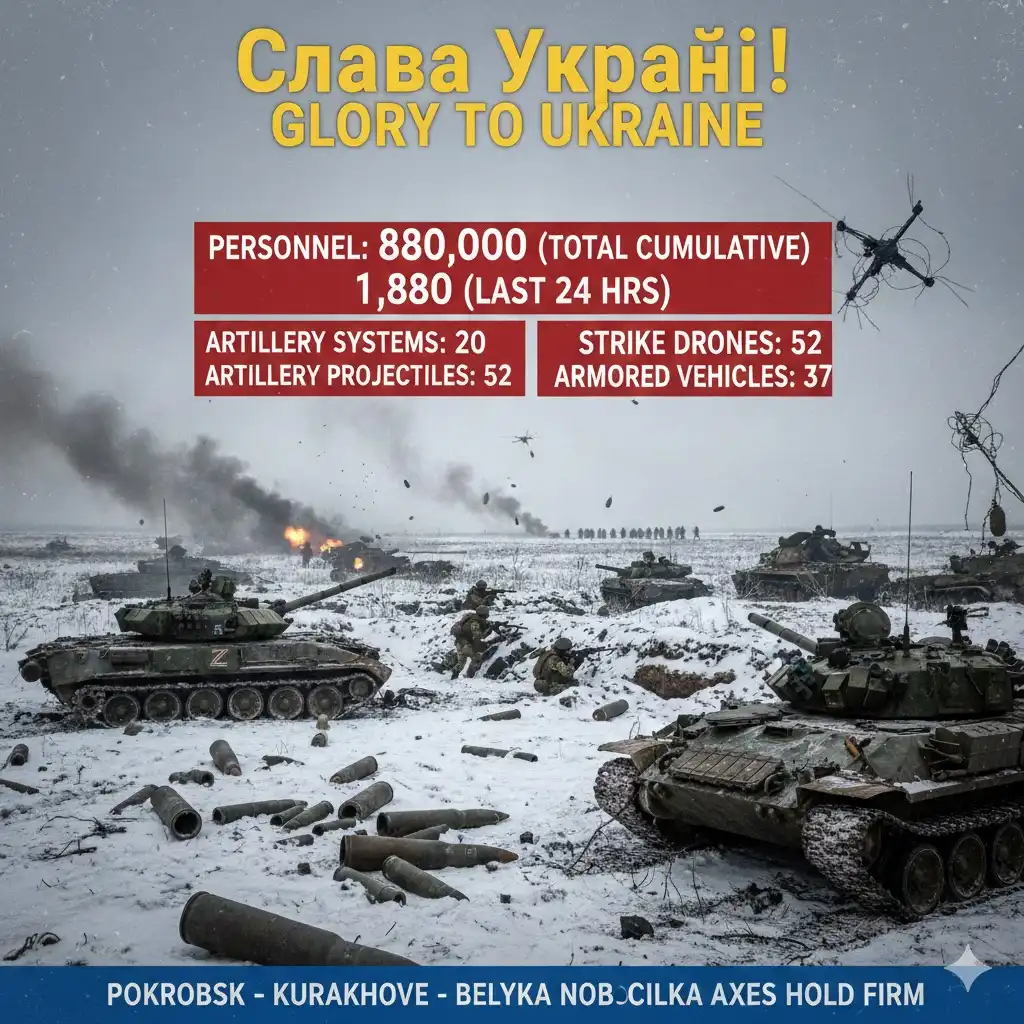
The Ukrainian General Staff’s daily update specified that
Russian forces lost 1,880 soldiers over the past day, contributing to the
cumulative total of 880,000 irreversibly lost personnel since February 2022.
This figure encompasses both killed in action and those wounded beyond return
to combat duties, according to Kyiv’s methodology.
Additional equipment losses included 20 artillery systems,
comprising towed guns and self-propelled units actively supporting Russian
assaults. Ukrainian forces reported destroying 1,200 artillery projectiles,
significantly degrading Moscow’s capacity to conduct sustained bombardments.
The tally also documented 52 strike drones and 37 armoured fighting vehicles
eliminated through defensive counteractions.
Frontline reports indicated intensified Russian activity
around Pokrovsk, Kurakhove and Velyka Novosilka axes, where Ukrainian units
repelled multiple mechanised assaults. Russian forces employed small infantry
groups supported by drones and artillery, suffering heavy casualties during
approach phases before reaching Ukrainian positions.
Russian Artillery Systems Suffer Major Setback
Among the 20 destroyed artillery systems, Ukrainian drone
operators targeted several advanced Russian platforms including the 2S19 Msta-S
152mm self-propelled howitzers and 2S1 Gvozdika systems. These losses occurred
during counter-battery operations conducted by Ukraine’s artillery units and
FPV drone teams operating in Donetsk Oblast.
The destruction of 1,200 artillery projectiles represents a
significant blow to Russian fire support capabilities, as these munitions
sustain Moscow’s signature tactic of preparatory barrages before infantry
assaults. Ukrainian sources credited improved counter-battery radar systems and
loitering munitions for achieving these results.
Western-supplied systems including American M109 Paladin
howitzers and British AS90 tracked guns supported Ukraine’s artillery response,
maintaining favourable fire ratios despite ammunition constraints. The General
Staff emphasised that Russian artillery losses have accelerated since the
arrival of additional NATO-standard platforms.
Drone Warfare Escalates on Multiple Fronts
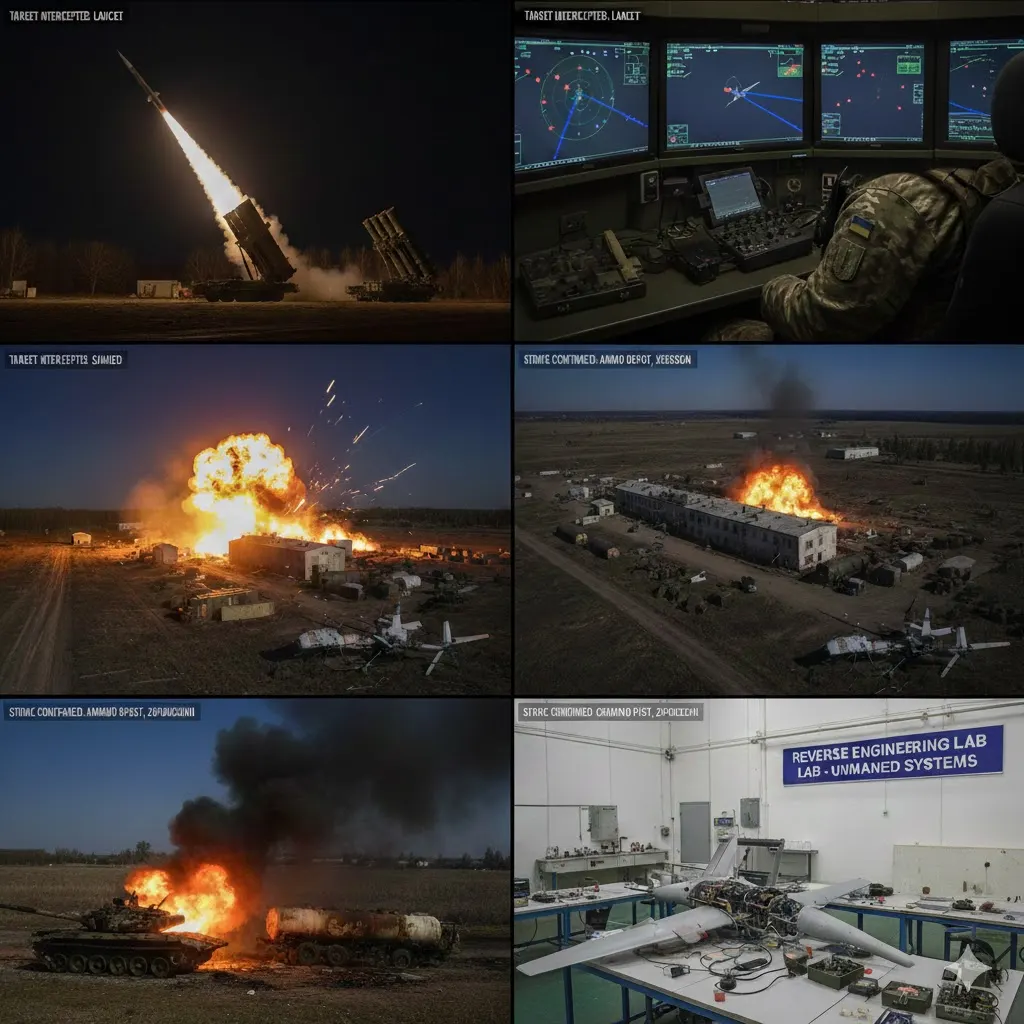
Russian forces lost 52 strike drones over the reporting
period, primarily Lancet and Shahed-type platforms intercepted during approach
to Ukrainian positions. Ukrainian air defence units, equipped with
Western-supplied Patriot and NASAMS systems, achieved high interception rates
while FPV interceptors neutralised low-altitude threats.
Ukrainian drone strikes meanwhile penetrated deep into
Russian rear areas, targeting ammunition depots, command posts and logistics
nodes. Reports confirmed hits on Russian positions in occupied Kherson and
Zaporizhzhia oblasts, where drone-delivered munitions destroyed armoured
vehicles and fuel storage.
The mutual escalation in drone usage reflects both sides’ increasing
reliance on unmanned systems to reduce personnel exposure while maintaining
offensive pressure. Ukraine reported capturing several downed Russian drones
for reverse-engineering purposes.
Armoured Vehicle Losses Reflect Intense Mechanised Combat
The destruction of 37 Russian armoured vehicles included
T-72B3 and T-80BV main battle tanks, BMP-2 infantry fighting vehicles and MT-LB
multi-purpose carriers. These losses occurred during failed assaults on
fortified Ukrainian positions near key Donetsk population centres.
Ukrainian tank hunters operating Soviet-era platforms
alongside Western-supplied Abrams and Challenger 2 tanks achieved multiple tank
kills using Javelin anti-tank missiles and drone-dropped grenades. The
engagements demonstrated Kyiv’s continued effectiveness in anti-armour warfare
despite numerical disadvantages.
Russian forces committed fresh mechanised units from rear
staging areas, only to encounter pre-planned Ukrainian kill zones featuring
mines, remote-controlled machine guns and artillery spotters. Survivors
withdrew under covering fire, abandoning damaged vehicles.
Eastern Front Remains Epicentre of Heavy Fighting
Pokrovsk direction saw the highest concentration of Russian
assaults, with Moscow committing up to six battalions in rotation against
Ukrainian defences. Ukrainian 110th Separate Mechanised Brigade reported
repelling 28 attacks, destroying 12 Russian tanks and eliminating over 400
enemy infantry.
Kurakhove axis experienced similar intensity, where Russian
airborne troops attempted penetration toward Dnipropetrovsk Oblast borders.
Ukrainian 72nd Mechanised Brigade’s drone company achieved 18 confirmed vehicle
kills, including three rare Russian BMPT Terminator support vehicles.
Velyka Novosilka sector remained active with Russian marines
probing Ukrainian lines near Staromayorske and Urozhaine. Kyiv’s forces
maintained cohesive defences, using terrain advantages to channel attackers
into pre-sighted artillery zones.
Southern Front Sees Sustained Positional Combat
Kherson Oblast bridgehead operations continued with Russian
forces attempting to expand lodgements on left bank Dnieper River positions.
Ukrainian missile and artillery strikes targeted Russian pontoon crossings and
ammunition stockpiles, contributing to personnel losses.
Zaporizhzhia front featured artillery duels between Russian
58th Combined Arms Army and Ukrainian 128th Mountain Assault Brigade. Ukrainian
forces reported destroying two Russian electronic warfare systems that had
jammed Ukrainian drones for weeks.
Ukrainian GUR special forces conducted cross-river raids,
eliminating Russian observation posts and capturing documents detailing
Moscow’s reinforcement plans. These operations forced Russian units to maintain
high alert levels, increasing vulnerability to artillery strikes.
Cumulative Losses Reflect Three Years of Attrition
The 880,000 total represents approximately 40 per cent
growth since January 2025, when Ukrainian estimates stood at 630,000. Western
intelligence assessments generally align with Kyiv’s figures, though some
analysts project slightly lower numbers accounting for rotations and rear
echelon casualties.
British Ministry of Defence updates have tracked Russian
losses exceeding 900,000 total casualties when including lightly wounded
personnel. US European Command assessments confirm Moscow’s monthly loss rates
averaging 25,000-30,000 personnel across all categories.
Ukrainian methodology excludes Russian mercenaries, North
Korean auxiliaries and irregular forces from main casualty counts, focusing on
contract soldiers and conscripts. Independent verification remains challenging
due to restricted access to combat zones and Russian information controls.
Western Aid Continues Supporting Ukrainian Defences
Recent US security assistance packages totalling $1.2
billion included additional HIMARS launchers, 155mm artillery shells and F-16
maintenance kits. European allies delivered 200,000 155mm rounds through March
US-Europe ammunition initiative.
Denmark transferred 24 F-16 fighters with full munitions
packages, while Netherlands completed Patriot system delivery. UK’s Storm
Shadow missile stocks replenished Ukrainian air-launched cruise missile
inventories.
These deliveries enabled sustained defensive operations
despite Russian numerical advantages in artillery and glide bombs. Ukrainian
forces rationed precision munitions for high-value targets while relying on
contact shells for area suppression.
Russian Reinforcement Challenges Persist
Moscow struggles to replace losses through expanded
recruitment drives offering financial incentives and contract extensions.
Recent decrees lowered minimum conscription age to 18 and extended mobilisation
authority to occupied territories.
North Korean military engineers arrived in Donetsk, tasked
with fortification construction and ammunition handling. Reports indicate Cuban
mercenaries deployed to Kharkiv front, supplementing Russian contract forces.
Russian military bloggers criticised command decisions
committing fresh units into attritional assaults without adequate
reconnaissance or fire support. Internal MoD assessments reportedly project
unsustainable loss rates continuing through 2026.
International Monitoring Tracks Escalating Toll
OSCE special
monitoring mission documented increased ceasefire violations coinciding
with Russian spring offensives. United Nations human rights office verified
over 12,000 civilian casualties since invasion began, predominantly in
government-controlled areas.
International Criminal Court issued arrest warrants for
Russian commanders overseeing assaults on Mariupol and Bakhmut. Human Rights
Watch documented unlawful use of cluster munitions by both sides during 2025
winter campaign.
NATO battle staffs maintained real-time tracking of Russian
force generation capacity, projecting 18-month window before Moscow achieves
equilibrium with Ukrainian-Western capabilities. Warsaw Pact-era equipment
continues forming bulk of Russian armoured losses.
The reported losses underscore grinding positional warfare
characterising Ukraine conflict’s third anniversary, with both sides committing
significant resources to limited territorial gains.