
Summary
- National
Guard troops deployed in US cities for crime, immigration enforcement. - Started
in Los Angeles June 2025, expanded to Washington, D.C. in August. - Plans
to deploy to Chicago, Baltimore, New York, Oakland, and others. - Deployments
face legal challenges over Posse Comitatus Act restrictions.
President Donald Trump is rapidly putting his idea of the
military as an all-powerful instrument for his policy objectives into
practice.
Experts believe it is redefining the role of the world’s
most powerful military and its interaction with the American public. Presidents
have rarely walked this path outside of times of war.
However, other Republicans in Congress, which is where
authorization for such actions is meant to come from, have mostly supported
Trump as he has drastically increased his use of military force.
As he increases plans to send soldiers to New Orleans,
Baltimore, and Chicago, that gives the president a lot of leeway.
“If I were one of those mayors, I’d be glad to have the
help,”
said Sen. Roger Wicker, R-Miss., the chair of the Senate Armed Services
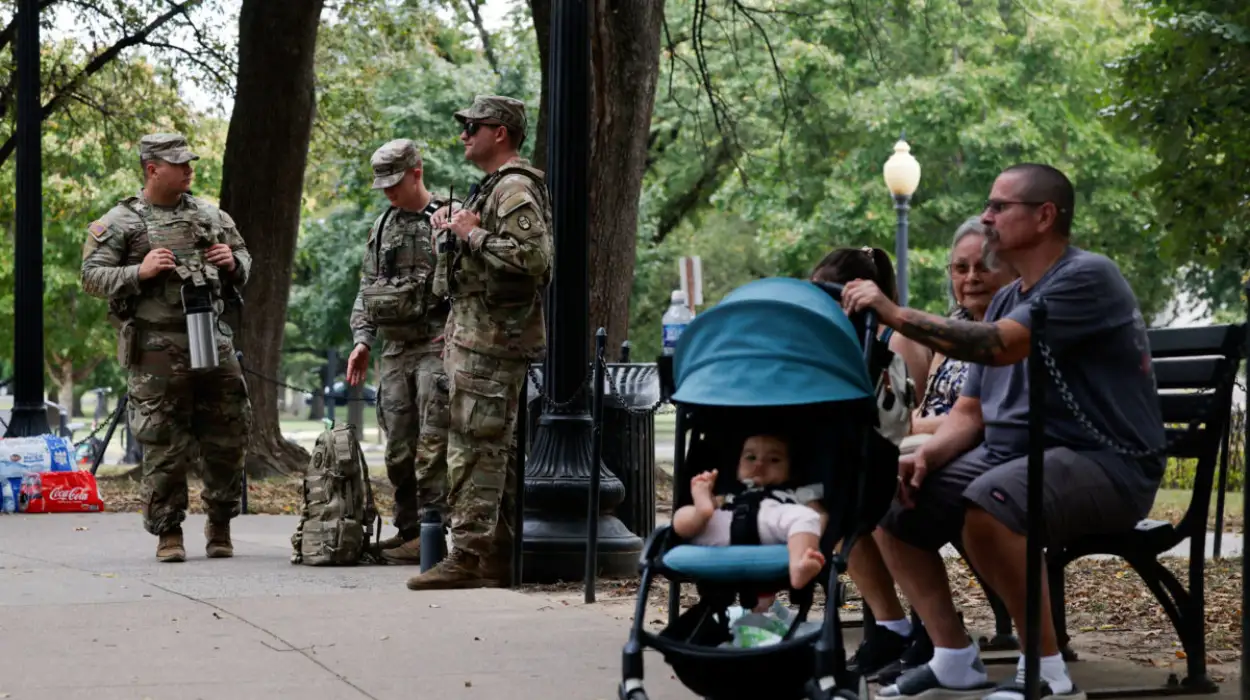
Committee, speaking from a Capitol building where National Guard troops were
patrolling the surrounding city.
“I think the big city Democrats are really
making a mistake. I think they’re being tone deaf.”
Lawmakers from Louisiana, a red state that surrounds
politically blue New Orleans, said it was a great idea for National Guard
troops to go there next.
“New Orleans, like most Democrat-run cities, has a high
crime rate, so it would be helpful,”
House Speaker Mike Johnson, a Louisiana
Republican, told The Associated Press.
Sen. John Kennedy, R-La., agreed:
“We need all the help we
can get. I’m delighted to bring in the National Guard.”
In recent years, Republicans have achieved political success
by concentrating on the problem of crime. According to a recent survey
conducted by the AP-NORC Center for Public Affairs Research, 81% of Americans
believe that crime is a “major problem” in big cities. This includes
over seven out of ten Democrats, almost all Republicans, and around
three-quarters of independents.
Nonetheless, data indicates that crime is declining
nationwide, with some areas recording 30-year lows.
National Guard forces were previously only used on American
land in extreme situations, including natural disasters or when local
authorities were overburdened by disorder or civil disturbance. Presidents have
seldom ever employed the soldiers to enforce the law.
The Pullman strike in Chicago in 1894, the Civil Rights
movement’s efforts to achieve desegregation in the South, and the deadly
rioting in 1992 following police officers’ violent beating of motorist Rodney
King and their acquittal on state charges are all notable examples.
Trump’s crime goal is unique, according to experts, because
he isn’t addressing a specific catastrophe. Instead, Trump is utilizing the
military to carry out his domestic goals, whether that means ordering National
Guard members to be prepared for law enforcement tasks, bolstering military
forces at the U.S.-Mexico border, or deploying military planes for deportation
flights.
“All of these things indicate an administration that is
making a broad, concerted effort to insert the military into civilian law enforcement
in a way and on a scale that has no precedent in American history,”
said Joseph
Nunn, an attorney at the Brennan Center’s Liberty and National Security
Program.
Trump says he has the “right” to send National Guard troops
to the cities, even over the objections of state governors.
“I’m the president of the United States. If I think our
country is in danger — and it is in danger in these cities — I can do it,”
he
said this past week.
In accordance with its constitutional responsibilities, Congress
has established legislation that specifies the conditions under which the
National Guard may be used domestically. However, the Republican-controlled
Congress has done nothing as Trump has pushed the boundaries of those laws.
Rather, any restrictions on Trump’s maximalist approach to the presidency have
been left to the courts.
Following days of protests over immigration raids, a federal
judge last week found that the Trump administration “willfully”
violated the Posse Comitatus Act, a nearly 150-year-old federal law that
restricts the role of the U.S. military in domestic law enforcement, when he
deployed National Guard troops to the Los Angeles area in early June.
According to Andrew Wiest, co-founder of the Center for the
Study of the National Guard at the University of Southern Mississippi, the
authors of the Constitution were attempting to prevent just that kind of usage
of the National Guard.
The fledgling country had recently been through a war of
independence, which was brought on by the British military using the colony as
a police force. As a result, its early leaders were reluctant to provide the
president excessive authority over the military. Since then, presidents have
had considerable authority over the military, which were once state-based
militias.
“This is another one of those pendulum moments where the
Guard will become more federal or maybe it will swing back in the other
direction,”
Wiest said.
“But since the founding of the Republic, it’s been
swinging towards the federal side.”
What legal limits apply to using the National Guard for
local policing?
This law, which dates back to 1878, prohibits the U.S.
military, including federalized National Guard troops, from engaging directly
in civilian law enforcement without express authority from either Congress or
the Constitution; it aims to clearly delineate and separate military functions
from police functions.
National Guard units (not federalized) are able to provide a
legal officer of the law to do tasks like policing and crowd control, assuming
any such authority exists within their home state; generally, governors control
national guard units unless they have been federally activated.
The federal government can call National Guard troops into
federal service (Title 10) subject to the restrictions under the PCA but troops
under a Title 32 status stay under state control but are federally funded and
can provide assistance to law enforcement without violating the PCA.