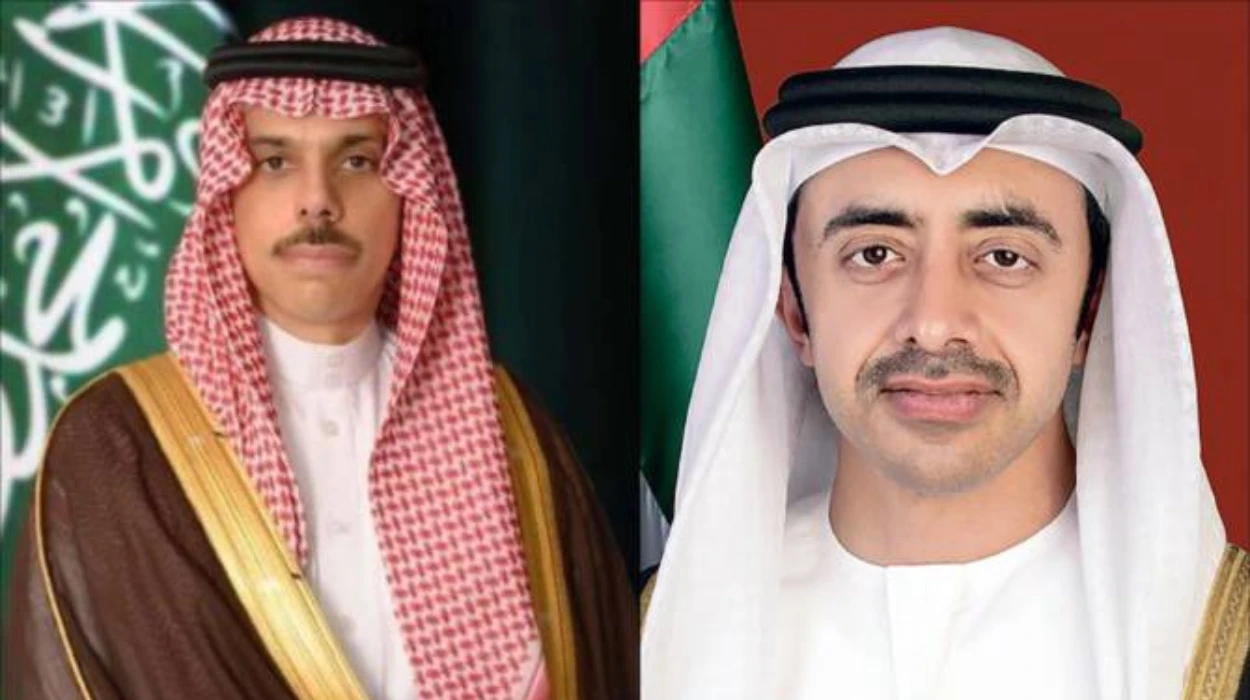

The foreign ministers of Saudi Arabia and the United Arab
Emirates (UAE) held a crucial phone call on Monday, reflecting the deepening
cooperation between the two Gulf powers amid urgent regional and international
challenges. The discussion, which encompassed a range of political, economic,
and security matters, comes at a pivotal moment when the Middle East remains
volatile due to ongoing conflicts and rising geopolitical tensions.
The call was reportedly initiated to strengthen bilateral
coordination and support joint efforts in promoting regional stability. Both
ministers underscored their commitment to working closely in addressing
pressing issues affecting the Gulf Cooperation Council (GCC) countries and the
broader Arab world.
Saudi Arabia’s Foreign Minister emphasized that
“Our nations share a common vision for peace, security,
and prosperity in the region,”
emphasizing the importance of unity in overcoming
challenges. The UAE’s Foreign Minister echoed this sentiment, stating,
“Through dialogue and cooperation, we can confront
threats and pave the way for development and stability.”
Strengthening Bilateral Ties in a Complex Regional Landscape
The relationship between Saudi Arabia and the UAE, two
leading economies and political actors in the Gulf, has evolved significantly
over the past decade. Both countries have invested heavily in joint
initiatives, especially in economic diversification, energy cooperation, and
counterterrorism efforts.
The recent phone conversation reaffirmed their commitment to
enhancing diplomatic ties and working collectively in international forums.
Discussions included coordination on regional conflicts, with particular focus
on Yemen, Lebanon, and the ongoing tensions involving Iran.
In recent years, both Riyadh and Abu Dhabi have taken
prominent roles in shaping the regional security architecture. The ministers
recognized the necessity of maintaining strong responses to regional security
threats, including missile attacks and insurgent activities.
“We stand firm against any actions that threaten the
sovereignty and peace of our nations,”
said the Saudi foreign minister during the call.
Addressing Regional Conflicts and Security Concerns
The call highlighted the mutual concern of Saudi Arabia and
the UAE over destabilizing activities in Yemen, where both countries have been
deeply involved in military and humanitarian efforts. The ministers agreed on
the urgency of a political solution and underscored the need for international
support to bring parties together for lasting peace.
They also touched upon their shared perspectives regarding
Lebanon’s political crisis and the influence of armed groups, noting that
regional interference only deepens the country’s woes. Highlighting their
positions, the UAE minister noted,
“We advocate for sovereignty and non-intervention as
keys to Lebanon’s recovery.”
The Iranian nuclear program and Tehran’s regional influence
were also central topics. The Saudi foreign minister remarked,
“Iran’s activities destabilize the region, and we must
act in concert with international partners to counter these
threats.”
The UAE minister added that diplomatic engagement should be
balanced with firm policies to ensure security and deter aggression.
Economic Cooperation and Trade Enhancement
Beyond security, the call also focused on economic
collaboration between the two Gulf allies. With both countries seeking to
diversify their oil-dependent economies, they discussed strategies to boost
trade, investment, and technological innovation.
Energy cooperation, particularly in renewable resources and
sustainable development, formed an important part of the conversation. The UAE
minister highlighted the shared ambition to lead the region’s green
transformation, saying,
“We aim to set regional standards for clean energy
through joint projects and innovation.”
The ministers also agreed on enhancing trade facilitation
and customs cooperation to increase intra-Gulf trade volumes in line with GCC
economic integration goals. Both sides expressed interest in expanding
partnerships in sectors such as tourism, technology, and infrastructure.
International Implications and Partnership With Global
Powers
Saudi Arabia and the UAE acknowledged the importance of
maintaining robust international partnerships, including with the United
States, Europe, and Asian strategic players. The ministers agreed that
cooperation with these powers is vital for regional peace and economic
progress.
They reviewed their approaches to recent geopolitical
shifts, including major developments in the Israeli-Palestinian conflict, and
the efforts to normalize Arab-Israeli relations under broader peace frameworks.
The Saudi foreign minister remarked cautiously,
“Lasting peace requires fairness and respect for
international law.”
The UAE minister emphasized the importance of diplomacy,
stating that their countries remain open to constructive dialogue with all
global stakeholders, aiming to foster a stable environment that benefits their
citizens and regional neighbors alike.
Humanitarian Initiatives and Regional Stability Efforts
Saudi Arabia and the UAE reiterated their commitment to
humanitarian aid in conflict zones. Particularly focusing on Yemen, the
ministers confirmed ongoing support for relief programs that alleviate
suffering and facilitate reconstruction.
The discussions also covered refugee support and addressing
displacement caused by regional turmoil. The foreign ministers agreed that
stability can only be attained when humanitarian needs are met alongside
political solutions.
The call demonstrated the joint resolve of these Gulf
leaders to act as stabilizing forces in a fractured region. By consolidating
their positions and initiatives, Saudi Arabia and the UAE seek to project
influence that aligns security interests with development and diplomacy.