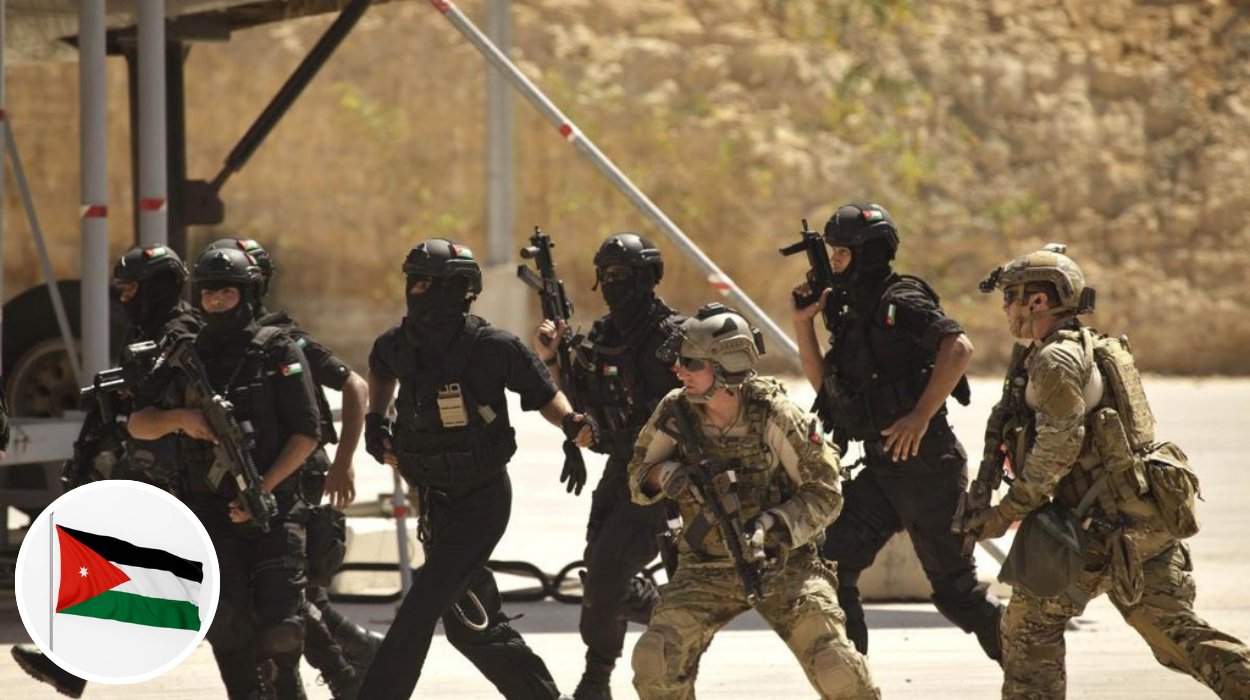

Summary
- The
Jordanian military announced that two armed individuals were killed after
attempting to infiltrate the country’s border from Syria. - The
incident occurred late Thursday night, August 1, 2025, near the
northeastern border area, according to official statements. - Jordanian
authorities described the incident as part of ongoing security challenges
posed by smuggling and militant activity along the Syrian border. - Weapons
were reportedly seized following the confrontation, according to state
media. - The
Jordanian Armed Forces regularly report attempts by armed groups to cross
from Syria, often related to drug or weapons smuggling. - No
statement identifying the nationality of the two deceased individuals has
been released. - The
incident comes amid heightened tensions in the region and ongoing
instability in southern Syria.
The Jordanian Armed Forces reported late Thursday the
deaths of two armed individuals after a foiled infiltration attempt from Syria,
underlining enduring security threats along the kingdom’s northern border. The
event, confirmed by military and government sources to multiple regional media
houses, took place near the northeastern frontier, an area long impacted by
lawlessness and smuggling linked to the Syrian conflict.
What Did the Jordanian Military Say About the Incident?
As reported by Al Jazeera’s newsroom on August 2, 2025,
the Jordanian Armed Forces announced that
“Two armed infiltrators were
killed while attempting to illegally cross the border from Syria into Jordanian
territory.”
Citing official sources, Al Jazeera further noted,
“The
rules of engagement were applied when the group was detected moving into
Jordan. After an exchange of fire, two were killed and others managed to
retreat back into Syrian land.”
This account was mirrored by coverage from
Reuters Arabic, which also quoted military officials confirming the use of
lethal force after the armed group refused to heed calls to surrender.
In its coverage, Jordan’s official state news agency
Petra cited a spokesperson for the General Command of the Army, who
emphasized,
“Jordan remains vigilant against all forms of infiltration and
continues to protect the nation’s security against armed threats from across
the border.”
The spokesperson added that the group was “carrying automatic
weapons” and that a subsequent search of the area led to the recovery of “guns
and other contraband.”
How Often Do Infiltration Attempts Happen on the
Syrian-Jordanian Border?
According to reporting by Salem Soltan for The
National, the Jordanian-Syrian border has witnessed an upsurge in
smuggling attempts since the collapse of government control in southern Syria.
Soltan wrote,
“The area is notorious for being used by drug traffickers and
militants, with Jordan intercepting dozens of armed smugglers over the past
year.”
Citing analysis by security think tanks, the article explains that
“Jordan faces a multifaceted threat ranging from narcotics trafficking,
especially the amphetamine captagon, to infiltration attempts by militants
seeking safe havens or transit routes.”
As noted by Zeina Khodr of Al Jazeera in her previous
analysis, Jordanian officials have repeatedly sounded alarm over the
flow of weapons and drugs from Syria, frequently linking such attempts to
cross-border criminal syndicates with ties to armed groups operating inside
Syria. Khodr wrote:
“Only in the past six months, Jordanian
authorities have reported seizing several large shipments of drugs and weapons,
underscoring a volatile situation along the northern frontier.”
What Security Measures Is Jordan Taking in Response to These
Threats?
According to a dispatch by the Associated Press (AP), Jordan
has reinforced its border with additional troops, armored vehicles, and
advanced surveillance technology. The AP report quotes Defense
Minister Brigadier-General Ahmed Msheibat as saying,
“Our armed forces are
fully prepared and are continuously updating operational tactics to confront
new methods used by smugglers and militants. The security of Jordan and its
citizens is paramount.”
Reporting by The Jordan Times often highlights frequent
military-led raids targeting smuggling routes and “safe houses” on the Syrian
side of the frontier. In an analysis published this year, the paper detailed
Jordan’s joint efforts with regional allies and international agencies to stem
the flow of narcotics and arms.
What Is the Context Behind the Latest Incident?
As noted by Ruth Pollard of Bloomberg, the recent
infiltration attempt comes amid increased volatility in southern Syria, where a
patchwork of armed groups and criminal organizations operate in the security
vacuum left by the fading of state authority. Pollard reports that
“Jordan’s military has warned that the frequency and sophistication of these
cross-border operations has increased in recent months, prompting a strong
response from Amman as it seeks to prevent the spillover of Syria’s crisis.”
The BBC’s Middle East correspondent, Lina Sinjab,
highlighted that
“Jordan’s government has repeatedly cautioned that its
stability is threatened by both extremism and the transnational trade of
illicit drugs flowing from Syria’s war-ravaged south.”
Sinjab also pointed to
recent diplomatic efforts by the Jordanian government to enhance border
cooperation with both Syrian authorities and Russian mediators, but results
remain limited as armed groups exploit the lack of effective control on the
Syrian side.
Were Any Statements Provided by Eyewitnesses or Local
Residents?
According to coverage by Reuters Arabic, local
residents in the Jordanian border town of Rukban described hearing heavy
gunfire late Thursday, followed by a significant movement of military
vehicles toward the border. Speaking to Reuters reporter Suleiman Al-Khalidi,
one resident said,
“We are used to seeing increased military presence in the
area, but last night was more intense than usual.” Another local source added,
“People are worried that the security situation could deteriorate further if
these confrontations become more frequent.”
As of Friday, August 2, 2025, and as relayed by state media
reports collected by Al Jazeera and Reuters, there has been no official
response from the Syrian government regarding the deaths of the alleged
infiltrators. Diplomatic channels between Amman and Damascus remain
strained, with only sporadic security coordination amid competing priorities.
What Have Regional and International Observers Said?
In analysis from Carnegie Middle East Center, regional
security experts warned of the increasing inability of the Syrian state to
control its territory, providing opportunities for drug smugglers and armed
groups to exploit the border. Most analysts predict border incidents
will remain a significant security concern for Jordan, especially as regional
instability persists.
Internationally, as cited in the United Nations’ latest
humanitarian update for the area, cross-border violence and insecurity
have compounded already dire conditions for displaced people and civilians,
with the UN’s Office for the Coordination of Humanitarian Affairs urging all
parties to respect international law and maintain civilian safety.
What Is the Known Identity of Those Killed in the Attempt?
No additional details on the identity or affiliation of the
two armed individuals have been released by Jordanian authorities as of Friday
afternoon. Coverage across all outlets, including Al Jazeera, Reuters Arabic,
and The National, confirms that “the nationalities and possible connections of
the infiltrators are under investigation.”
Reporting by The Jordan Times and coverage from social media
monitored by international news rooms indicate mixed public reactions,
with some praising the military’s swift response, while others voice concerns
over the persistence of smuggling and violence in the impoverished border
regions. According to AP interviews, one commentator on social media wrote,
“The government needs to do more for our border communities who are living on
the front lines of this crisis.”
What Are the Wider Implications for Border Security in the
Region?
According to a joint assessment from the International
Crisis Group and the Middle East Institute, incidents like these
underscore the challenge facing all countries adjacent to Syria, as ongoing
conflict and economic desperation foster networks engaged in illicit
activities. The Jordanian government’s current policy emphasizes
robust border defense and seeks greater international support, including
equipment, intelligence, and joint operations with neighboring states.