
Summary
- Hamas
to demand key ceasefire revisions. - Trump’s
Gaza proposal under review. - Likely
to accept the plan soon. - Plan
seen as negotiation basis.
In order to end the two-year conflict in Gaza and for an
ostensibly prolonged international administration of the destroyed territory,
Trump gave Hamas “three or four days” starting Tuesday to respond to
his 20-point plan, or “pay in hell.”
Hamas must now “choose between the bad and the
worst,” according to Gaza political scientist Mkhaimar Abusada, who is
based in Cairo.
“If they say ‘no’, as Trump has made clear, that will not be
good and will allow Israel to do whatever it takes to finish this. They will
say “yes, but we need this and that”,
Abusada said.
Hugh Lovatt, a senior fellow at the European Council on
Foreign Relations, said it would be very difficult for Hamas to accept the
terms unconditionally.
“That is understandable. The text lacks details. But
then anything other than total and final acceptance will be used against Hamas
by Israel, the Trump administration and possibly the Europeans,”
he said.
Prime Minister Benjamin Netanyahu of Israel has agreed
to the Trump plan, which was developed without consulting Hamas and includes
several of Israel’s main demands.
Israel would “finish the job” if Hamas rejected
the proposal or delayed its implementation, according to Netanyahu, who is
wanted by the international criminal court for suspected war crimes committed
during the Israeli offensive in Gaza. Israel unilaterally halted a two-month
truce in March, delaying the start of a second phase that would have put an end
to hostilities for good.
Discussions over the group’s response are made more difficult
by the fact that Hamas officials are split between Gaza, Doha, and Istanbul.
Hamas is under pressure from Qatar and Turkey to compromise.
One sticking point is the plan’s demand that Hamas disarm, a
source close to the organisation said. The surrender of all weapons would be
very difficult for Hamas to accept, especially without any political process or
substantial progress towards a two-state solution.
“There are different trends within the movement. The
membership in Doha tends to be more pragmatic, especially compared to the
military leadership in Gaza. There is an obvious need to have the buy-in of the
military win, and the rank and file fighters,”
said Lovatt.
The Hamas raid into southern Israel, which murdered 1,200
people, primarily civilians, set off the war. Less than half of the 250
hostages that were captured are still alive, with 48 of them still in Gaza.
Israel’s offensive in Gaza has killed around 66,000 people,
primarily civilians, left most of the 2.3 million people living there relocated
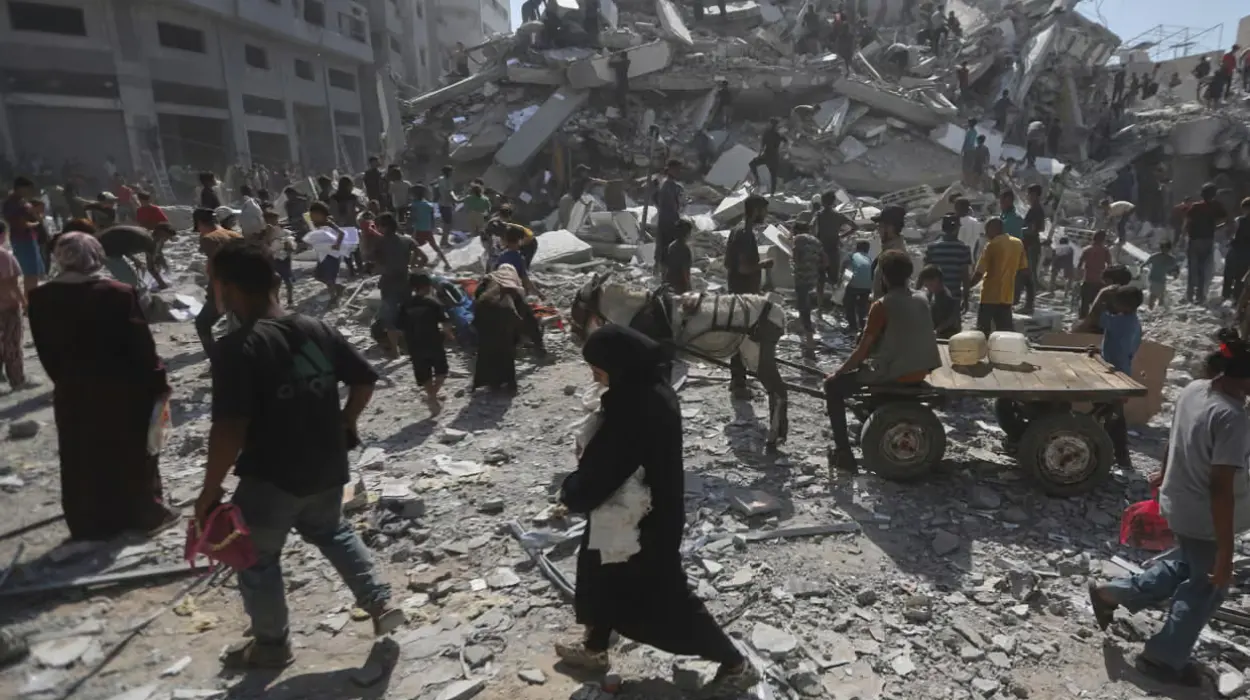
numerous times, and reduced much of the region to ruins.
Trump’s plan calls for a truce to be implemented, the
Israeli military to gradually retreat to a buffer zone around the perimeter, an
increase in humanitarian aid, and the terrorists to free all Israeli detainees
within 72 hours. Additionally, Israel must release over 1,000 Palestinian
detainees, many of whom are serving life sentences.
Another concern for Hamas is the vague promise of Israeli
withdrawals, though the clear statement that there will be no annexation or
occupation of Gaza by Israel was welcomed by one source close to Hamas.
Some analysts say divisions within Hamas are often
exaggerated.
“I don’t think there is a real split between Gaza, the West
Bank and the outside leadership. They all agree on opposing the disarmament
because the armed struggle is such a deep principle in their nature and
identity,”
said Michael Milshtein, an expert in Hamas at Tel Aviv University.
Hamas has lost a great deal in the conflict. Nearly all
senior military commanders have been murdered, along with thousands of
fighters. According to a report by the independent violence monitoring group
ACLED, Israeli bombings have killed at least 40 Hamas military wing officers
and key operatives since March. According to ACLED, only one senior officer
remains in charge of Hamas’ pre-7 October military council as a result of their
killings.
But because there is no other option, Hamas keeps up
guerilla warfare and preserves semblances of government. The gang was still
very much present in Gaza City, the “central camps” further south,
and the al-Mawasi beach area, according to humanitarian officials in Gaza.
Milshtein said that, according to military sources, 90% of
Hamas commanders had been killed, 97% of its rockets destroyed or launched, but
only 40% of the group’s extensive tunnel network had been destroyed.
“Hamas have adjusted to the new conditions. They are active
in areas where the [Israeli military] has declared Hamas is totally defeated,
but you can’t totally erase Hamas. They have metamorphosed and they have
survived,”
Milshtein said.
Some within Hamas are committed to rejecting the Trump plan
outright.
“There is a trend from the military wing, especially the
younger fighters, which wants to keep fighting,”
Lovatt said.
“Their view is
that Israel is struggling strategically: the mobilisation of reservists is a
huge burden, elections are due within a year or so, there is growing
international and domestic pressure … So, for them, it’s just a question of who
will hold out the longest.”
What guarantees is Hamas seeking for Israeli withdrawal?
Hamas is asking for clear and binding guarantees on the
global stage to ensure that Israel will fully withdraw its troops and forces
from the Gaza Strip, opposing any partial withdrawal or a withdrawal that is
phased or staged and to leave Israel in control of portions of Gaza.
The group asks for assurances that there will be no Israeli
assassination attempts against them, to include being killed in the Gaza Strip
and outside.
Hamas has asked for a more specific timetable for the
withdrawal of Israeli forces and a mechanism for the withdrawal of those forces
including details on how the withdrawal will be managed and verified.