
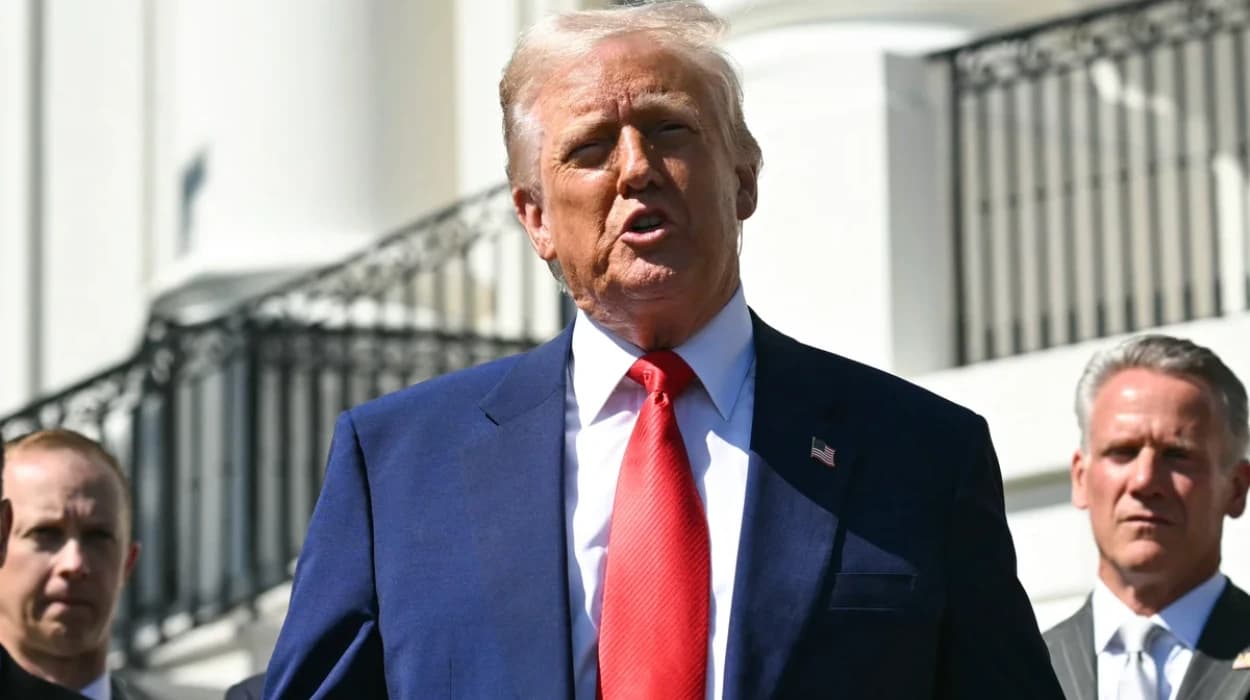
- Trump’s administration issued new security strategy.
- Describes European allies as weak partners.
- Focuses on reasserting U.S. dominance.
The White House's document, which was made public on Friday, will undoubtedly infuriate longstanding U.S. allies in Europe with its harsh criticism of their immigration and free speech policies, implying that they face the "prospect of civilizational erasure" and casting doubt on their long-term dependability as American allies.
Trump's "America First" attitude, which advocates nonintervention internationally, challenges decades of strategic partnerships, and puts U.S. interests before everything else, is reinforced in sometimes cold and belligerent words.
The memo stated that
"what works for America or, in two words, 'America First,'"
is the primary driving force behind U.S. strategy.
Since the Republican president took office again in January, this is the first national security policy that the administration is legally obligated to make public. It is a sharp departure from the path taken by Democratic President Joe Biden's administration, which aimed to check a more assertive Russia and revitalize ties after many were shaken during Trump's first term.
According to the national security strategy, it is in America's critical interests to mediate an end to Russia's nearly four-year conflict in Ukraine. However, after years of treating Moscow as a global outcast, the statement makes it clear that the United States wants to strengthen its ties with Russia.
Additionally, the pamphlet criticizes America's allies in Europe. According to the U.S., they are dealing with both an existential crisis and domestic economic difficulties, and they have occasionally clashed with Trump's changing stances on the Russia-Ukraine conflict this year.
According to the strategy plan, Europe's economic stagnation "is eclipsed by the real and more stark prospect of civilizational erasure."
The United States claims that Europe's immigration policies, falling birthrates, "censorship of free speech and suppression of political opposition," and "loss of national identities and self-confidence" are weakening the continent.
“Should present trends continue, the continent will be unrecognizable in 20 years or less. As such, it is far from obvious whether certain European countries will have economies and militaries strong enough to remain reliable allies,”
the document said.
“Many of these nations are currently doubling down on their present path. We want Europe to remain European, to regain its civilizational self-confidence.”
Trump's government has conducted a number of military strikes on suspected drug traffickers in the Caribbean Sea and eastern Pacific Ocean while considering potential military action in Venezuela to put pressure on President Nicolás Maduro, in defiance of his "America First" slogan.
The actions are part of "a 'Trump Corollary' to the Monroe Doctrine," according to the national security policy. President James Monroe's 1823 Monroe Doctrine served as justification for American military actions in Latin America and was initially intended to oppose any European interference in the Western Hemisphere.
Even after establishing the biggest military force in the area in decades, Trump's policy plan claims that the United States is rethinking its military commitment there.
How will European governments likely respond diplomatically?
European governments will probably respond diplomatically with public disconfirmations rejecting US characterizations of weakness or popular decay, while pursuing private channels to save NATO security ties and push for burden- participating clarity amid Trump's" America First" pivot.
Germany's Foreign Minister Johann Wadephul formally dismissed the strategy's suppression and repression claims as unwarranted" outside advice," with France and others anticipated to echo defenses of EU popular norms and sovereignty. Anticipate coordinated EU statements emphasizing strategic autonomy, increased defense spending, and rejection of migration or policy reviews, avoiding escalation to maintain alliance stability.
Behind unrestricted doors, centrals like Berlin and Paris will seek interpretations via ministers and summits, potentially accelerating European defense enterprise like FCAS or MGCS to demonstrate tone- reliance without alienating the US on Ukraine or China.