
Campaign finance reform in the United States seeks to
regulate the flow of money in elections to enhance transparency, reduce undue
influence from wealthy donors, and promote equitable participation. Recent
developments under President Donald Trump’s second term have spotlighted
debates over reforming or relaxing existing limits, particularly through
proposals tied to Project 2025, which advocates higher contribution caps and
structural changes to oversight bodies like the Federal Election Commission
(FEC).
These discussions build on decades of legislative evolution,
from post-Watergate restrictions to Citizens United’s expansion of independent
spending.
Historical Evolution
of Campaign Finance Laws
The Federal Election Campaign Act (FECA) of 1971 established
basic disclosure requirements and spending limits for federal candidates,
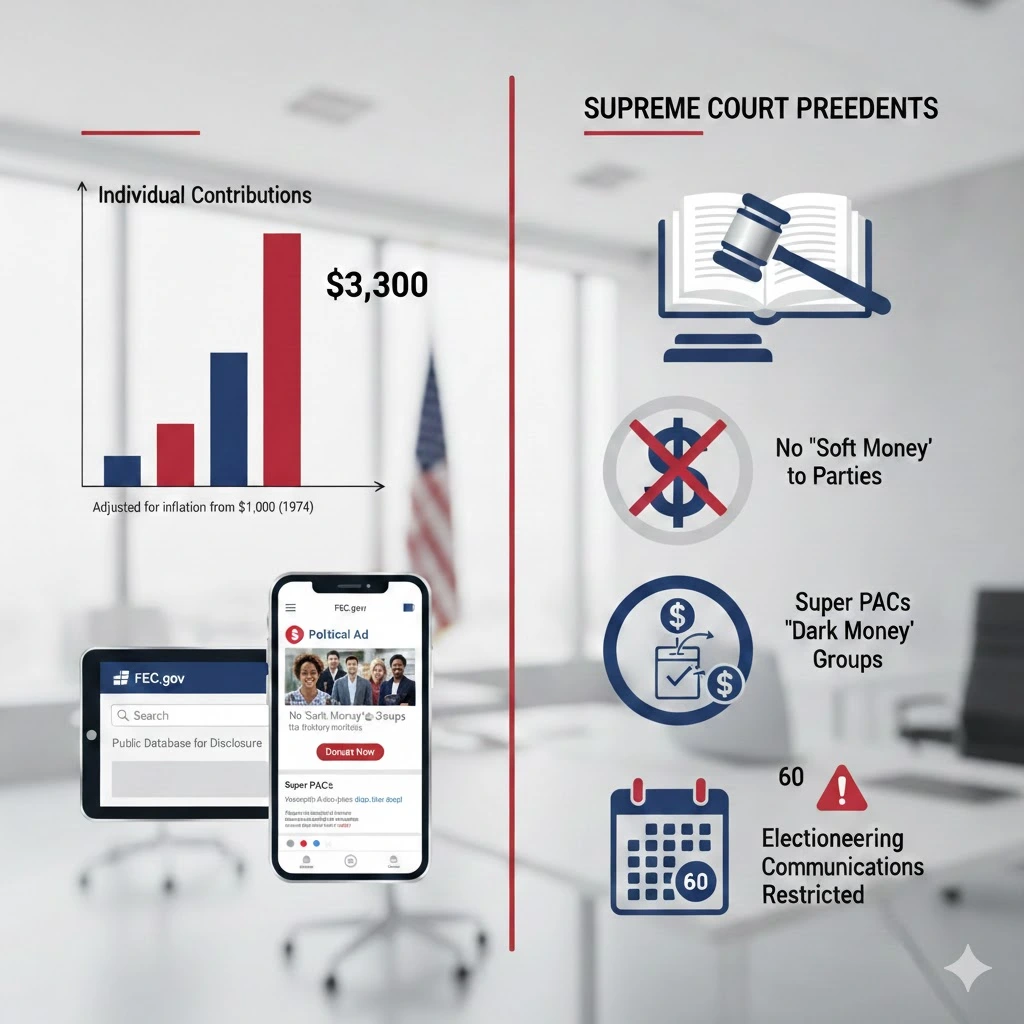
amended in 1974 after Watergate to cap individual contributions at $1,000 per
election and create the FEC as a bipartisan enforcer.
Public funding for presidential campaigns emerged via the
1971 Revenue Act, matching small donations up to $250 with federal dollars
through 1996, when 49% of Bill Clinton’s funds and 94% of Bob Dole’s came from
this system.
Bipartisan Campaign Reform Act (BCRA) of 2002, or
McCain-Feingold, banned soft money unregulated donations to parties and
restricted electioneering communications within 60 days of general elections or
30 days of primaries. Buckley v. Valeo (1976) upheld contribution limits as
anticorruption measures but struck spending caps as free speech violations,
setting precedents for later rulings.
Landmark Supreme
Court Decisions
Citizens United v. FEC (2010) invalidated BCRA’s corporate
and union spending bans on independent ads, deeming them protected speech under
the First Amendment, unleashing super PACs that raised $6 billion in 2020
alone. SpeechNow.org v. FEC followed, removing limits on independent
expenditures, allowing unlimited donations to these groups.
McCutcheon v. FEC (2014) eliminated aggregate biennial
limits ($123,200 individual cap), while base limits per candidate ($2,700
primary/general combined in 2016) persisted. These rulings shifted power to
outside spenders, with 2024 cycles seeing $2.3 billion in super PAC funding
versus $1.1 billion direct to candidates per OpenSecrets data.
Current Framework and
Contribution Limits
Individuals may donate $3,300 per candidate per election in
2024 ($6,600 primary/general), $5,000 per PAC, $10,000 state/local parties,
$41,300 national party committees, and $123,900 aggregate ($57,500
candidates/PACs, $66,500 parties). Multicandidate PACs cap at $5,000/candidate,
$15,000/party. Super PACs accept unlimited sums but cannot coordinate with
campaigns.
Presidential candidates access public matching for donations
under $250, general election grants up to $103 million (unclaimed since 2012).
Disclosure mandates via FEC forms 3X (24/48-hour independent expenditures over
$1,000) ensure transparency, though dark money 501(c)(4) groups report donors
quarterly without names.
Role of the Federal
Election Commission
The FEC, comprising six commissioners (three per party,
four-vote quorum), enforces FECA/BCRA through audits, fines, and civil suits.
From 2019-2023, 64% of 451 enforcement matters deadlocked on partisan lines,
stalling probes into $100 million+ violations. Annual budget: $78 million,
staff 200+, handling 15,000+ disclosures yearly.
Deadlocks often block super PAC coordination cases, with DOJ
deferring to FEC interpretations per tradition.
Project 2025
Proposals Under Trump Administration
Project 2025, authored by Heritage Foundation with 31
ex-Trump officials, recommends raising individual contribution limits
“much higher” to empower candidates/parties over super PACs, arguing
current caps ($3,300) serve no anticorruption role amid $824,600 joint
fundraising checks. It critiques limits hamstringing parties against unlimited
outside groups post-Citizens United.
Structural FEC reforms target bipartisan balance: presidents
negotiate Democratic Senate picks to avoid “extreme overenforcers,”
potentially stacking against enforcement. Oppose For the People Act changes
like independent chair or subpoena power. Direct DOJ to heed FEC deadlocks,
limiting criminal probes; reject agency modernization.
In 2025, Trump ousted Democratic FEC chair, raising
weaponization fears; executive actions align with Project 2025’s deregulation
push.
Recent Legislative
Efforts
For the People Act (HR1/S1, 2021-2025 cycles) proposed $250
million public funding (6:1 match small donations), $10 million/candidate cap,
super PAC donor disclosure, and FEC reforms (independent chair, 2/6 quorum).
Stalled in Senate filibuster.
DISCLOSE Act mandates 501(c)(4) donor disclosure over
$10,000; passed House thrice, blocked Senate. 2025 House GOP bills cut FEC
funding 15%, delay enforcement rules.
Super PACs and Dark
Money Dynamics
Super PACs raised $4.1 billion in 2024 midterms/presidential,
15 largest groups spending $500 million+ on ads. Crossroads GPS (Karl Rove)
exemplifies 501(c)(4) dark money, $100 million undisclosed 2020. Joint
fundraising committees bundle $800,000+ checks to Trump Save America 2024.
Post-2025, aligned super PACs like Make America Great Again
Inc. report $1.2 billion, with foreign-influenced funds scrutinized under FECA
bans.
State-Level Reforms
and Innovations
Twenty states ban corporate contributions; 15 cap super
PACs. Seattle’s Democracy Dollars ($100 vouchers/voter) boosted turnout 5%; NYC
matching (8:1 under $250) amplified small donors 20-fold. Maine/Boise public
funding reduces big donor reliance 70%.
Arizona Free Enterprise Club v. Bennett (2011) struck
trigger limits matching private funds; upheld vouchers as non-expenditure.
High-spending races favor incumbents 91% House, 85% Senate (2018-2024). Super
PACs 70% negative ads; 0.1% donors ($2,900+) gave 25% funds 2022. Small donors
(<$200) rose to 23% Obama 2012 but lag 15% 2024.
Bipartisan Perspectives
on Reform
Republicans argue limits infringe speech, favor super PAC
transparency over caps; Democrats push public funding, disclosure to curb
corruption. Post-Citizens United, both parties leverage outside groups equally,
$15 billion total 2024.
Crypto donations surged $500 million 2024; FEC rules lag,
classifying Bitcoin as barter. Online ads evade BCRA via text; AI deepfakes
prompt 2025 disclosure bills. Dark money apps bundle anonymously.
Canada bans corporate/union donations, $1,725/party cap;
France public funding 50% reimburses; Germany €50,000 cap, broadcaster
equality. U.S. outliers with $20 billion+ cycles.
Economic Analyses of
Money’s Influence
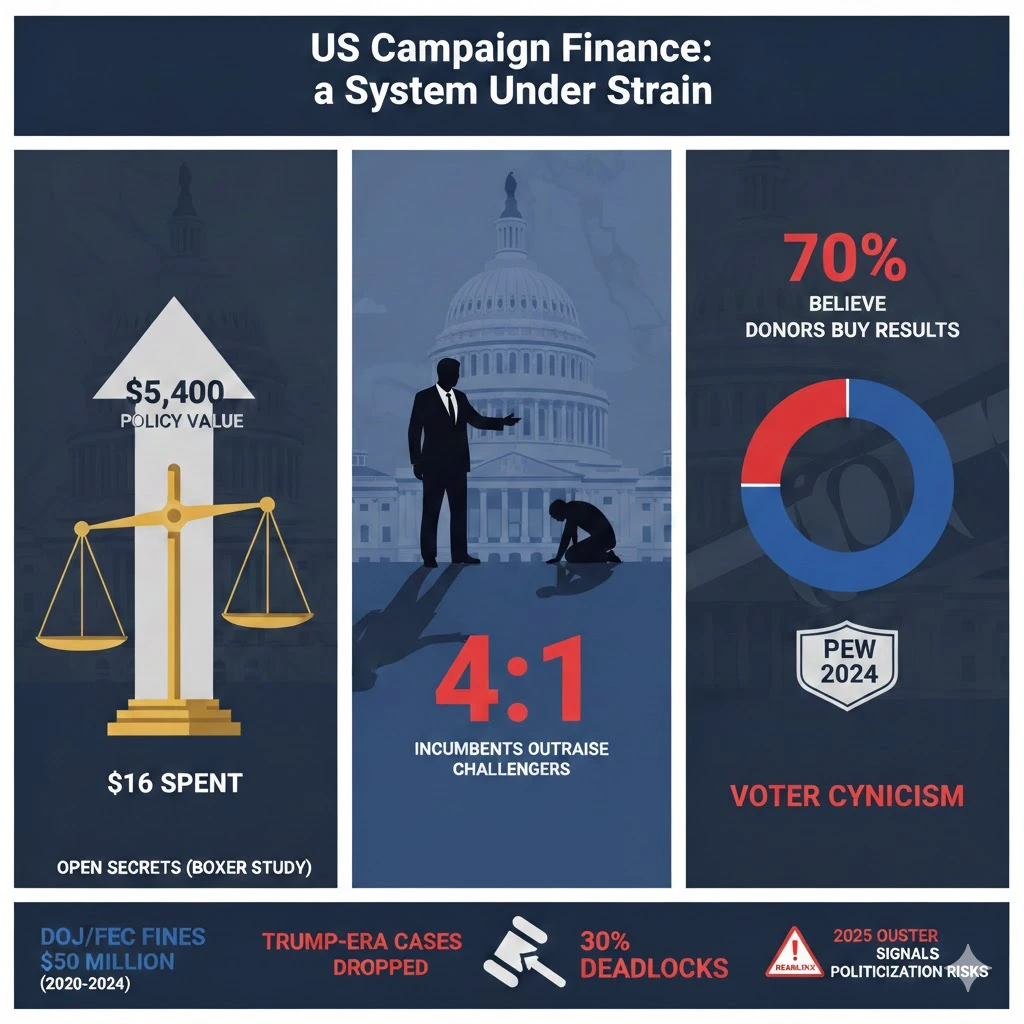
OpenSecrets: $16 spent yields $5,400 policy value (Boxer
study); incumbents outraise challengers 4:1. Voter cynicism: 70% believe donors
buy results (Pew 2024).
DOJ/FEC fines $50 million 2020-2024; Trump-era cases dropped
30% deadlocks. 2025 ouster signals politicization risks.
Future Prospects for
Comprehensive Reform
2026 midterms test Project 2025: higher limits bill
introduced House. Public funding via Democracy Vouchers gains AZ/NV traction.
SCOTUS Loper Bright (2024) curbs agency deference, aiding deregulation.
Bipartisan disclosure compromise viable; caps unlikely
absent amendment. Independent FEC (one per caucus + neutrals); real-time
disclosure apps; ban foreign-influenced PACs via ban foreign nationals FECA
Section 319.
Voter-owned elections nationwide could shift $10 billion
private to public.