
Summary
- OGE
rules prohibit gifts from prohibited sources. - Exceptions
for modest meals under $20/occasion. - Allowed
if integral to official duties.
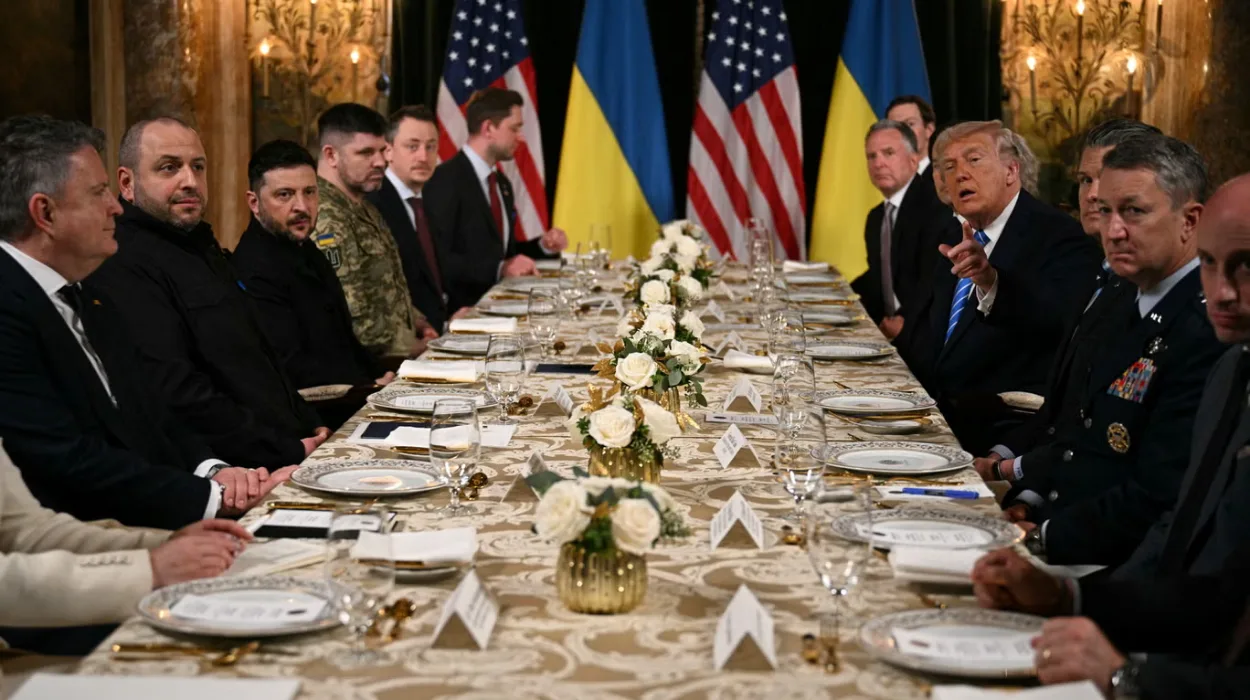
Zelensky and his delegation were being hosted by Trump at
his Florida resort for negotiations to settle the nearly four-year-old Russian
war.
The American later stated that while “a lot of
progress” had been made in achieving peace, there were still a number of
“thorny issues” that needed to be resolved.
Secretary of State Marco Rubio, Secretary of Defense Pete
Hegseth, Chairman of the Joint Chiefs of Staff Dan Caine, and advisers Susie
Wiles, Stephen Miller, Steve Witkoff, and Jared Kushner were seated opposite
Zelensky’s delegation during the dinner.
Turning his attention to the press, the president said,
“I think you could sit outside and have some food. Would
you like to have food or do you consider that a bribe, and therefore you cannot
write honestly? Or therefore you have to write a bad story?”
Trump told his assistant, Margo Martin, to
“take them
outside and tell the chef to serve them a little lunch”
after a journalist
stood up to accept the offer on behalf of his peers. As the press corps expressed their thanks, the president
commented to his guests:
“That should guarantee you good stories, but it won’t.
It’ll only get worse. They’ll go out of their way to make them worse.”
Politico reporter Alex Gangito subsequently wrote in a pool report:
“Pool did in fact get lunch and we are seated at small
round tables on the club patio. For those wondering at home, we were served sliced steak,
pigs in a blanket, coconut shrimp, fries and chocolate chip cookies. And water
bottles with a Trump label.”
Trump’s gesture toward the reporters who had skipped their
Christmas break to cover the summit showed a far nicer attitude than he has
recently shown, aside from his jabs about alleged media bias.
The president’s animosity toward the media, especially
female reporters, has drawn a lot of criticism in recent months. He labeled one
of them “a stupid person” and yelled at another, “Quiet,
piggy.”
Zelensky later stated that security guarantees between the UnitedStates and his nation were “100% agreed” and that an agreement
between the United States, Europe, and Ukraine was “almost agreed”
while Trump and Zelensky were debating a 20-point peace plan to end hostilities
with Russia.
In exchange for receiving “NATO-style” defensive
support from allied nations forming a “coalition of the willing,”
Ukraine would give up on its ambitions to join NATO, a point of contention for
Russian President Vladimir Putin, who has long opposed what he sees as the
military alliance’s eastward creep.
But Ukraine is still refusing to give up any land to
Moscow’s invading soldiers, rejecting any plan that would amount to Russia
annexing Crimea or the Donbas.
Although it is improbable, it is unclear if Putin would
agree to an agreement without at least asserting ownership of the Donetsk and
Luhansk oblasts that his soldiers presently hold in eastern Ukraine.
How have US ethics rules applied to similar gifts or meals
before?
U.S. ethics rules, governed by the Office of Government
Ethics (OGE) under 5 CFR Part 2635, generally enjoin administrative branch
workers from accepting gifts from banned sources like foreign officers or those
seeking sanctioned action due to their position, with limited exceptions for
reflections of modest value during sanctioned events.
Reflections and refreshments not of “nominal
value” (generally under $20 per occasion,$50 annually per source) are
allowed if integral to sanctioned duties, extensively attended events, or
particular gemütlichkeit without impacting opinions; chairpersons, pure from
numerous OGE rules, follow analogous voluntary norms via Administrative Orders
like 13989.
In previous cases, similar as sanctioned feasts with foreign
leaders (e.g., Trump’s Mar-a-Lago meetings), participated food is treated as
protocol hospitality rather than a fix, handed no quid pro quo; Senate and
House rules image this, permitting food at emblematic events while barring
high- value gifts.