
- US
ideological polarization sharpens in armed forces. - Affects
wider, junior military cross-section deeply. - Challenges
military’s apolitical stance severely.
The political climate facing currently serving officers is
“challenging” and “the most dangerous time” in his memory,
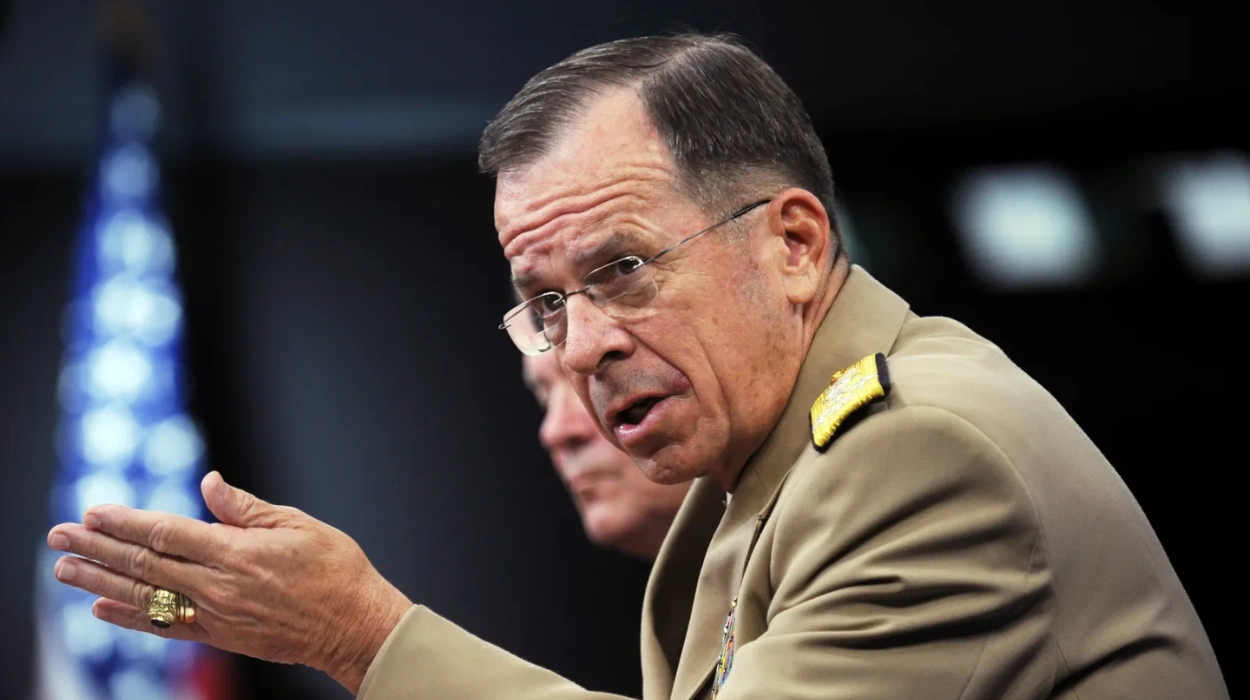
according to retired Adm. Mike Mullen, who served as the US military’s top
commander under Presidents George W. Bush and Barack Obama.
Speaking on Wednesday at a security summit hosted by the
Aspen Institute think tank, he cautioned that, compared to his time as joint
chiefs head from 2007 to 2011, it was now far more difficult to uphold the
military’s traditional apolitical posture.
“I didn’t really understand how hard [the
civilian-military relationship] was until I was in the middle of it,”
he
said.
“I talked about the military being apolitical a lot in those four year
and it’s only gotten harder. We have gotten so much more divided.”
Mullen’s remarks come after claims that the Trump
administration has deliberately attempted to politicize the armed forces by
firing senior commanders and sending national guard units on unusual law
enforcement operations in American cities, such as Washington, DC, to combat
alleged “crime waves.”
“In recent history, the political world has been the
purview of the chairman [and] the vice-chairman … very few individuals [in the
military], honestly, including myself, are ready for that, because we haven’t
grown up in it,”
Mullen said.
“The challenge now is that pool has gotten a lot deeper
and a lot wider, and it involves a much larger number of the military
leadership than it used to – down to, in some cases, one or two stars. It’s a
much more difficult world politically than it was back then.”
He questioned the rationale behind the dismissal of a number
of senior commanders, including Adm Lisa Franchetti, the first female chief of
the navy, and Gen. CQ Brown, his successor as chairman of the joint chiefs. He
claimed that the dismissed officers would have faithfully served under Donald
Trump.
“There’s a view from the administration that these are
individuals that they did not want serving for them,”
he said.
“There is
some mystery behind why some of this happened, and there are surmised reasons
but the [suggested] opposition to the president just that just is not true.
On the 20th of January … we pivot to whoever the new
president is and the new administration, and that’s who we follow. Those are
the policies that we execute, whether we personally like them or not.”
According to him, junior ranks were unsettled by the abrupt
changes in senior personnel, leaving “the troops hanging.”
Additionally, Mullen denounced a recent film produced by six
Democratic congressmen who had served in the armed forces, which urged active
duty members to defy “illegal orders.” Since then, the six have
stated that the FBI is looking into them.
“There isn’t anybody serving at the high level [or] way
beyond that doesn’t know you don’t have to follow an unlawful order,”
Mullen said.
“We just don’t need that from either side, quite frankly,
because we need to be an apolitical outfit.”
During his first term as president, Mullen, who was known
for being vocal while serving as chair of the joint chiefs, chastised Trump for
employing the military to drive Black Lives Matter demonstrators out of
Lafayette Square, which is close to the White House, in order to make room for
a visit to St. John’s Church.
“It sickened me,”
he wrote in the Atlantic in an
article headlined “I cannot remain silent” and warned of the dangers of the
military “being co-opted for political purposes”.
“I remain confident in the professionalism of our men and
women in uniform,”
he wrote.
“They will serve with skill and with
compassion. They will obey lawful orders. But I am less confident in the
soundness of the orders they will be given by this commander in chief.”
What steps have senior leaders taken to prevent
politicization?
Elderly US service leaders, including former Joint Chiefs
Chairman Gen. Mark Milley, have issued repeated directives emphasizing the
fortified forces’ apolitical tradition to fight rising polarization among
troops.
Commands have boosted enforcement of DoD Instruction
1344.10, proscribing prejudiced political conditioning in livery, similar as
wearing crusade gear or posting divisive social media from sanctioned accounts,
with commanders needed to conduct periodic training on impartiality.
Joint Chiefs and service registers promote”
professional service morality” briefings at all situations, from rookies
to generals, while covering unit cohesion through anonymous checks; high-
profile reprimands of prejudiced incidents, like Fort Bragg events, emphasize
zero forbearance for division.