
Summary
- Governor
Dunleavy requests Trump declare Alaska disaster. - Powerful
storm devastated southwest villages, displacing 1,500 people. - Large-scale
air evacuations ongoing due to flooding, destruction.
In order to enable more federal resources to enter the area
and fix housing and utilities before winter arrives, the senators and
congressmen from the state pleaded with the president to accept the
designation. Senators Lisa Murkowski and Dan Sullivan, along with b
Nick Begich of Alaska, noted that the disaster’s scope has outgrown the state’s
capacity to respond.
“This significant storm affected thousands of miles of
coast, spanning the Aleutian Islands to the North Slope,”
the letter to Trump
states.
“Immediate federal assistance is needed to support Alaskans recovering
from the damage of this storm and to mitigate the impact of future severe
weather events.”
Over the weekend, the Yukon-Kuskokwim Delta’s isolated
Alaska Native settlements were pounded by the leftovers of Typhoon Halong,
which brought record-breaking storm surge, rain, and strong winds that poured
water into homes and caused some to float off their foundations. Two people are
still unaccounted for, and at least one person was slain.
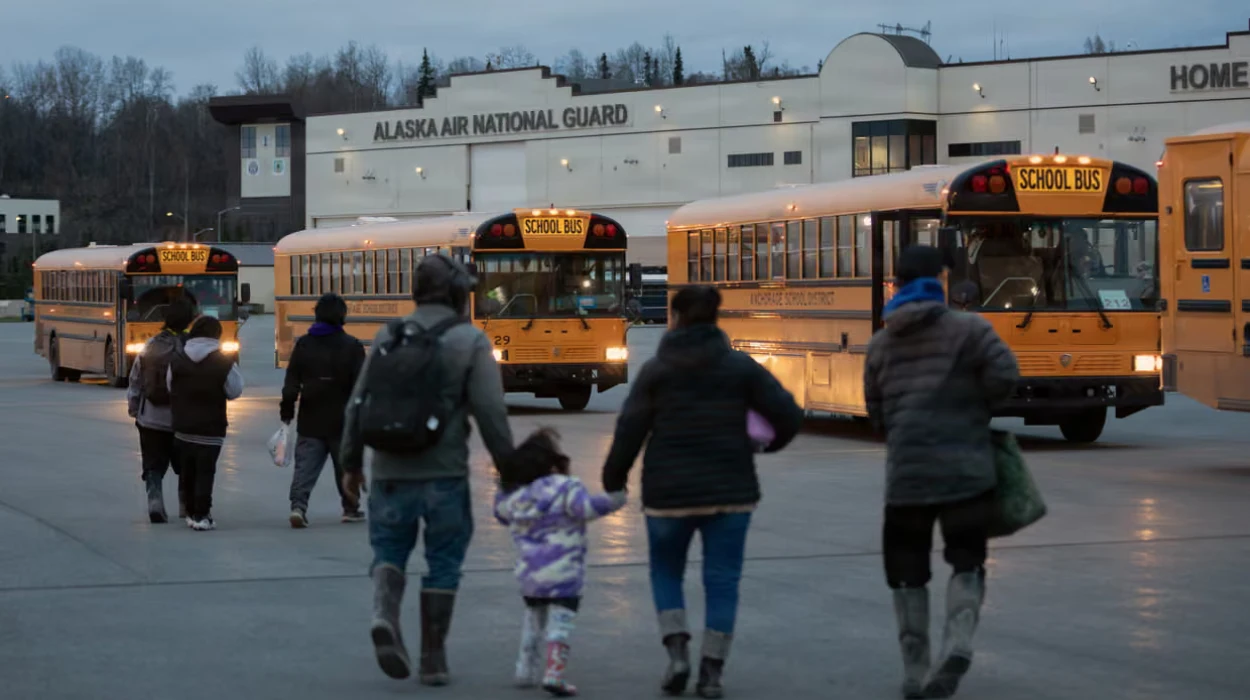
The state set up temporary shelters, which quickly expanded
to accommodate roughly 1,500 people, a remarkable figure
in a thinly inhabited area where, at this time of year, villages are only
accessible by air or sea. Earlier this week, Alaska Public Media reported that
up to 1,000 people were being accommodated in just two local schools before
evacuees were moved to larger shelters.
However, because of the difficult conditions, which included
restricted access to restrooms and power, the state started transporting people
by plane to larger shelters in Anchorage, which was roughly 500 miles (805 km)
away.
Devastation was widespread, and authorities are still
assessing the entire extent of the devastation. According to locals, the storm
wrought havoc, pushing waves into their homes and trembling southwest villages
like an earthquake.
In the Alaska Native village of Kipnuk, Alexie Stone, who
was with his brothers and children, said over the weekend he could look outside
and see under the water, like an aquarium. A shed drifted toward them,
threatening to shatter the glass, but turned away before it hit.
The house came to rest just a few feet away from where it
previously stood, after another building blocked its path. It remains
uninhabitable, along with most of the village.
“In our village, we’d say that we’re Native strong, we have Native
pride, and nothing can break us down. But this is the hardest that we went
through,”
Stone said on Thursday outside a shelter in the Alaska Airlines
center in Anchorage.
“Everybody’s taking care of everybody in there. We’re all
thankful that we’re all alive.”
Stone’s mother, Julia Stone, is a village police officer in
Kipnuk. She was working last weekend when the winds suddenly picked up and her
police cellphone began ringing with calls for help from residents – some who
reported that their houses were floating. She tried to reach search and rescue
teams and others to determine if there were available boats to help, but the
situation was “chaos”, she said.
“It’s a nightmare what we went through, but I thank God we
are together,”
she said.
What aid programs are available for storm-affected
communities in Alaska?
The Individual and Family Grant (IFG) Program and Temporary
Housing Program (THP) offer timely financial assistance to individuals and
families for necessary disaster-related expenses, temporary housing, repairs,
and other serious needs not covered by insurance.
The Federal Emergency Management Agency (FEMA) offers
disaster assistance for housing, repairs, and other unmet needs. Applications
must be made separately for the state assistance programs but survivors are
encouraged to apply to both programs to maximize their possible assistance.
The U.S. Small Business Administration or SBA provides
low-interest loans to eligible small businesses, private non-profits, and
individuals who were economically or physically impacted by the storm. The loan
amounts can be as high as $2 million with generous repayment options.