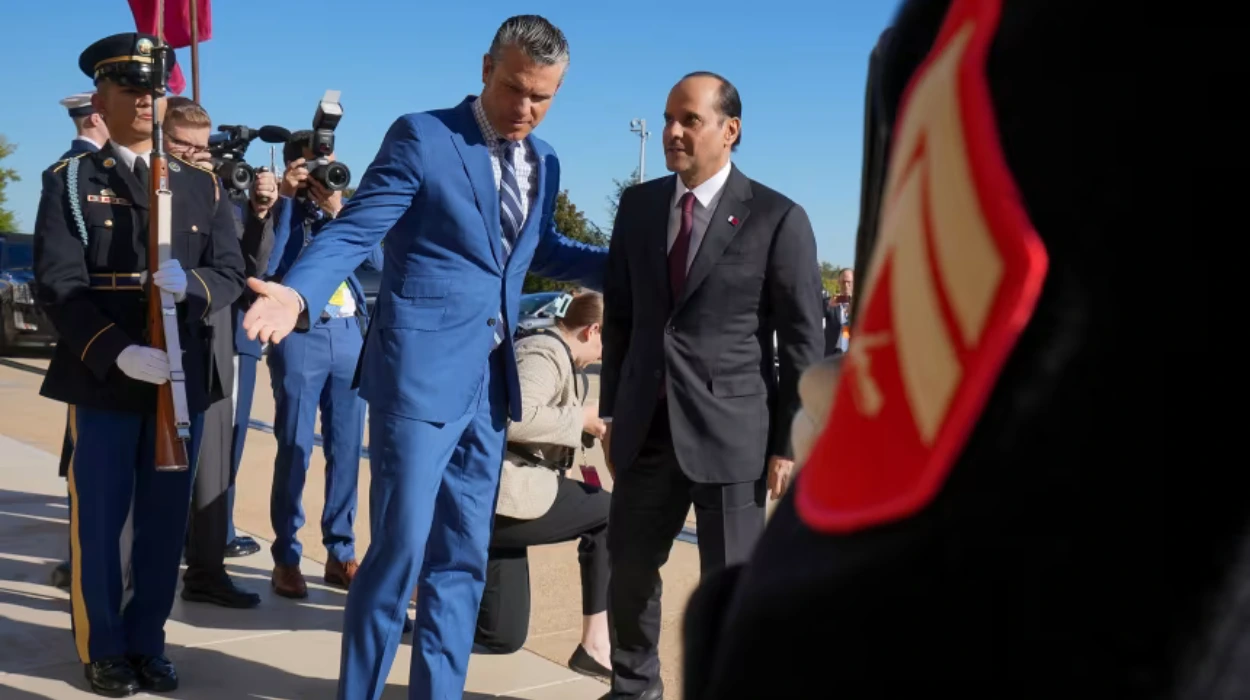

In October 2025, the United States
Department of Defense officially announced that Qatar will build an air force
facility at Mountain Home Air Force Base in Idaho. This facility is designed to
host Qatari F-15 fighter jets and will serve as a dedicated training location
for Qatari pilots. The announcement was made by U.S. Secretary of Defense Pete
Hegseth during a high-profile meeting with Qatari Defense Minister Sheikh Saoud
bin Abdulrahman Al Thani at the Pentagon. Hegseth emphasized that the facility
will enhance joint training exercises, increase combat lethality, and improve
interoperability between U.S. and Qatari forces. Importantly, this facility is
not an independent Qatari military base but a segment within the U.S. Air Force
base, remaining under American jurisdiction. The creation of this training
center marks a significant deepening of the longstanding U.S.-Qatar military
partnership and reflects mutual interests in regional security and military
preparedness.
Historical and strategic context
of the U.S.-Qatar military cooperation
The partnership between the United
States and Qatar regarding military cooperation has a robust history to build
upon. Qatar hosts the largest U.S. military base in the Middle East, Al Udeid
Air Base, which supports operations across the Persian Gulf, Afghanistan, and
portions of Africa and Central Asia. This base underpins
the U.S. Central Command’s air and ground operations and exemplifies the
strategic depth of the U.S.-Qatar security relationship. The agreement to
establish the Idaho facility follows multiple years of informal training
collaborations and continued diplomatic and defense engagement. Qatar’s hosting
of the base has been a critical component in regional stability and the U.S.
military’s global posture, facilitating rapid deployment capabilities and
intelligence cooperation.
The Idaho training center reflects
a two-way commitment where Qatar expands its capacity to train pilots using
advanced American technology, such as the F-15QA variant purchased through
Foreign Military Sales. The U.S. benefits by ensuring that allied forces are
trained to standardized operational procedures, enhancing coalition
effectiveness. The agreement also symbolizes a broader U.S. strategy to
strengthen alliances among Gulf states to counter regional threats, including
Iranian-backed militias and extremist groups. This step towards enhanced
training collaboration supplements existing military sales, exercises, and
intelligence-sharing frameworks.
Operational details and facility
use
Mountain Home Air Force Base in
Idaho is a long-established U.S. Air Force installation known for hosting
various international military training programs. It already supports the
presence of allied air units, such as Germany and Singapore, underlining its
suitability for multinational cooperation. The forthcoming Qatari facility will
include hangars, maintenance shops, and classrooms tailored for the F-15QA aircraft
and its pilots. This bespoke infrastructure will accommodate the entire
training cycle, including flight operations, technical maintenance training,
and mission preparations.
Though details such as the total
number of F-15 fighter jets and personnel to be stationed there have not been
publicly disclosed, the facility is intended to foster interoperability and
readiness. Training alongside U.S. Air Force counterparts allows Qatari pilots
to operate within coalition frameworks and familiarize themselves with American
military protocols, tactics, and technology interfaces. The arrangement aims at
improving operational coordination for future joint missions, peacekeeping
operations, or regional contingencies involving coalition forces.
Political and regional
implications
The announcement of the Qatar air
force facility in Idaho has elicited varied responses domestically and
internationally. Strategically, it represents a deepening of military ties
between a small Gulf state and a superpower, signaling Qatar’s increasing role
as a security partner beyond its geographical region. This development
strengthens U.S. influence in the Gulf and broader Middle East while providing
Qatar with advanced defense capabilities and enhanced pilot training. It also
emphasizes the U.S. commitment to safeguarding important non-NATO allies in
volatile regions through multilateral and bilateral military cooperation.
Domestically in the United States,
the facility underscores Idaho’s continued importance as a hub for
international military collaboration. However, the announcement has prompted
debates and viral reactions on social media concerning the presence of foreign
military entities on American soil. These discussions revolve around
sovereignty concerns, transparency, and the strategic rationale behind
welcoming allied nation training programs within U.S. bases. While such
partnerships follow established precedents—similar to how Germany and Singapore
conduct training in U.S. states—the scale and profile involving Qatar have
brought unprecedented attention.
Regionally, Qatar’s military
investments and training expansions come at a time of heightened tensions in
the Middle East, including ongoing conflicts in Gaza and complex relations with
Iran. Qatar’s role as a mediator in recent Israel-Hamas ceasefire negotiations
complements its security cooperation with the U.S., projecting an image of a
critical diplomatic and military partner. The Idaho facility hence represents
both a security asset and a diplomatic statement cementing Qatar’s strategic
alignment with Western defense architectures.
Future Outlook and significance
Looking ahead, Qatar’s air force
facility in Idaho is expected to commence operations following construction and
certification phases aligned with standard military protocols. The training
programs facilitated at the base will likely serve as a model for enduring
U.S.-Qatar military cooperation emphasizing technological sophistication and
coalition readiness. This endeavor opens avenues for further reciprocal
military exchanges and joint exercises designed to adapt to emerging global
security challenges.
The facility also illustrates a
growing trend where the U.S. hosts foreign military personnel for training in
its territory, reinforcing alliance structures in peacetime and conflict
deterrence. Such bases foster interoperability not only in terms of tactics and
technology but as platforms of political and military loyalty. For Qatar, enhanced
training capabilities mean improved defense readiness and operational
independence, vital for small states facing complex security environments.
The agreement to build a Qatari
air force facility within Mountain Home Air Force Base in Idaho symbolizes a
milestone in U.S.-Qatar defense relations. It serves mutual interests of
enhanced military capacity, strategic partnership, and regional security
alignment. Despite mixed public reactions, the facility aligns with
longstanding U.S. military practices hosting allied training and signals
deepening Gulf-U.S. cooperation in a period of significant geopolitical flux.