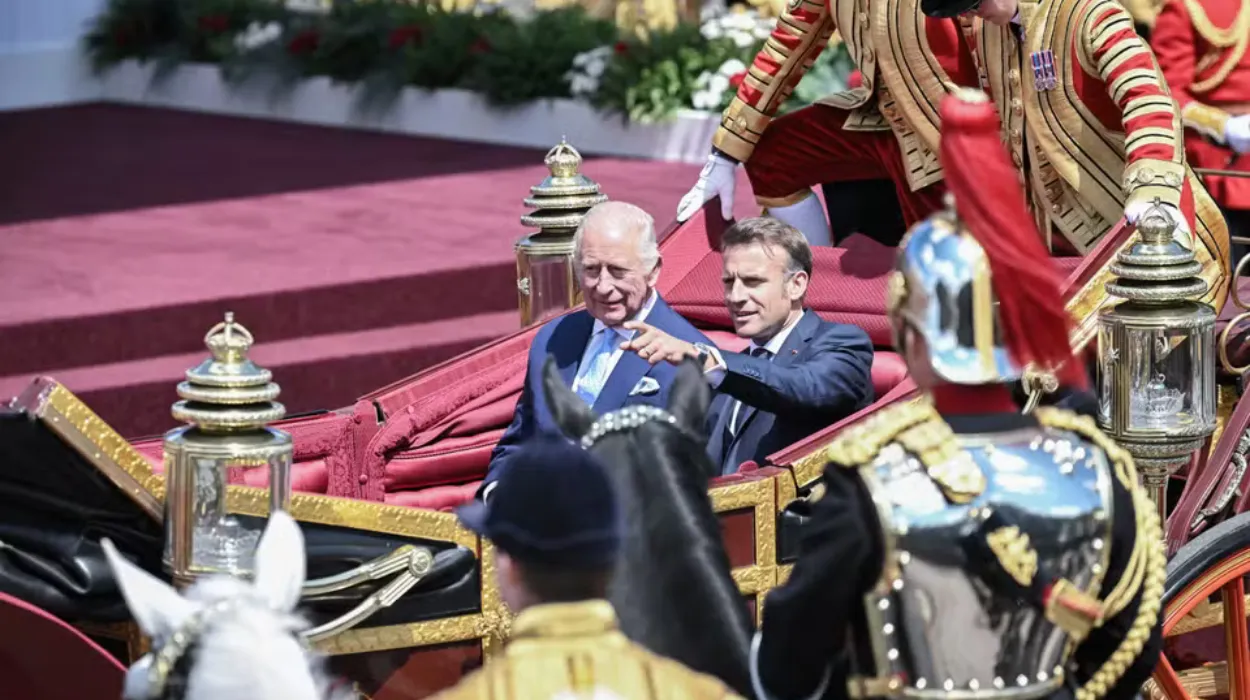

The last French state visit to the
United Kingdom took place from July 8 to July 10, 2025, when President Emmanuel
Macron and his wife, Brigitte Macron, were officially hosted by King Charles
III and Queen Consort Camilla. This visit marked the first state visit by a
French president since Nicolas Sarkozy in 2008 and was notable as the first by
a European Union leader to the UK since Brexit. The visit underscored efforts
to strengthen bilateral relations amid post-Brexit political and economic
realities.
President Macron’s agenda included addressing security and defense
cooperation, climate change, energy collaboration, space and technology
partnerships—including artificial intelligence—and cultural and academic
exchanges. Macron also engaged with British political leaders, including Prime
Minister Keir Starmer and opposition party representatives, reflecting the
visit’s broad diplomatic scope. Events included a ceremonial welcome at Windsor
Castle, addresses at Westminster Abbey and the UK Parliament, and wreath-laying
ceremonies at statues honoring key figures symbolizing UK-France historical
ties. This visit was widely regarded as a diplomatic milestone aimed at
repairing and renewing ties between the two nations after Brexit-induced
strains.
Emmanuel Macron’s personal
background and family life
Born on December 21, 1977,
Emmanuel Jean-Michel Frédéric Macron hails from Amiens, France. His father was
a professor of neurology, and his mother was a physician, nurturing an
academically inclined upbringing. Macron studied philosophy at Paris Nanterre
University before attending the prestigious École Nationale d’Administration (ENA),
which trains France’s elite civil servants. Prior to political office, he
worked as an investment banker before serving in the Ministry of Economy under
President François Hollande.
Macron’s wife, Brigitte Macron
(née Trogneux), born April 13, 1953, has drawn
public attention both for her role as the First Lady of France and for their
notable age gap of 24 years. Brigitte was Emmanuel’s high school teacher and
the couple married in 2007. Despite the age difference, their longstanding
relationship has been a point of discussion in media and politics. They have no
children together, but Markel, Emmanuel’s stepson from Brigitte’s previous
marriage, is part of their family unit. Brigitte Macron is widely recognized
for her influence on Emmanuel’s career and her engagement in social and
educational causes as First Lady.
Emmanuel Macron’s administration
and term details
Emmanuel Macron assumed the French
presidency on May 14, 2017, after winning the presidential election with a
centrist platform. His first term was characterized by ambitious economic and
social reforms, efforts to strengthen the European Union, and assertive foreign
policy positions. He was re-elected for a second term in April 2022, with his
current term set to end in May 2027. Macron’s policies emphasize modernization
of the French economy, digital transformation, environmental sustainability,
and European integration. His leadership style balances pro-business reforms
with efforts to address social inequalities and promote cultural diplomacy.
Amid his presidency, Macron has faced various domestic challenges, including
mass protests and labor strikes, yet remains a central figure in European and
global politics.
Macron’s education and connections
to New Caledonia
Emmanuel Jean-Michel Frédéric
Macron, born December 21, 1977, in Amiens, France, comes from a background
deeply rooted in academic excellence and public service. His early education
took place in his hometown of Amiens, where he demonstrated intellectual rigor
and curiosity. Pursuing higher education, Macron attended prestigious
institutions in Paris, including the University of Paris (Paris Nanterre
University) and later the elite École Nationale d’Administration (ENA), one of
France’s top civil service schools. His academic focus was broad and
interdisciplinary, encompassing philosophy, public administration, and
economics, which equipped him well for the complexities of governance and
policymaking. Macron’s philosophical studies, combined with his training in
administration and public policy, provided a framework for analytical thinking,
practical problem-solving, and an understanding of institutional
governance—skills that would later define his political career. His educational
path reflects the traditional French republican model of cultivating
technocrats to serve in public office, preparing Macron for his rapid ascent
within France’s political and administrative hierarchy.
During his presidency, Macron has
shown a keen interest in France’s overseas territories, including the Pacific
archipelago of New Caledonia. New Caledonia holds a unique position within the
French Republic as a special collectivity with considerable autonomy,
reflecting its distinct cultural identity and complex history marked by
indigenous Kanak aspirations for independence. The territory has experienced
decades of political tension resulting from competing pro-independence and
loyalist movements. The 1998 Noumea Accord mandated a series of referendums
granting New Caledonia the choice of remaining part of France or pursuing full
sovereignty. Macron has continuously emphasized the importance of dialogue and
inclusive governance as essential to resolving these longstanding tensions.
In July 2023, President Macron
undertook a significant visit to New Caledonia, underscoring France’s
commitment to its overseas territories and its Indo-Pacific strategic
interests. The visit was part of a broader tour that included nearby Pacific
nations such as Vanuatu and Papua New Guinea, situating France as an active
player in regional geopolitics amidst growing U.S.-China competition in the
Pacific. Macron’s visit to Nouméa, New Caledonia’s capital, focused on
fostering unity and trust, aiming to bridge divisions between pro-independence
Kanak groups and loyalist factions. Accompanying Macron was a delegation that
included political leaders from New Caledonia and French ministers responsible
for foreign affairs and defense, demonstrating the high level of French
governmental engagement with the territory.
During the visit, Macron
reaffirmed France’s sovereignty over New Caledonia while acknowledging the
territory’s distinct identity and history. His message reflected a
“semi-colon” philosophy—the referendum outcome voting to remain
French was not the final word but a continuation of a complex political journey
toward coexistence and reconciliation. Macron stressed the necessity of
fostering a “shared history” through processes involving truth-telling,
respectful discourse, and collective efforts to build a new political framework
accommodating diverse perspectives. These efforts align with the ongoing work
to finalize a new political statute that would succeed the Noumea Accord and
adapt to contemporary realities, including constitutional amendments in France
and upcoming local elections planned to shape the territory’s governance.
Macron’s visit was seen as a critical moment aiming to energize dialogue and
reduce tensions after the contentious referendums and political fragmentation
in New Caledonia.
The political complexity in New
Caledonia is notably influenced by the indigenous Kanak population,
representing approximately 40 percent of residents. Most Kanaks support
independence, viewing colonial legacies and central French administration as
obstacles to self-determination and cultural preservation. Conversely, the
wealthier European-descended loyalist community broadly favors continued ties
to France for economic stability and security. Macron’s administration faces
the delicate task of balancing these competing impulses and securing a peaceful
path that addresses economic, social, and cultural dimensions fairly. Macron’s
visit and rhetoric reflect a long-term French government strategy to maintain
its strategic presence in the Pacific while respecting the legitimate
aspirations of New Caledonia’s peoples.
Macron’s attention to New
Caledonia also complements France’s broader Indo-Pacific policy framework,
which seeks to reaffirm French influence in the region. Control over New
Caledonia, French Polynesia, and Wallis and Futuna enables France to project
military and diplomatic power, participate actively in regional security, and
contribute to cooperative initiatives on climate change and biodiversity
conservation. The 2023 visit involved symbolic military ceremonies, including
displays of French airpower, signaling the importance of New Caledonia to
France’s strategic posture. Furthermore, Macron’s presence underscored France’s
commitment to fostering economic development and infrastructure modernization
to enhance the territory’s integration with global markets and improve local
living conditions.
Macron’s religion and public image
Emmanuel Macron is publicly
identified as a Roman Catholic, reflecting the predominant religion in France.
While personal faith plays a relatively private role in his public life,
Macron’s cultural Catholicism informs certain ethical perspectives and the
broader identity framework within which many French citizens view politics. He
promotes secularism in government affairs consistent with the French concept of
laïcité but acknowledges the cultural heritage of Catholicism in the nation’s
history. His wife Brigitte Macron also identifies as Catholic. The president’s
approach to religion balances respect for religious diversity with a strict
adherence to secular governance principles.
Macron’s public image combines
youthful dynamism with an emphasis on experience and intellectual leadership.
He is portrayed as a pro-European reformist committed to balancing tradition
with innovation. Media and public narratives often focus on his policy
initiatives, charismatic speaking style, and his modernist approach to
governance. His family life, including his marriage to Brigitte Macron and the
notable age gap therein, occasionally attracts media curiosity but generally
reinforces a narrative of personal commitment and partnership. Macron’s steady
leadership through turbulent global and domestic contexts has positioned him as
a key figure in 21st-century French and European politics.
The last French state visit to the
United Kingdom was conducted by President Emmanuel Macron and his wife Brigitte
in July 2025, emphasizing renewed bilateral relations post-Brexit across
political, economic and cultural domains. Macron’s biography reflects a
trajectory from academic excellence to centrist presidency marked by reform.
His marriage to Brigitte Macron balances public interest in their personal life
with consistent commitment to public service. Macron’s administration actively
engages with overseas territories like New Caledonia, reflecting France’s
complex cultural and geopolitical landscape. His public image is shaped by
Catholic cultural roots, pragmatic policy leadership, and ongoing prominence in
EU and global affairs.