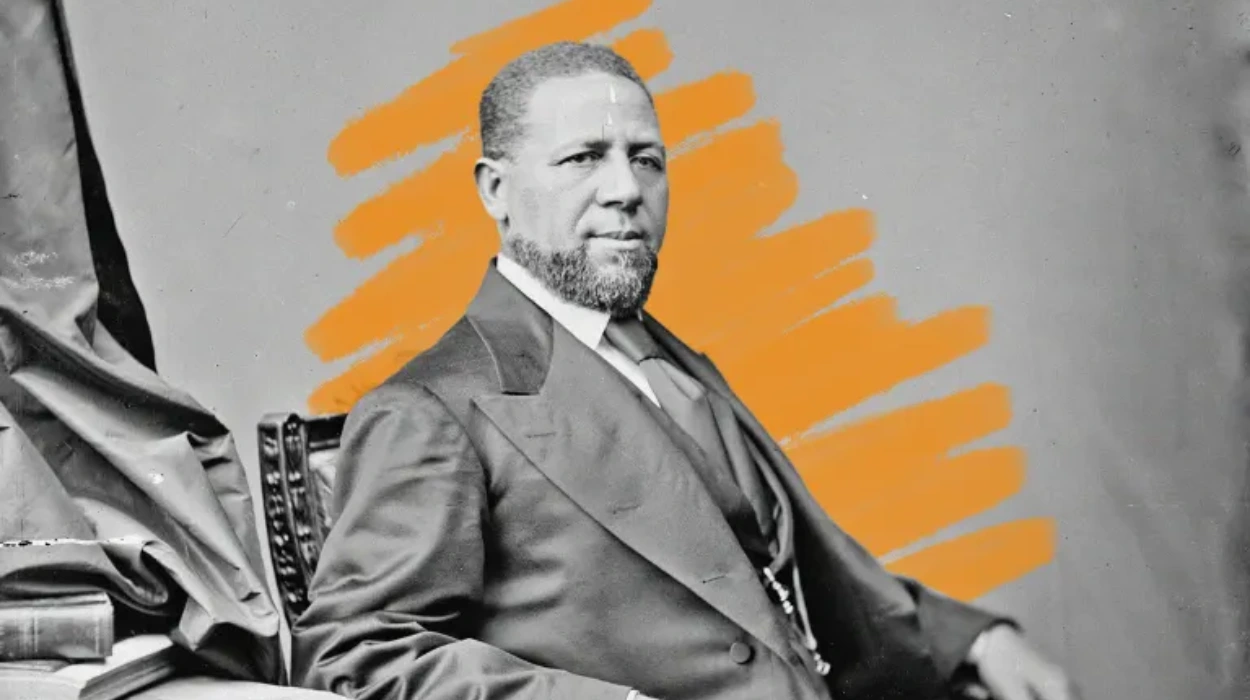

The history of the
United States Senate marks a pivotal moment with the election of its first
Black member, Hiram Rhodes Revels. His groundbreaking achievement during the
tumultuous Reconstruction era symbolized significant progress in American civil
rights and political inclusion.
Early Life and Education
of Hiram R. Revels
Born free on September 27, 1827, in Fayetteville, North Carolina,
Hiram Revels was a descendant of free people of color with African, European,
and Native American ancestry. His family’s status as free people before the
American Revolution was a rare distinction amid the prevalent institution of
slavery in the South. Raised by a Baptist preacher father, Revels received his
early education locally before advancing to attend the Beech Grove Quaker
Seminary in Indiana and the Darke County Seminary in Ohio. Later, he studied
religious teachings at Knox College in Illinois.
Revels was ordained as a minister in the African Methodist
Episcopal (AME) Church in 1845, dedicating much of his adult life to preaching
and teaching across the Midwest. His ministry often met resistance; in
Missouri, he was once imprisoned for preaching to African Americans but was
never subjected to physical violence. His education and moral grounding helped
shape his leadership skills and commitment to racial equality.
Military Service and Contributions During the Civil War
During the American Civil War, Revels joined the Union Army as a
chaplain, playing a vital role in organizing two regiments of the United States
Colored Troops. His work boosted the recruitment and morale of Black soldiers
fighting to preserve the Union and abolish slavery. Revels also witnessed key
battles, including the Siege of Vicksburg, which was crucial in the Union’s
victory.
His military service added to his stature as a leader who not only
preached equality but actively participated in the fight for freedom and civil
rights. The war’s outcome and the subsequent Reconstruction amendments set the
stage for Revels’s political career.
Political Rise in Mississippi During Reconstruction
After the Civil War, Revels moved to Mississippi a state
undergoing profound changes as it reintegrated into the Union. Amid
Reconstruction, newfound political opportunities emerged for African Americans.
Revels was elected as an alderman in Natchez in 1868 and subsequently served in
the Mississippi State Senate representing Adams County starting in 1869.
His eloquence and principled nature earned him respect among his
peers. One notable moment was his opening prayer in the Mississippi state legislature,
which was recognized as extraordinary and influential. This event was credited
with propelling him toward national office.
Election and Historic Senatorial Service
In 1870, the Republican-controlled Mississippi legislature elected
Hiram Revels to fill the U.S. Senate seat left vacant by Albert G. Brown, who
had ceased to serve after Mississippi’s secession during the Civil War. Revels
was sworn in on February 25, 1870, thus becoming the first African American to
serve in the United States Congress.
His election was met with both jubilation and opposition. Some
Southern Democrats contested his eligibility, citing the Dred Scott decision
and questioning whether he met the nine-year citizenship requirement under the
U.S. Constitution. Supporters highlighted that Revels had voted in Ohio before
the Civil War, thereby fulfilling citizenship requirements long before the 14th
Amendment guaranteed citizenship to all born or naturalized in the U.S.
Senator Charles Sumner and others defended Revels passionately,
emphasizing the Civil War and Reconstruction amendments had effectively
overturned previous racial exclusion laws. The Senate’s vote to seat Revels was
largely along party lines, with Republicans in favor and Democrats opposing.
Legislative Focus and Impact
During his term from 1870 to 1871, Revels served on the Education
and Labor Committee as well as the Committee on the District of Columbia. His
speeches advocated for racial equality, integration of schools in Washington,
D.C., and an inclusive approach toward Reconstruction policies.
Revels promoted amnesty for former Confederates who pledged
loyalty to the United States and urged reconciliation over continued
punishment. He supported infrastructure bills to improve Mississippi’s economy
and worked to defend the rights of Black workers, including those barred from
employment at the Washington Navy Yard.
Though his Senate term was brief, Revels’s dignified conduct and
moderate positions earned him admiration and helped demonstrate the capability
of African Americans to serve at the highest levels of government.
Leadership at Alcorn Agricultural and Mechanical College
After his Senate service, Hiram Revels became the first president
of Alcorn Agricultural and Mechanical College (now Alcorn State University) in
Mississippi. As one of the nation’s first historically Black colleges, Alcorn
was a symbol of higher education progress for African Americans during
Reconstruction.
Revels’s tenure at Alcorn involved teaching philosophy and
administrative leadership, advancing educational opportunities for Black
students. Though he faced political pressures and was briefly dismissed due to
his opposition to certain governor policies, he was reappointed and served
until retirement. His efforts contributed significantly to the college’s early
success.
Later Years and Enduring Legacy
Revels continued his ministry and theological teaching, including
at historically Black Rust College in Mississippi. He also briefly served as
Mississippi’s Secretary of State, further reflecting his stature in state
politics.
Hiram Rhodes Revels passed away on January 16, 1901, but left a
profound legacy as a trailblazer for African American political participation.
His daughter, Susie Revels Cayton, and grandsons became influential in
journalism and civil rights advocacy.
Notably, modern scholars recognize Revels among the greatest African Americans in history, honoring his pioneering
role and commitment to racial justice.
Historical Context and Significance
Revels’s journey embodies a unique moment in U.S. history
Reconstruction when federal intervention and constitutional amendments briefly
expanded political rights for formerly enslaved people and other African
Americans. His election predated popular election of senators (which began in
1913) and required approval from state legislatures, emphasizing the political
complexities of the era.
His moderate stance aimed at bridging divides between races,
seeking to restore national unity without sacrificing Black civil rights.
Revels’s success challenged entrenched racist narratives and paved the way for
other African American politicians during and after Reconstruction.
Hiram R. Revels was more than just the first Black U.S.
senator; he was a symbol of progress, hope, and the ongoing struggle for
equality in America. His leadership as a minister, soldier, educator, and
legislator demonstrated the multifaceted contributions African Americans made
during one of the nation’s most transformative periods.
While his time in the Senate was brief, Revels’s impact resonates
through history as an enduring reminder that inclusion and justice have always
been essential to the American democratic experiment.