
The “nuclear option” is a parliamentary maneuver in the United States Senate that allows the majority party to override existing Senate rules
by a simple majority vote, bypassing the traditional supermajority requirement.
It is considered a last-resort tactic intended to overcome filibusters and
obstruction by the minority party.
Although the term sounds extreme, the procedure fundamentally
changes how legislation, nominations, or other Senate actions can proceed when
blocked, with significant implications for Senate dynamics and minority rights.
Understanding the nuclear option
In the Senate, certain actions require a three-fifths
supermajority (usually 60 out of 100 senators) to invoke cloture, effectively
ending debate and allowing a vote. The nuclear option changes this threshold to
a simple majority (51 votes), enabling the majority party to break filibusters
and advance measures without minority consent. It does this by raising a point
of order that changes Senate precedent. Although the presiding officer may initially
overrule this point based on existing rules, the Senate can then appeal and
overturn the ruling by a simple majority, establishing a new precedent.
Historical usage
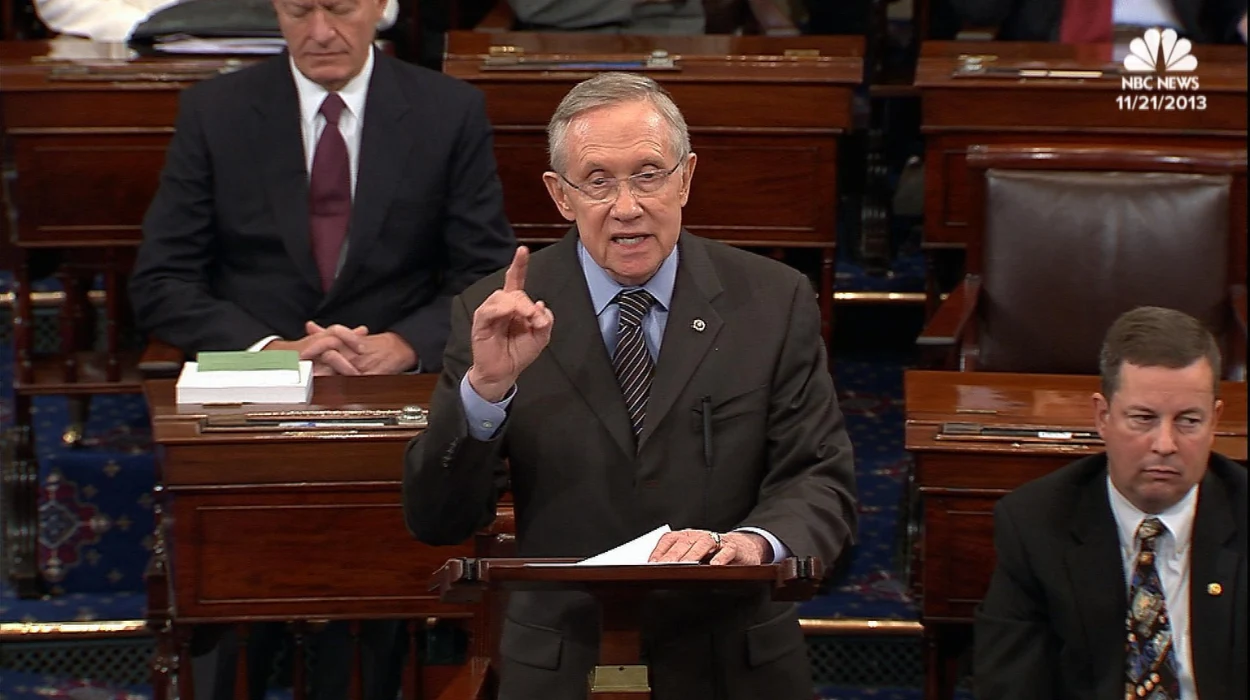
The nuclear option was first invoked in 2013 under Senate Majority
Leader Harry Reid to lower the cloture threshold for most presidential
nominations and federal judicial appointments except for the Supreme Court.
This move was justified by what Democrats described as unprecedented
obstruction from Republicans. In 2017, Senate Majority Leader Mitch McConnell
expanded the nuclear option to cover Supreme Court nominations to facilitate
confirmation votes with a simple majority, notably to confirm Justice Neil
Gorsuch. The nuclear option has not yet been formally applied to legislative
filibusters but remains a subject of debate.
Implications and controversies
The nuclear option refers to a parliamentary maneuver in the
United States Senate that allows the majority party to override existing Senate
rules, most notably the supermajority requirement to end debate (cloture), by a
simple majority vote rather than the traditional three-fifths (60 senators)
threshold. First termed by Senator Trent Lott in 2003, its name derives from
the idea that this parliamentary change is akin to a “nuclear strike” due to
its dramatic and potentially destabilizing impact on Senate proceedings and
traditions.
By eliminating the supermajority requirement, the nuclear option
fundamentally alters the balance of power within the Senate. In practice, it
diminishes the minority party’s ability to negotiate, delay, or block
legislation and appointments through the filibuster, historically one of the
few tools minorities have to influence or halt Senate actions. The traditional
filibuster necessitated bipartisan cooperation or at least some level of
consensus, encouraging negotiation and compromise on legislation. The nuclear
option, by enabling the majority to bypass this hurdle with a simple majority
(51 votes), transforms the legislative process into a more majoritarian body,
potentially increasing the pace and volume of legislation but also intensifying
partisan polarization.
Critics of the nuclear option warn that it undermines Senate
traditions by eroding minority protections designed specifically to slow down
hasty decision-making and encourage deliberative democracy. They argue that
this shift risks making the Senate resemble the House of Representatives, where
simple majority rule dominates, thereby reducing the checks on the majority
party and increasing legislative volatility with frequent swings based on the
party in power. Furthermore, eliminating the supermajority requirement risks
marginalizing minority voices and might exacerbate political tensions,
decreasing legislative stability over time.
Public perception and political debate
The “nuclear option” in the U.S. Senate has long been perceived as
a dramatic and extreme parliamentary tactic, reserved as a last-resort measure
when deep partisan gridlock threatens to stall critical legislation or
nominations. The term itself, coined by former Senate Majority Leader Trent
Lott in 2003, evokes the imagery of a nuclear strike: an unprecedented,
powerful, and potentially destructive move that could reshape the Senate’s
rules and political conventions permanently. This metaphor underscores the
significance lawmakers place on Senate traditions and rules, as well as the
potential consequences of overriding them by simple majority rather than
consensus.
Initially, many senators viewed the nuclear option with
trepidation, fearing it would undermine the Senate’s principle as a
deliberative body protecting minority rights. The prospect of changing key
procedural rules to limit the minority party’s ability to filibuster was seen
as tantamount to blowing up the longstanding norms of bipartisanship and
debate. Early discussions about invoking this option often stirred intense
debate because it represented a shift from the supermajority rule historically
required to end filibusters or change Senate procedures.
However, as partisan polarization deepened, the nuclear option
gradually gained acceptance among Senate majorities increasingly frustrated by
what they perceived as minority obstructionism. It has now become an
established tactic to overcome especially contentious blocks, first for
judicial nominations below the Supreme Court in 2013 under Senate Democrats and
later for Supreme Court nominees in 2017 under Senate Republicans. This trend
reflects a pragmatic willingness among senators to sacrifice some traditions to
maintain legislative functionality.
Significant procedural tools
The “nuclear option” is one of the most impactful
procedural maneuvers available in the U.S. Senate, reflecting a critical
tension in the legislative process: balancing minority rights with the need for
legislative efficiency. Traditionally, the Senate operates on a system that
protects the rights of the minority party to extend debate often through
filibusters thereby requiring a supermajority (typically 60 out of 100
senators) to move forward on most legislation or nominations. The nuclear
option, however, enables the Senate majority to override this requirement with
a simple majority vote, fundamentally altering the chamber’s operational
dynamics.
The term “nuclear option” originated in 2003 when
Senator Trent Lott referred to the potential rule change as akin to
“nuclear war” due to its far-reaching and explosive impact on Senate
procedures. The option allows the presiding officer, usually the Vice President
or the Senate Majority Leader, to interpret Senate rules in a way that
eliminates the filibuster’s supermajority threshold for specific types of
votes. This reinterpretation becomes a new precedent that changes how the
Senate functions going forward.
Historically, the nuclear option was invoked first in 2013 by
Senate Democrats under Majority Leader Harry Reid, who used it to lower the
cloture threshold from 60 votes to a simple majority for confirming most
presidential nominations, excluding those for the Supreme Court. This step
addressed unprecedented obstruction tactics by the Republican minority. Then in
2017, Senate Republicans extended the nuclear option to Supreme Court
nominations, enabling President Trump’s pick to be confirmed with a simple
majority.