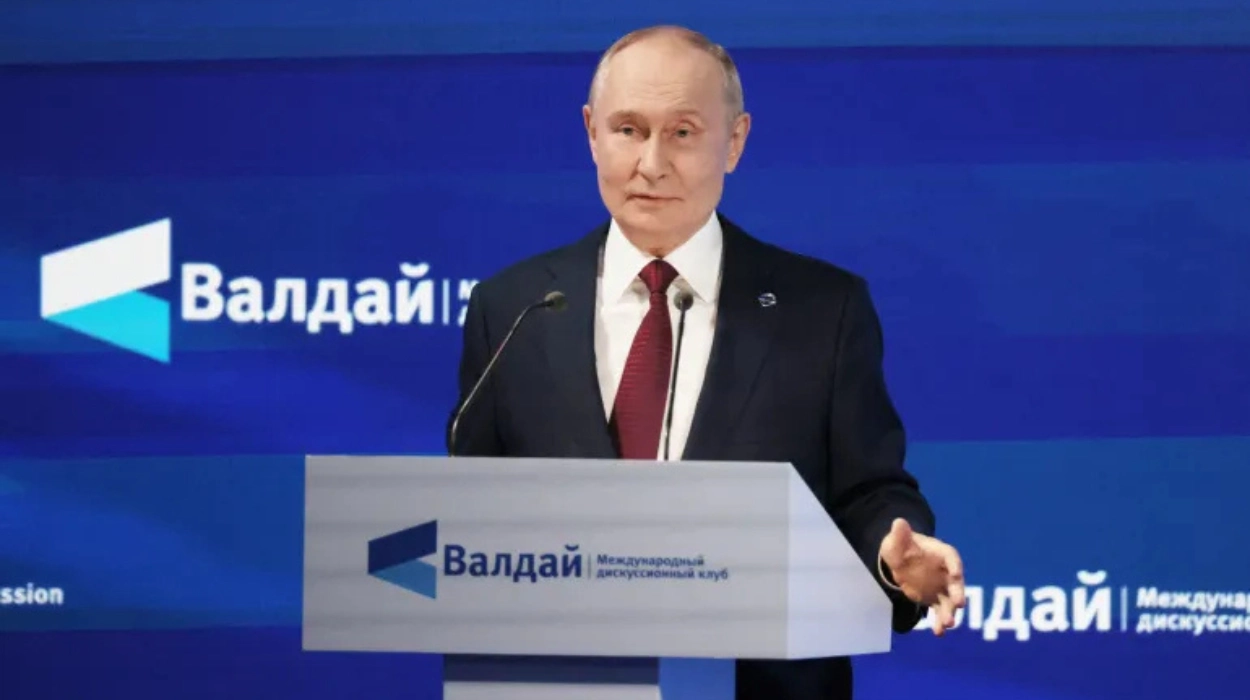

Despite NATO’s ongoing rearmament and reinforcement of
Eastern European member states, Putin expressed confidence in Russia’s capacity
to defend itself and project power. He cited the advance of Russian forces
along the entire front in Ukraine as evidence of military progress and asserted
that Russia is “advancing and feels confident.” Putin challenged critics who
label Russia a “paper tiger,” asserting that if Russia is considered such while
battling the entire NATO bloc, then NATO itself must be questioned.
He highlighted Russia’s strategic military capabilities and
preparation to deter any NATO challenges. The Kremlin frames NATO’s military
expansion and increased arms transfers to Ukraine, including long-range missile
systems and advanced drones, as provocative actions that threaten regional
security and legitimate Russian interests.
In response, Moscow has increased its own defense spending,
modernized force structures, and enhanced rapid deployment units for border
defense and strategic deterrence. This military confidence also serves as a
narrative tool domestically to consolidate support amid economic challenges and
the prolonged conflict.
Historical context and NATO membership dynamics
Putin’s antagonism toward NATO’s eastward expansion traces
back to the post-Cold War period when former Soviet states and Warsaw Pact
countries gradually sought NATO membership. Russia has repeatedly opposed this
enlargement, viewing it as a breach
of assurances given in the early 1990s and a direct threat to its sphere of
influence. While there is no credible evidence Putin formally requested to join
NATO, as some speculative narratives have hinted, he has articulated grievances
about broken security guarantees and NATO’s disregard for Russian security
concerns.
His government underscores that the inclusion of NATO
members like Estonia, Latvia, Lithuania, Poland, and the more recent entries of
Finland and Sweden
constitute encirclement and strategic encroachment. Putin
refers to these transitions as “stupid” decisions that fail to consider
historical ties and geographic realities. The Kremlin’s official stance rejects
Ukrainian aspirations for NATO membership as a red line that must not be
crossed, catalyzing much of the current conflict dynamics.
Threats and escalation risks
Rhetoric from the Kremlin, particularly from President
Vladimir Putin, has intensified as Russia confronts continued NATO support for
Ukraine and military reinforcement near Russia’s borders. Putin and Russian
officials have made explicit threats signaling grave repercussions for any
escalation or further arms supplies from NATO members. Notably, Putin warned
that Western weapons deliveries—including advanced systems such as Tomahawk
cruise missiles—risk provoking “severe negative consequences” that would
destabilize international security. The Kremlin positions Russia’s stance as
defensive, asserting that Moscow acts only in response to alleged Western
aggression and “militarization” of Europe. This narrative attempts to frame
Russia’s military and geopolitical posture as necessary measures against
encircling threats rather than offensive provocations.
Central to the escalation risks in 2025 are the increasing
uses of asymmetric warfare tools, especially drone incursions into Baltic
airspace and NATO countries’ borders, alongside cyberattacks and hybrid
tactics. Russia has been accused of deploying armed drones across airspaces of
Estonia and Poland and conducting electronic warfare operations intended to
undermine NATO surveillance and communications. Incidents such as forced
airport closures in Norway and Denmark due to unidentified drone activities
underscore the sophistication and persistence of these unconventional threats.
These tactics complicate NATO’s defensive calculus as response options to drone
and cyber incursions must be carefully calibrated to avoid unintended
escalation into direct conflict. NATO members are accelerating the deployment
of counter-drone technologies, including plans for drone detection “walls,”
expanded air patrols, and enhanced electronic warfare capabilities, evidencing
the strategic imperative to deter or intercept hostile aerial and cyber
operations.
The precarious balance of deterrence between Russia and NATO
hinges on signaling and strategic uncertainty. NATO’s commitment to collective
defense under Article 5 of the Washington Treaty obliges mutual support in the
event of an armed attack on a member state. However, Article 5 does not compel
all members to automatic military retaliation, only to take actions deemed
necessary to restore security. This consensus-dependent model introduces
uncertainties regarding the uniformity and speed of NATO responses to
provocations, particularly as some members hesitate due to political or
economic considerations. Russia’s leadership interprets NATO’s internal
divisions, fluctuating defense spending, and previous political skepticism from
the United States as opportunities to test the Alliance’s cohesion. Increasingly
aggressive Russian hybrid warfare campaigns aim to sow discord, fear, and
political fragmentation within NATO member states, thereby weakening collective
deterrence.
Russian public perception also influences escalation
dynamics. Surveys indicate a majority of Russians continue to view conflict
with NATO as a plausible scenario, though anxiety levels vary over time.
Despite the perception of a looming threat, many Russians appear resigned or
view such a conflict as distant from domestic life, paralleling attitudes
toward the ongoing war in Ukraine. The Kremlin’s control of media narratives
and public discourse emphasizes national pride, portraying the conflict as a
necessary defense against Western encroachment while minimizing anticipated
domestic hardships. This domestic context may embolden leadership’s willingness
to accept higher risks of escalation given the comparatively muted internal
opposition and growing nationalism surrounding Russia’s geopolitical agenda.
The combination of explicit Kremlin threats, hybrid warfare
operations, and ambiguous NATO response capabilities creates a volatile
security environment in Europe. The risk of inadvertent escalation,
particularly due to miscalculations or unintentional engagements from frequent
drone and airspace incursions, is significant. Both sides have expanded
military deployments and invested heavily in rapid reaction and missile defense
systems, yet the probability of localized confrontations escalating into
broader conflict remains a critical concern. Diplomatic efforts to manage
tensions are hampered by mutual distrust and stark incompatibility in security
priorities, with Western states supporting Ukraine’s sovereignty and Russia
insisting on security guarantees including non-expansion of NATO.
In response to ongoing pressures, NATO continues to enhance
its eastern flank through increased troop deployments, infrastructure
modernization, and intelligence sharing. Some member states, particularly those
bordering Russia such as Poland, Estonia, Latvia, and Lithuania, have exceeded
the NATO guideline of allocating 2% of GDP to defense, signaling commitment to
collective security. At the same time, the integrated nature of modern
warfare—combining conventional, cyber, informational, and unmanned systems—requires
nuanced strategies that go beyond the traditional military balance of forces.
The evolving nature of the Russia-NATO confrontation in 2025 reflects this
complexity, underscoring the strategic and operational challenges of deterring
aggression while avoiding escalation.
The current phase of Russia-NATO relations is marked by
heightened threats, tactical hybrid operations, and strategic uncertainty that
significantly raise the risk of escalation. Putin’s explicit warnings and
promise of swift countermeasures against Western military support to Ukraine
frame a high-stakes geopolitical confrontation where miscalculations could have
severe consequences. NATO’s defensive enhancements and internal political
dynamics add layers of complexity to crisis management. Understanding these
risks and the interplay between military technology, diplomacy, and public
perception is essential to anticipating the trajectory of this critical
security challenge.
Implications for global security and diplomatic efforts
The sharpened confrontation between Russia and NATO,
underscored by Putin’s declarations and military posturing, has profound
implications for European and global security architectures. This period marks
the most significant East-West military tension since the Cold War, with the
potential to destabilize broader international relations and economic ties.
Diplomatic efforts remain strained as Western powers reinforce support for
Ukraine while Russia rejects external mediation that it perceives as biased.
The conflict compounds existing geopolitical fault lines
involving China, Iran, and other global actors navigating the new multipolar
order Putin described as the “polycentric era.” The evolving Russia-NATO
standoff demands nuanced engagement strategies balancing deterrence, dialogue,
and humanitarian considerations to prevent further escalation and conflict
proliferation.
Russia’s declaration of war against NATO led by President
Vladimir Putin in 2025, coupled with his firm assertions of military confidence
and explicit threats, create a high-stakes strategic environment. NATO’s
rearmament and expansion continue to provoke sharp Russian opposition grounded
in historical, security, and ideological concerns. The situation remains
volatile, with global reverberations touching diplomatic, military, and
economic spheres. Understanding the complexities and realities of this renewed
tension is vital for anticipating future developments and fostering pathways
toward de-escalation and security cooperation.