
Summary
- US
Congress blocks export licenses for engines vital to Turkey’s KAAN
fifth-gen fighter jet. - This
delays flight-testing, production, and export plans. - The
blocked engines are US-made F110 turbines used in KAAN prototypes.
The second prototype of Turkey’s domestically produced
fifth-generation Kaan fighter is already well along, but Turkish Aerospace, the
manufacturer, is having trouble locating powerplants for the jets’ production.
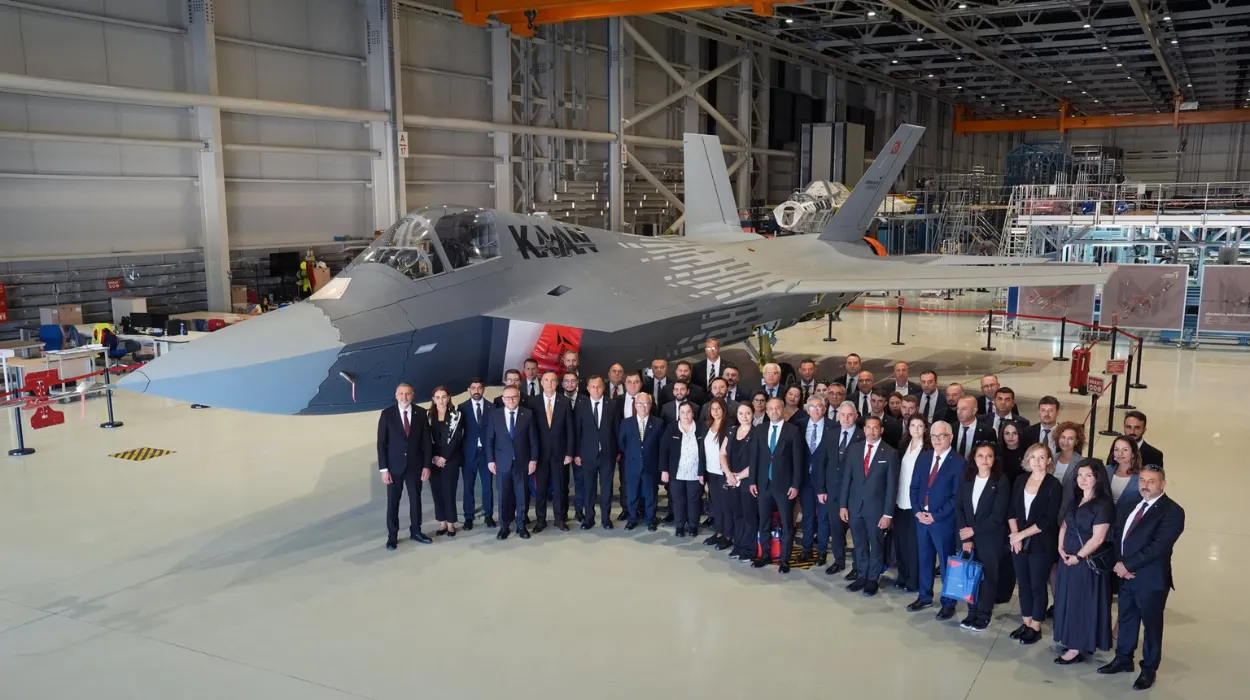
On September 26, 2025, a photo published by the Turkish
Armed Forces Strengthening Foundation (TSKGV) showed the second Kaan prototype
in the background. Standing in front of the first Kaan prototype, the photo
depicted a TSKGV group visiting Turkish Aerospace’s facilities in
Kahramankazan, close to Ankara. Although it didn’t seem to have either wings or
a tail, the second prototype’s fuselage’s interior structure looked to be
mostly finished.
After suspending Turkey’s participation in the F-35 Joint
Strike Fighter program the year before, the US State Department imposed
penalties against Turkey on December 14, 2020, under the Countering America’s
Adversaries Through Penalties Act (CAATSA).
This resulted from Ankara’s determination to move forward
with the purchase of the Russian S-400 air defense system, despite the US
government’s warning
that doing so would reveal the F-35’s stealth advantages due to Turkish hosting
of Russian technicians. This ultimately resulted in Turkey being kicked out of
the F-35 program completely, as well as a prohibition on all defense-related US
export licenses to the country.
After hosting Turkish President Recep Tayyip Erdoğan at the
White House in Washington, DC, on 25 September 2025, US President Donald Trump
hinted of the potential for Türkiye to be allowed to buy F-35s if it stopped
buying Russian oil, although this seems problematic, given that Ankara
proceeded with its S-400 purchase.
However, Turkish Foreign Minister Hakan Fidan stated on 26
September, “At present, the F-35s we are expecting and Kaan’s engines are being
held up in the US Congress, with their export licences frozen. Those licences
must be activated and the engines delivered so that Kaan’s production can move
forward.”
Although two US General Electric F110-GE-129 turbofans,
which were part of the first batch of these powerplants provided to Turkish
Aerospace before the US sanctions, power the first Kaan prototype, it is
obvious that several dozen turbofans would be needed for the Kaan to go into
production.
Tusaş Engine Industries (TEI) of Turkey and TRMotor are
working together to build an indigenous powerplant for the Kaan called the
TF35000 turbofan, but it is unlikely that the aircraft will be ready for
integration before 2032.
In his remarks, Fidan said that if the CAATSA problem is not
fixed, Türkiye will have to look for another powerplant provider. One possible
remedy in this respect could be found in China’s WS series of combat power
plants.
Although Turkey is still a member of NATO, the Erdoğan
administration’s foreign policy approach has frequently caused the nation to
clash with the organization. This was exemplified by the acquisition of the S-400
system, but more recently, Erdoğan has maintained friendly ties with Russia and
China, NATO’s enemies. For instance, Erdoğan was one of the national leaders in
attendance at the Shanghai Cooperation Organization (SCO) 2025 summit in
Tianjin, China, when he met with Russian President Vladimir Putin and Chinese
President Xi Jinpeng.
Another dilemma concerning the Kaan program and Turkey’s
defense export licenses is how likely it is that the US government will support
the creation of a fifth-generation fighter in 10 years.
What are the immediate impacts on KAAN test flights and
timeline?
The KAAN program has completed its initial prototype, which
had its first flight in February 2024. A second test flight of this prototype
occurred later that year. Two additional prototypes are under construction,
with flight tests beginning for one by mid-2026 and the other by early 2027.
The first production blocks rely on engines manufactured in
the US by General Electric (GE) F110. The US Congress’ temporary suspension of
engine license exports introduces a risk of delay in flight testing, early
deliveries, and commitments to other export partners, namely Indonesia.
Turkish defense officials, including Haluk Görgün, (head of
the Presidency of Defense Industries) claim that “although the blockade is
in place,” the program “is facing no delays.”