
Summary
- Trump to host Armenia, Azerbaijan leaders.
- Peace deal ends Nagorno-Karabakh conflict.
- The US gets rights to strategic corridors.
- Corridor named "Trump Route" linking Nakhchivan.
- The deal includes a ceasefire and restored diplomacy.
The deal between the South Caucasus rivals - assuming it holds - would be a significant accomplishment for the Trump administration that is sure to rattle Moscow, which sees the region as within its sphere of influence.
"It's a long time - 35 years - they fought and now they're friends, and they're going to be friends for a long time,"
Trump said at a signing ceremony at the White House, where he was flanked by Azerbaijani President Ilham Aliyev and Armenian Prime Minister Nikol Pashinyan.
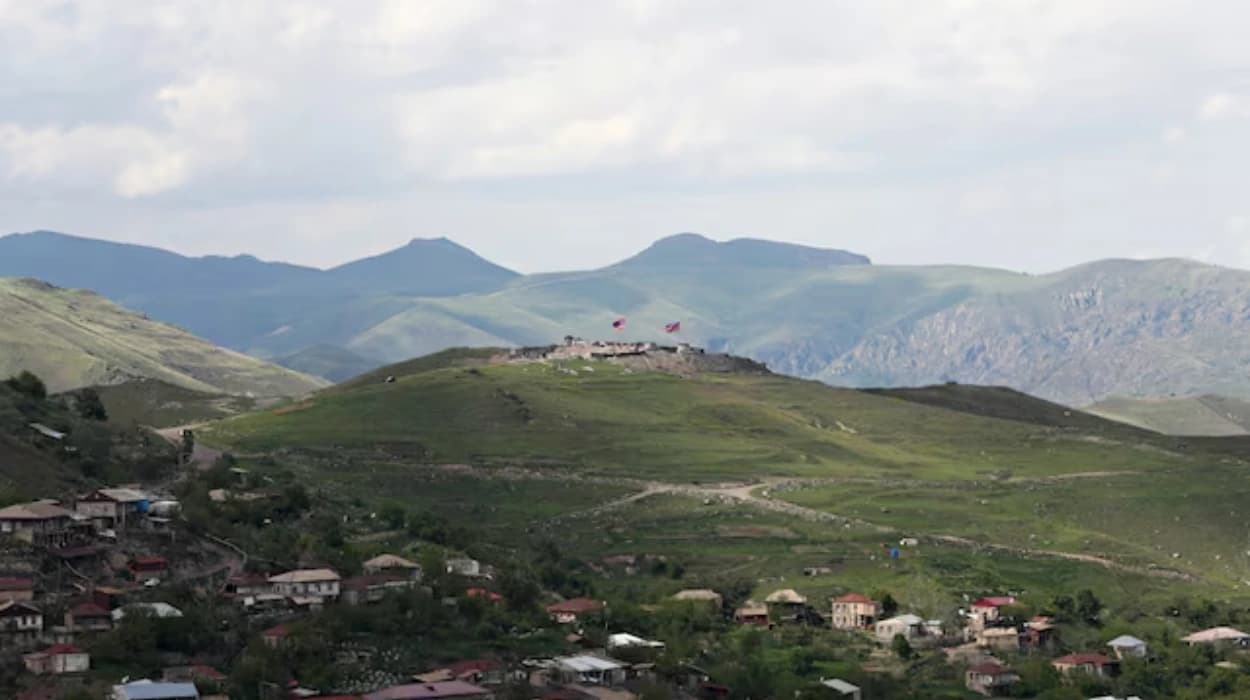
Since Nagorno-Karabakh, a mountainous Azerbaijani territory primarily inhabited by ethnic Armenians, broke away from Azerbaijan with Armenia's help in the late 1980s, tensions between Armenia and Azerbaijan have existed. When Azerbaijan regained complete control of the area in 2023, nearly all of the 100,000 ethnic Armenians living there fled to Armenia.
According to Trump, the two nations agreed to put an end to hostilities, establish diplomatic ties, and respect one another's territorial integrity.
According to the White House, the deal gives the United States the only right to develop a vital transit route in the South Caucasus, which would enable increased exports of oil and other commodities.
Trump claimed that in order to increase collaboration on trade, energy, and technology—including artificial intelligence—the US inked distinct agreements with each nation.
According to him, limitations on Azerbaijan-US defense cooperation have also been removed.
Both presidents declared they would nominate Trump for the Nobel Peace Prize and commended him for his role in bringing the conflict to a close.
“So who if not President Trump deserves the Nobel Peace Prize?”
Aliyev said.
In the first few months of his second term, Trump has made an effort to portray himself as a world peacemaker. He is credited by the White House with negotiating peace agreements between Rwanda and the Democratic Republic of the Congo, Pakistan and India, and Cambodia and Thailand, as well as a truce between Cambodia and Thailand.
The deal, according to U.S. officials, was worked out over several trips to the area and would serve as a foundation for efforts to fully normalize relations between the nations.
Senior government officials told reporters that the deal would send a strong message to the entire area and that it was the first time that multiple frozen issues on Russia's perimeter had been resolved since the end of the Cold War.
The South Caucasus, an energy-producing region that borders Russia, Europe, Turkey, and Iran and is crisscrossed by gas and oil pipelines but is also riven by closed borders and long-standing ethnic wars, could be transformed by the peace agreement.
How will the peace treaty influence Armenia and Azerbaijan's regional stability?
The treaty commits both nations to cease hostilities, establish diplomatic ties, and respect each other's territorial sovereignty, aiming for lasting peace and stability after decades of enmity centered on Nagorno-Karabakh.
A key element is the 99-year U.S.-operated Zangezur corridor (also called the Trump Route for International Peace and Prosperity), connecting Azerbaijan with its Nakhchivan exclave through Armenia. This is expected to open closed borders, boost trade and transit routes linking Europe and Asia, and enhance regional economic integration.
This shift may cause friction with neighboring powers like Russia and Iran, who view the corridor and outside involvement with suspicion.