
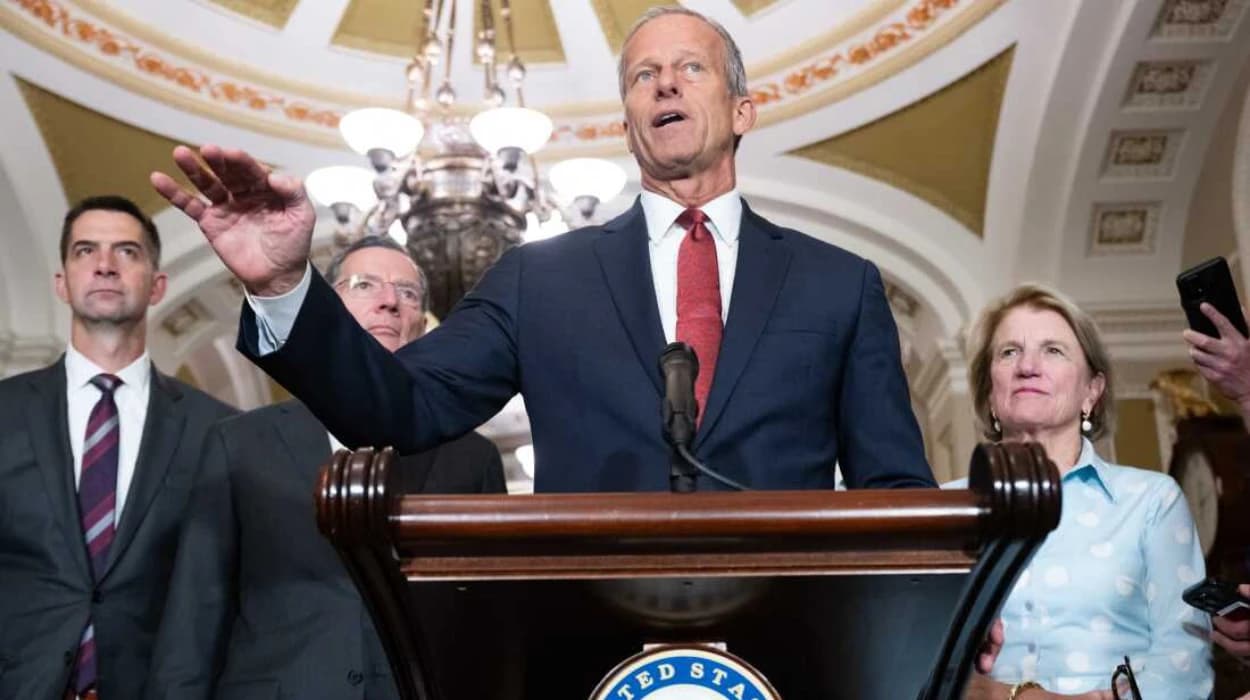
- Senate rules referee's decision impacts Republicans.
- Forces drop of Big Beautiful Bill part.
- Major provision likely removed from legislation.
Late on Friday night, Democrats reported that the Senate parliamentarian had decided that the fast-track legislative methods Republicans are utilizing would prevent a clause mandating states to share the cost of federal food aid from remaining in the measure.
It is a major setback. In addition to significantly altering the Supplemental Nutrition Assistance Program's structure, the proposal included a sizable amount of savings that helped defray the cost of the bill's tax breaks for the wealthy.
The top Democrat on the Senate Budget Committee, Sen. Jeff Merkley (D-Ore.), celebrated the decision after Democrats presented their case to the lawmaker in private discussions.
“As much as Senate Republicans would prefer to throw out the rule book and advance their conservative families lose and billionaires win agenda, this process has rules and Democrats are making sure those rules are enforced,”
Merkley said.
“We will be fighting this bill every single day until Republicans bring it to the floor.”
The bill's House version mandated that states cover at least 5% of the $100 billion yearly cost of SNAP payments, which are distributed to over 20 million people each month. States would have had a significant incentive to remove participants from the program if they had been required to pay benefit costs.
The plan would save $128 billion over ten years, according to the Congressional Budget Office. The Senate version probably saved less because it only required SNAP cost-sharing in states with high rates of incorrect SNAP payments.
Stricter "work requirements" for SNAP recipients without impairments and restrictions on future benefit increases are still there in both the House and Senate versions of the bill.
Republicans are able to pass the Big Beautiful Bill through the Senate with a simple majority vote rather than the customary 60 votes thanks to a parliamentary procedure known as "budget reconciliation." The SNAP cost-sharing proposal appears to have been subject to the 60-vote threshold under the so-called Byrd Rule, presumably because its savings were incidental to its non-budgetary obligation on state governments.
According to Merkley's office, another contentious clause that is thought to have a Byrd Rule issue, a prohibition on states regulating artificial intelligence is currently being examined.
What specific provision did the parliamentarian reject?
Senate Parliamentarian Elizabeth MacDonough rejected a provision in Republicans'" Big Beautiful Bill" that would have needed petitioners seeking primary injunctions against unconstitutional civil conduct to post potentially massive bonds.
The measure aimed to discourage judicial blocks on administrative programs by assessing fiscal penalties on complainants, but MacDonough ruled it violated Byrd Rule norms for conciliation bills by constituting non-budgetary policy change.
GOP lawmakers must now exercise it to pass via simple maturity, as booting her advice requires 60 votes or a rare bottom challenge risking party concinnity. This follows previous blocks on Medicaid cuts and other rudiments.