
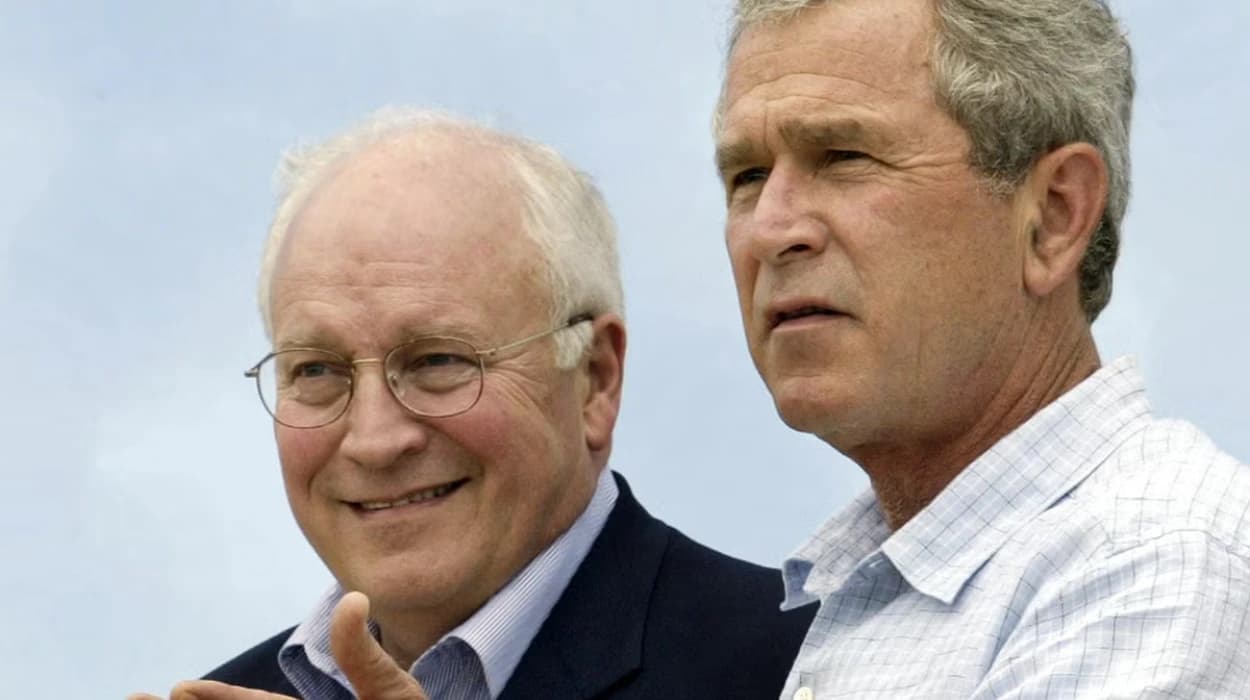
- George W. Bush honored Dick Cheney at his funeral service.
- Called Cheney "defender of the nation" and trusted advisor.
- Praised Cheney’s steady leadership during national challenges.
Cheney, one of the most significant and contentious vice presidents in contemporary American history, serving under Bush from 2001 to 2009. Cheney passed away earlier this month at the age of 84.
As Cheney was honored for his decades of public service and dedication to the nation, two former presidents Bush and Joe Biden as well as four former vice presidents Kamala Harris, Mike Pence, Al Gore, and Dan Quayle were present.
Trump and Vance were not invited to the memorial ceremony on Thursday morning at Washington National Cathedral, despite the fact that sitting presidents usually attend the funerals of past presidents and vice presidents, a source told CNN.
After the events of January 6, 2021, the Cheney family and Trump had a severe falling out, which was reflected in the seeming snub.
"At such a moment, most in this position would have jumped at the chance. But Dick stayed detached and he analyzed it. Before I made my decision, he insisted on giving me a complete rundown of all the reasons I should not choose him,"
Bush said.
"In the end, I trusted my judgment. I remember my dad's words when I told him what I was planning. He said, 'Son, you couldn't pick a better man,'"
he added.
Before the 2024 presidential election, Cheney supported former Vice President Kamala Harris, according to his daughter.
After Cheney passed away on November 3, the current president, Donald Trump, did not say much about him. In addition to not making a statement regarding Cheney's passing, Trump did not release the presidential proclamation that usually follows the passing of prominent individuals.
Press secretary Karoline Leavitt stated that the White House lowered its flags to half-staff upon Cheney's passing
"in accordance with statutory law."
Although several of Cheney's actions proved to be very controversial, particularly in the wake of the September 11 terror attacks on the United States in 2001, Cheney was regarded by many as one of the most important vice presidents in recent history.
In 1991, after Iraqi dictator Saddam Hussein invaded Kuwait, he assisted in organizing the United States' entry into the First Gulf War while serving as defense secretary.
In particular, the 2003 invasion of Iraq served as a spark for strong opposition in the US and other countries. By asserting that Saddam was creating weapons of mass destruction and that he could be connected to Al-Qaeda, the terrorist organization responsible for the 9/11 attacks, President Bush's administration and its allies were charged with creating a false pretext for invasion.
Thousands of fighters and civilians were killed and injured throughout the conflict, which was held responsible for the region's devastation and the ultimate emergence of the extremist organization Islamic State.
Later, Cheney defended the invasion of Iraq, stating to the Senate Intelligence Committee in 2014 that
"I would do it again in a minute."
His wife Lynne, daughters Liz and Mary, and seven grandkids survive him.
What role did Cheney play in decisions about the Iraq War?
Cheney was an early and oral exponent of overrunning Iraq, asserting that Saddam Hussein’s governance held munitions of mass destruction( WMDs) and had ties to al- Qaeda, claims that were later discredited. He laboriously shaped the Bush administration’s “ war on terror ” strategy and made multitudinous public statements emphasizing the trouble posed by Iraq.
Cheney supported programs during the occupation, including the controversial disbanding of the Iraqi army and the debaathification process, which critics say contributed to insecurity and insular violence.
Cheney’s heritage is nearly tied to the Iraq War decision, which remains a deeply controversial aspect of his vice administration due to the war’s human, fiscal, and geopolitical costs.