
- British
far-right activists increased Channel patrols. - They
travel to northern France frequently. - Aim
to deter migrants from crossing.
Social media videos show members of the far-right group
Raise the Colours in Normandy confronting alleged undocumented migrants and
claiming to have discovered and destroyed small boats that would have crossed
the Channel.
As a “civilian border control force,” the
activists claim that their goal is to “stop an invasion of illegal
immigrants” into the United Kingdom.
They contend that little action is being taken by the UK and
France to prevent illegal immigration across the Channel.
However, organizations that support migrants claim that the
group is “encouraging violent and xenophobic practices” due to the
French and British authorities’ inaction.
“These are people who come to France with the express
intention of committing crimes such as harassment. They are a threat to public
order,”
said a spokesperson from L’Auberge Des Migrants, one of nine
associations that issued a statement calling for France and the UK to take
action against the group.
“The measures that are being taken [by the authorities]
are totally inadequate in view of the real threats that members of this
far-right group pose,”
they added.
With 37,000 individuals crossing the English Channel in
2024, one of the highest yearly numbers in the previous ten years—it has
emerged as the main point of entry for illegal immigration into the UK over the
last ten years.
The numbers are generally comparable throughout Europe,
where the number of unauthorized maritime arrivals has increased dramatically
since 2015, particularly in Italy, Spain, and Greece.
In the UK, the tiny boats, that is, the inflatable boats
frequently used to transport migrants between Calais and Dover have emerged as
a particularly contentious subject.
For years, the far right in Britain has promoted the idea
that the boats are full of criminals who are a threat to British society,
particularly women and children.
According to Tim Bale, a professor of politics at Queen Mary
University of London, a “significant minority” of UK voters now
associate the small boats with the notion “that the UK government has lost
control of its borders, and that many of those trying to get into the country
are from countries whose culture and religion is seen as alien and
dangerous.”
With Keir Starmer’s government outlining a number of
measures to discourage illicit Channel crossings, the topic has also begun to
dominate mainstream politics amid the growing popularity of the right-wing
party Reform UK.
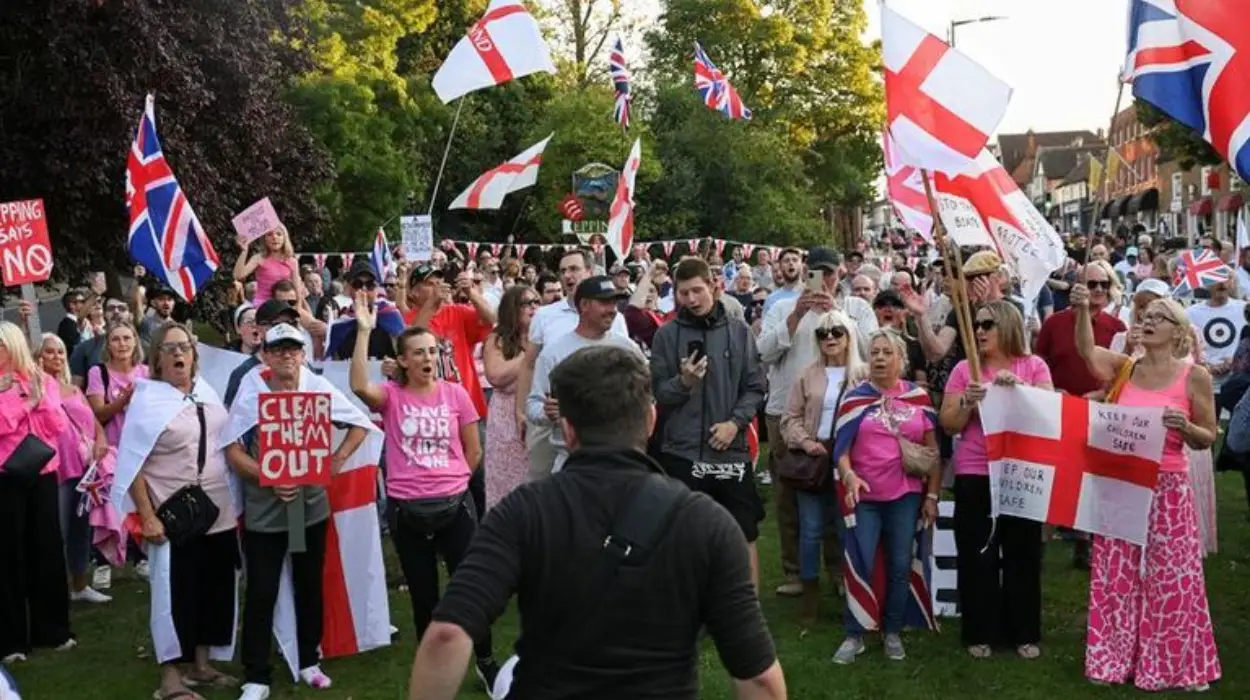
Over the summer, Raise the Colours led a movement to cover
the UK with national flags in response to growing anti-immigration sentiment.
Although the UK’s extreme right has a long history of
exploiting national flags as a symbol to further its ideals, the group has
denied that the flagging effort is an attempt to spread racist propaganda.
According to Paul Jackson, a lecturer at the University of
Northampton studying the history of radicalism and extremism, these include
“issues such as managing borders, criticizing government policies around
immigration and broad patriotic themes.”
Aaron Winter, a senior sociology lecturer at Lancaster
University, noted that the flagging campaign has been carried out “in ways
that almost stake a nativist claim onto neighborhoods and is used to intimidate
people, explicitly targeting migrants.”
The organization has been documenting trips to France on the
internet for the past few months, including livestreams of members hiding in
sand dunes to observe activities in the Channel at night and posing as
authorized journalists to confront suspected illegal migrants.
A video of a member wading into the shallows and yelling
that suspected undocumented migrants on a boat in the distance are
“potential rapists” and “murderers” was uploaded to the
group’s social media channel in early November.
The group declared in late November that it will intensify
its operations in France under the code name “Overlord,” which also
refers to the Battle of Normandy, in which over 160,000 allied troops landed in
France to start the liberation of Western Europe during World War II.
Another video depicts the group’s leaders being halted by
French authorities to verify their identities before being let to
proceed.
“Within ten seconds they opened the window of their
vehicle to continue openly harassing the migrants, even though the police were
just ten metres behind them,”
said the spokesperson from L’Auberge Des
Migrants.
“There is a striking discrepancy. The migrants, who are
covered by international protections, are constantly being checked, expelled
and dispersed [by the police]. And, yet, when far-right groups suddenly turn
up, nothing is done. These people move around the coastline completely freely,
harassing exiles live on social networks,”
they said.
On December 5, French police held members of Raise the
Colours for a few hours before releasing them.
According to the group’s web claims, 5,500 people have shown
a willingness to travel to France to “stop the boats.” It has called
for donations, drones, thermal cameras, stab-proof vests, encrypted radios, and
volunteers.
What legal actions have French authorities taken against
these activists?
French authorities have responded to British far-right
activists’ conditioning in northern France with limited but targeted legal
measures, primarily identity checks, detentions and examinations rather than
wide executions.
Police have conducted identity verifications and temporary
detentions of individualities from groups like Raise the Colours during sand
details near Calais and Dunkirk, with some released after warnings; no mass
apprehensions reported as of December 11, 2025.
Authorities appertained incidents involving alleged boat
damage, importunity of settlers or aid workers to prosecutors for review under
charges of irritated violence, detest speech and public order offenses, though
issues remain pending amid complaints of lenient enforcement.