
Summary
- Trump
announced US Space Command HQ moved to Alabama. - Reverses
Biden decision to keep HQ in Colorado Springs. - Huntsville
called “Rocket City,” key for space and defense. - The
move is expected to create thousands of jobs, boost the economy.
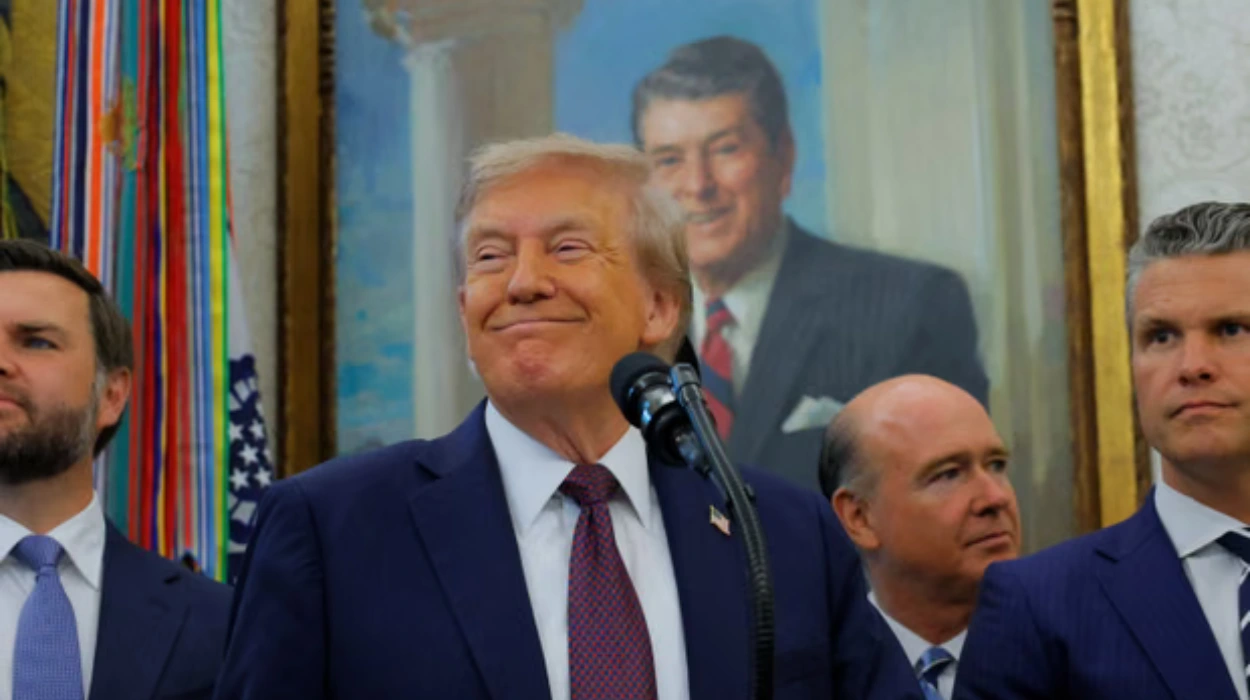
At a White House news conference, Trump announced that the
space command would move to Huntsville, Alabama, surrounded by Republican
senators and members of Congress. The action overrides a decision made by the
Biden administration to locate the facility at its existing temporary
headquarters in Colorado, which leans Democratic.
“The US Space Command headquarters will move to the
beautiful locale of a place called Huntsville, Alabama, forever to be known
from this point forward as Rocket City,”
Trump said.
“We had a lot of
competition but Alabama’s getting it.”
Alabama, which voted for Trump “by about 47
points,” would receive hundreds of billions of dollars and more than
30,000 new jobs as a result of the relocation, the president said.
“They fought harder for it than anyone else,”
Trump claimed,
before adding that Colorado’s decision to allow mail-in voting was “corrupt”.
“The problem I have with Colorado, one of the big problems,
[is that] they do mail-in voting,”
he said.
“So they have automatically crooked
elections and we can’t have that. When a state is for mail-in voting, that
means they want dishonest elections. So that played a big factor.”
The US Army Space and Missile Defense Command, NASA’s
Marshall Space Flight Center, and the 38,000-acre Redstone Arsenal are already located
in Huntsville. Due to its cost-effectiveness, the city was chosen by the US Air
Force as its preferred location for Space Command in 2021.
Two years later, in 2023, Biden overturned those plans to
relocate to Alabama. Instead, Biden chose to make the then temporary Colorado
Springs location permanent, taking a recommendation from Gen James Dickinson,
the former head of Space Command. Dickinson reportedly said relocating to
Alabama could jeopardize military readiness as making the headquarters fully
operational would take time.
“For FOUR YEARS, I have fought to get U.S. Space Command
moved to its SELECTED home at Redstone Arsenal in Huntsville, Alabama,”
Senator
Tommy Tuberville wrote alongside a video statement after Trump’s announcement.
“Thank you, President Trump and Secretary [Pete] Hegseth, for reversing Joe
Biden’s political cronyism and restoring MERIT and INTEGRITY to this process.”
In his video, Tuberville criticized Biden for his 2023
choice to keep Spacecom in Colorado Springs, claiming the former president
“caved” to “woke politics” at the time and allowed the
“nation’s security [to] take a backseat to politics.” He then claimed
that the action would save taxpayers $480 million and congratulated Trump for
“restoring merit and integrity” to space exploration.
Following days of fervent internet conjecture on his health,
which was stoked by his lack of public appearances since last week, Trump
announced a change of direction.
Trump said that he had attended multiple news conferences in
the previous week and cited some “pretty poignant” posts when asked
if he was aware that there had been 1.3 million social media engagements as of
Saturday am speculating on his potential “demise.”
What operational reasons did the Pentagon give for opposing
the move?
Military officials warned that relocating Space Command
would jeopardize military readiness, causing disruptions that could affect
critical national security operations in space. Concerns were raised about
logistical complications, loss of experienced personnel, and delays arising
from moving the command’s infrastructure and workforce.
The decision to keep the headquarters in Colorado under the
Biden administration was based on assessments from Space Command leadership and
defense experts who emphasized continuity and minimizing risks to ongoing space
defense missions.
The Pentagon viewed Colorado Springs as the optimal
strategic location due to established infrastructure, existing workforce, and
proximity to other defense installations.