
Summary
- Texas House approves new GOP-favored map.
- Map grants five extra House seats to Republicans.
- Democrats oppose the plan, citing racial
discrimination. - Trump was accused of stacking the midterm election
deck.
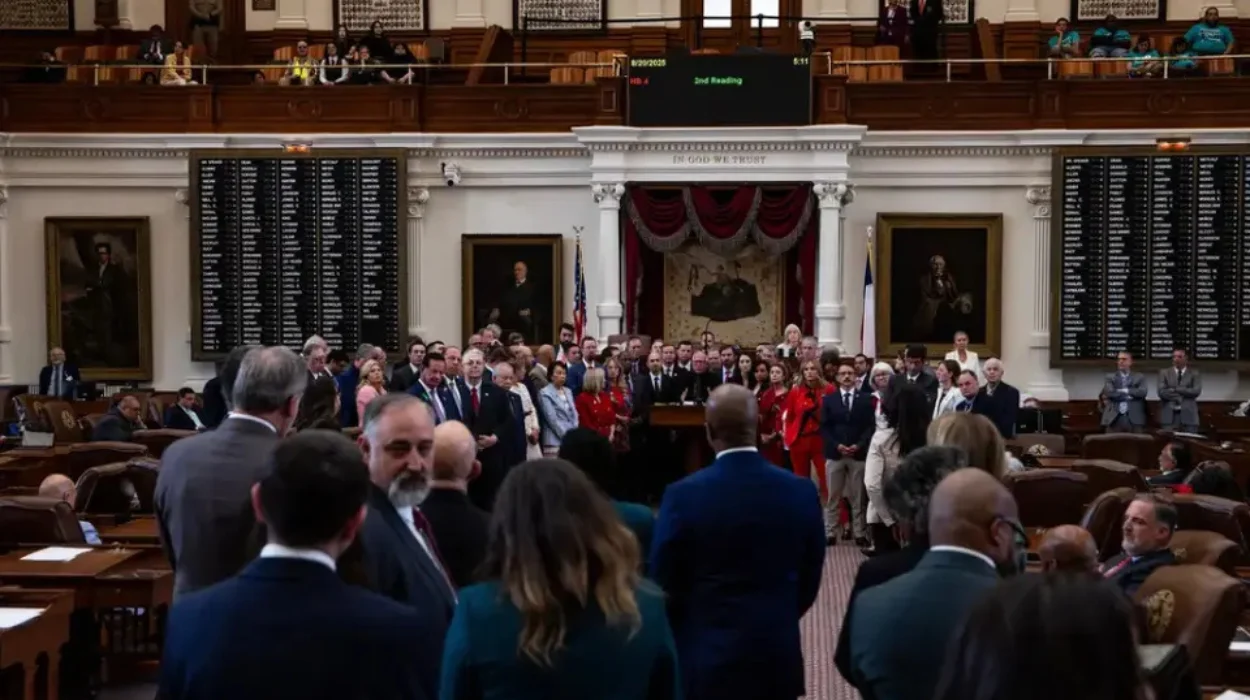
By a vote of 88 to 52, the House approved the
map along party lines. Later this week, the entire Senate was supposed to
deliver the updated lines to Governor Greg Abbott’s desk after a Senate panel
advanced the plan Thursday morning.
Under pressure from Trump to preserve the GOP’s
narrow majority in Congress, Republican lawmakers are pursuing the unique
mid-decade redistricting plan, which has sparked a national map-drawing
conflict.
Only four years have passed since the Legislature last revised the state’s congressional map
in the wake of the 2020 Census.
In an attempt to delay the adoption of the map
and create a nationwide backlash among blue states, where lawmakers could begin
their own retaliatory redistricting attempts, Democrats in the Texas House
organized a two-week boycott over the proposal.
Republicans have claimed that the new districts
were created solely to increase their partisan advantage, claiming that the
GOP’s 2024 victory margins validated new boundaries that strengthened their
control of the party.
Additionally, they have presented the initiative
as a reaction to Democratic gerrymandering in other places.
In outlining House Bill 4, the map’s proponent,
Rep. Todd Hunter, R-Corpus Christi, stressed that Republicans were legally
allowed to undertake redistricting in the middle of the decade in order to
maximize political benefit.
“Redistricting can be done at any point in
time,”
he said.
“The underlying goal of this plan is straightforward: improve
Republican political performance.”
Without substantially endangering any of the 25
districts that Republicans currently control, the plan reddens Democratic-held
seats in South Texas and destroys Democratic strongholds in the Austin, Dallas,
and Houston areas to generate up to five Republican pickup possibilities.
Additionally, a few Democratic members of
Congress would be forced into seats currently occupied by other Democrats under
the proposed map, perhaps resulting in primary conflicts between younger,
up-and-coming candidates and more seasoned members of the Texas delegation.
In 2019, the U.S. Supreme Court decided that
states have the right to create electoral maps based on political affiliation.
However, the Voting Rights Act’s Section 2 states that the map cannot reduce
persons of color’s ability to vote.
How might the new congressional map impact
future Texas elections?
The map is designed to add five additional U.S.
House seats favoring Republicans, increasing their chances to flip
Democratic-held districts and expand their representation. This boosts GOP
electoral strength in Texas and helps protect their narrow majority in the U.S.
House.
By “packing” Democratic voters into
fewer districts and “cracking” others by splitting up Democratic
strongholds and merging them into larger, more rural, Republican-leaning
districts, the map reduces the overall impact of Democratic voters. This
strategic redrawing weakens the Democrats’ ability to compete genome-wide.
The map deliberately skews district boundaries
to maximize Republican success, potentially leading to less competitive races
and solidifying GOP control in many districts.