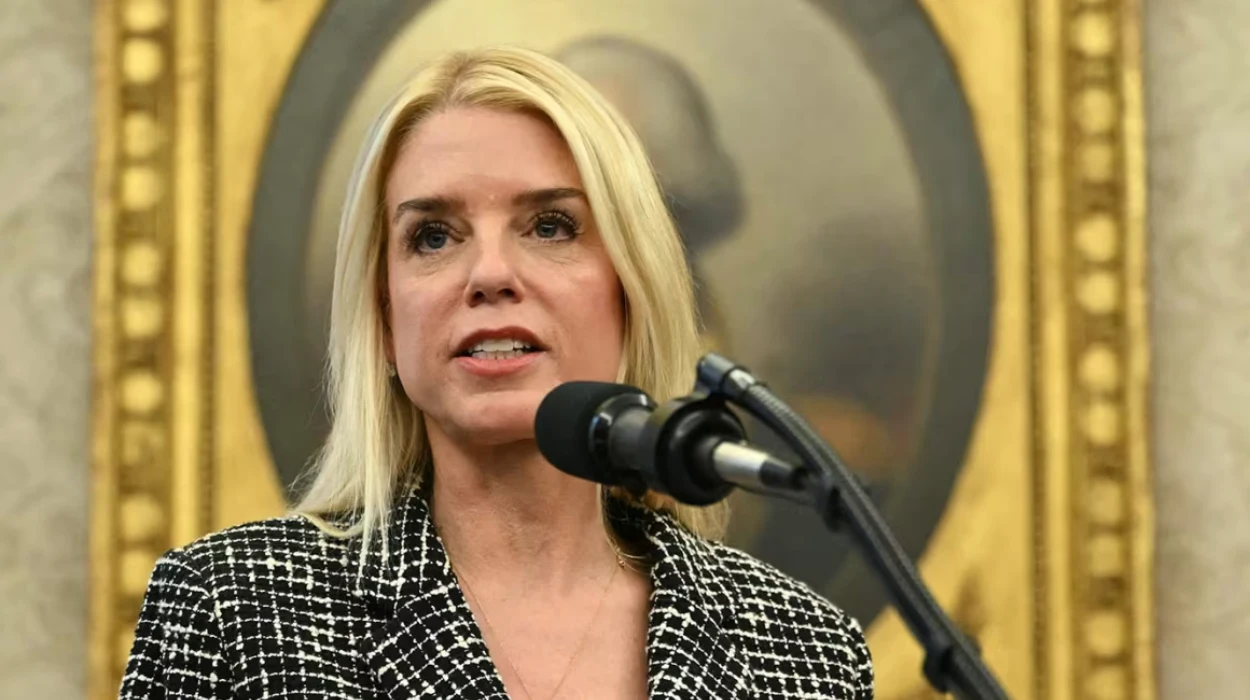

Born on November 17, 1965, in Tampa, Florida, Pamela Jo
Bondi is a fourth-generation Florida resident whose formative years and
schooling prepared her for a successful career in law and politics. Bondi
completed her undergraduate work at the University of Florida, earning a
Bachelor of Science, and then transferred to law school and earned her Juris
Doctor from Stetson University College of Law. After being admitted to the
Florida Bar in 1991, she spent 18 years as a prosecutor at the Hillsborough
County State Attorney’s Office, handling a diverse case-load that encompassed
domestic violence, capital murder, and various other serious criminal offenses.
This extensive prosecutorial experience helped Bondi develop a reputation for
toughness and dedication, especially in the area of protecting victim’s rights
and fighting crime.
Bondi’s legal experience also provided a firm launching pad
into electoral politics. Her years in the prosecutor’s office honed her
litigation skills and increased her understanding of the justice system,
passion for fighting drug abuse, and commitment to combating violent crime.
These early years also provided her a first-hand understanding of community
issues, law enforcement issues, and the connection of prosecution to policy.
Political rise and tenure as Florida Attorney General
Pam Bondi began her career in electoral politics in 2010
when she ran for Attorney General of Florida. This campaign marked the first
time a woman was elected to the office in Florida’s history, and in 2014 she
was re-elected, paving the way for her to become Florida’s first two-term
Republican attorney general. Pam Bondi served as Florida’s attorney general
from 2011 to 2019 and her tenure was defined by aggressive law enforcement and
ambitious legal agendas.
One of the signature issues for Bondi was the opioid
epidemic when Florida was branded the “pill mill capital of the United
States.” In the early stages of her time in office, she strongly advocated
for legislation shutting down clinics and doctors suspected of illegally
prescribing opioids, and the state closed down almost 100 oxycodone dispensers
once flagged as large contributors to the epidemic. Her leadership positioned
Florida as a national leader regarding the opioid abuse epidemic through legal
and legislative response.
In addition to drug abuse prevention, Bondi paid particular
attention to consumer protection and combating public corruption. She
prosecuted numerous cases of financial crime and fraud, advocated for victims’
rights, and prosecuted cases of mortgage fraud and white-collar crimes. She
also led several initiatives to combat human trafficking and worked on
legislation to strengthen support programs for victims of trauma.
Nonetheless, Bondi’s time in office was not devoid of
controversy. In 2013, she was criticized for persuading the then-Governor Rick
Scott to change the date of an execution scheduled to be carried out on death
row to avoid interrupting a fundraising event for Bondi’s campaign—a decision
that Bondi later publicly expressed regret for and apologized over.
Furthermore, Bondi had a reputation for opposing marijuana legalization, and
for directing considerable energy and time to litigation against the Affordable
Care Act (Obamacare) and its provisions—especially the individual mandate.
During her time as Florida’s attorney general, Bondi’s
public presence increased significantly, along with appearances on various
television programs, including a role as co-host on the Fox News program “The
Five.” Such exposure increased her profile, shifting from legal authority to
media personality. As with any media celebrity, controversy sometimes
accompanied the dual roles of legal authority and television commentator,
especially with regard to ethics questions regarding her appearances on television
while a public official.
Role in national politics and appointment as U.S. Attorney
General
Following her two terms as Florida Attorney General, Pam
Bondi transitioned into a more national role. She became part of President
Donald Trump’s legal defense team during his first impeachment trial in 2020,
showcasing her status as a loyal Republican ally and national legal figure
within conservative circles. Between 2019 and 2024, Bondi acted as a partner at
Ballard Partners LLC, a prominent lobbying firm, further expanding her
influence in Washington, D.C.
In November of 2024, Donald Trump, who had been elected
President and was set to take office in January, nominated Bondi as the 87th
Attorney General of the United States, after Matt Gaetz withdrew his name from
consideration. She was confirmed by the Senate by a vote of 54 to 46 on
February 4, 2025, which conveys the usual partisan divisions in the U.S. Senate
while also stating her position as a political figure in the country. Bondi was
sworn in the following day, February 5, 2025, to lead the Department of Justice
during a time of particularly hostile and complex political relations.
During Bondi’s first months of service as U.S. Attorney
General, she quickly enacted some contentious yet bold policies, including
disbanding the FBI’s Foreign Influence Task Force and the DOJ’s Task Force
KleptoCapture, and decreasing enforcement of the Foreign Agents Registration
Act. These actions demonstrated her allegiance to the incoming administration’s
agenda while establishing herself as a collaborative agent of government to
improve federal enforcement and regulation.
Bondi’s service continued with addressing sensitive subjects
including how her agency would respond to the release of records regarding
Jeffrey Epstein and responding to lawsuits from nine states concerning
immigration enforcement acted upon by the Trump administration. Her statements
were publicly antagonistic to the courts and judiciary when referring to their
“meddling” into the executive branch’s constitutional authority during this
time.
Financial profile and personal life
Pam Bondi’s financial situation reflects her long-term
careers in public service and private legal practice. Her 2025 projected net
worth will fall between $6 and $10 million, all of which Bondi has accumulated
through her salaries as Florida Attorney General, private sector legal
practice, lobbying fees and public speaking fees. Based on general generated
data, presidents of public corporations earn approximately $150,000 to $200,000
per year, plus Bondi earned fees for consulting and speaking fees.
Bondi’s personal life consists primarily of her marriage to
Scott Fitzgerald, who is a private citizen, but otherwise Bondi has lived in
relative anonymity when not in public office. Bondi is believed to practice
Roman Catholicism, which has informed her social and moral viewpoints. Bondi
has no children, which leaves her with her time and energy to concentrate on
her numerous professional responsibilities.
The representation of Bondi’s private life in the media
characterizes her professional obligations against the backdrop of family
duties and responsibility. While Bondi has purportedly raised money for
charitable causes and engaged in community outreach, it is consistent with her
public service and legal/political background.
Impact, public perception, and legacy
Pam Bondi’s career is a journey of energized triumphs and
challenges based on partisanship. As the first female Attorney General in
Florida, Pam’s effects on the policy areas of state and federal enforcement
practice are focused on the areas of drug abuse, human trafficking, and
financial crimes. Her leadership style
can be described well as aggressive prosecution flavored with a media-savvy
component that projects a powerful public persona, even at times, controversial.
When she transitioned to the U.S. Attorney General position,
she fell into the national legal and political divides at a tumultuous time in
American democracy that pulled her toward a prominent timeline in politics. Her
time served as U.S. Attorney General included substantive starts to revamping
federal justice priorities that aligned with Conservativism, but more
significantly, substantial legal issues surrounding election integrity,
immigration enforcement, and large-scale criminal investigations.
Opinions about Bondi vary widely. Supporters describe her as
dedicated and vigorous policymaker, while her opponents express concern
regarding her promoting politicization of justice, and ethics, for someone to
be a lawyer. Her appearance on the airwaves and various forms of media likely
contributed to improved outcomes, but also increased scrutiny, which often
comes with being a high-profile case.
Most likely Bondi’s legacy will be assessed through the lens
of breaking through gender barriers, development of anti-drug policy, and
managing the complexities of law, politics, and media in the United States 21st
century. As we navigate our current socio-legal dilemmas, her career will
provide insights into the dual role of attorneys as actors of law and politics,
as we continue to navigate challenges for our society in contemporary America.