
Summary
- Israel
agreed to initial troop withdrawal under U.S.-brokered ceasefire. - Troops
pulled back to a designated ‘yellow line’ inside Gaza. - Ceasefire
includes release of hostages by Hamas and prisoners by Israel.
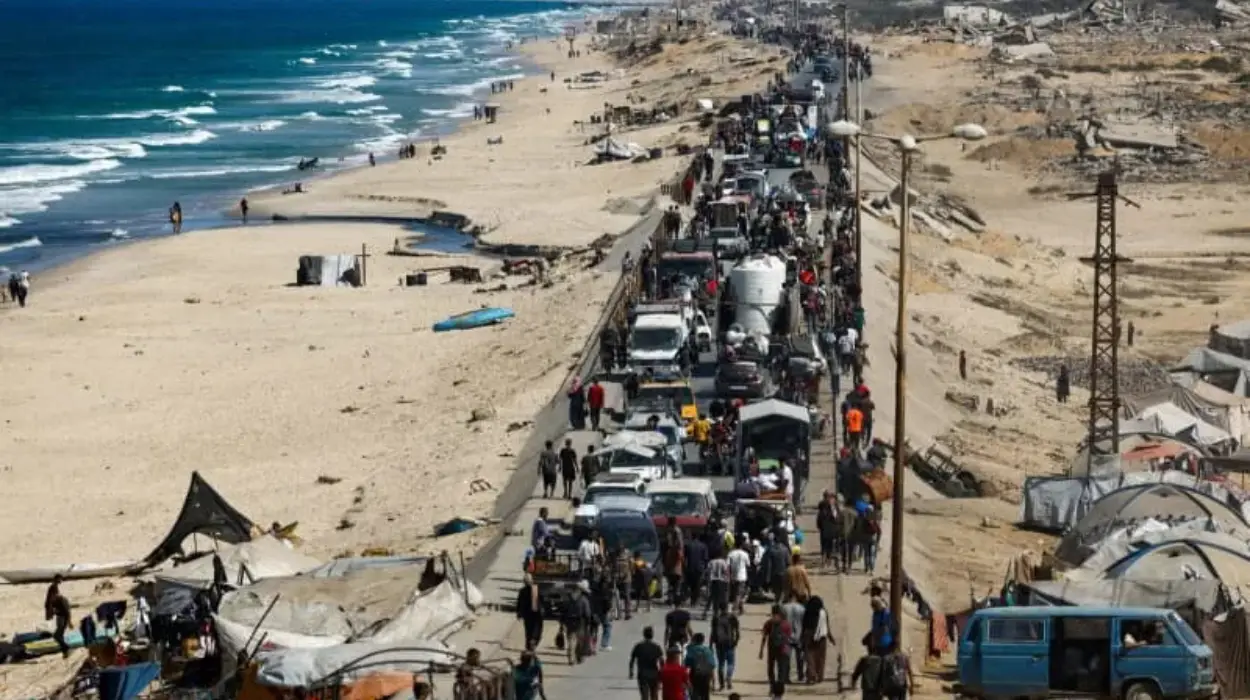
As a ceasefire between Israel and
the Palestinian terrorist organization Hamas seemed to be holding, thousands of
Palestinians moved north along Gaza’s coast on Saturday, returning to their
deserted homes by foot, car, and cart.
Under the first phase of a deal
mediated by the United States and signed this week, Israeli troops withdrew
from the conflict, which has claimed tens of thousands of lives and left much
of Gaza in ruins.
“It is an indescribable
feeling; praise be to God,”
said Nabila Basal as she traveled by foot with
her daughter, who she said had suffered a head wound in the war.
“We are
very, very happy that the war has stopped, and the suffering has ended.”
According to a security source
cited by Israeli Army Radio, Steve Witkoff, the Middle East envoy for US
President Donald Trump, visited Gaza early on Saturday to see the Israeli
military redeployment.
Admiral Brad Cooper, the commander
of the US military’s Central Command (CENTCOM), joined him. According to a
statement, his visit was a component of the formation of a task force to assist
with stabilizing efforts in Gaza. US forces would not, however, be stationed
inside the Strip.
The clock started
to tick for Hamas to free its hostages within 72 hours after Israeli forces
finished their redeployment on Friday, which keeps them out of major cities but
leaves them in control of almost half the Gaza Strip.
“We are very excited, waiting
for our son and for all the 48 hostages,” said Hagai Angrest, whose son
Matan is among the 20 Israeli hostages believed to still be alive.
“We are
waiting for the phone call.”
Two hostages remain unaccounted
for, and 26 hostages have been pronounced dead in absentia.
The agreement states that Israel
will release 1,700 inmates taken during the war and 250 Palestinians serving
lengthy terms in its prisons upon the release of the hostages.
The arrangement calls for hundreds
of trucks a day to flood into Gaza with food and medical aid.
More than 67,000 Palestinians have
been murdered in the war that followed the attacks, according to Gaza’s health
ministry, which is governed by Hamas and does not differentiate between
civilians and fighters.
Trump, the first American
president to do so since George W. Bush in 2008, is scheduled to travel to the
area on Monday and speak to Israel’s parliament, the Knesset.
What humanitarian aid is being
allowed into Gaza now?
Aid convoys, coordinated by the
United Nations and other humanitarian organizations, are bringing in food
staples like flour, sugar, canned goods, medicines, baby formula, and
nutritional supplements.
Humanitarian corridors established
by the Israeli military facilitate the safe movement of aid trucks into Gaza,
operating for specific hours daily. The Kerem Shalom crossing is the main entry
point, with a limited number of aid trucks allowed in each day compared to
pre-conflict levels (dozens versus the usual hundreds).
There have been airdrops of
medical and food supplies by Israel and allied countries including Jordan and
the UAE.