
- Senate
blocked six-bill funding package on 29 January 2026 over Democratic
demands for DHS and ICE reforms, risking partial government shutdown by
Saturday midnight. - Pennsylvania
House Democrats urged Senators Fetterman and McCormick to oppose DHS
funding without enforceable changes to ICE operations, citing public
safety and due process risks. - Letter
to editor (Milwaukee Journal Sentinel, 30 January) calls for Congress to
reject DHS funding until reforms like warrants, de-escalation training and
ending racial profiling are secured. - Triggered
by fatal ICE shootings of Alex Pretti and Renee Good in Minnesota;
proposed reforms include body cameras, no masks and uniform conduct codes. - House
Republicans warn against Senate alterations; negotiations seek short-term
DHS extension while separating non-DHS bills for passage.
Washington (Washington Insider Magazine) January 30, 2026
– Congress stands on the brink of a partial government shutdown after the
Senate blocked a six-bill funding package on 29 January, primarily due to
Democratic demands for reforms to Department of Homeland Security (DHS)
operations. Pennsylvania Democratic House members urged their senators to oppose
the DHS funding bill without enforceable changes to Immigration and Customs
Enforcement (ICE) and related agencies, citing risks to public safety and due
process. A letter to the editor published on 30 January called for Congress to
vote no on DHS funding until reforms including warrants, de-escalation training
and ending racial profiling are secured. Negotiations continue between Senate
leaders and the White House for a compromise separating non-DHS bills while
extending short-term DHS funding to avert a lapse by Saturday midnight.
The Senate vote on Thursday, 29 January 2026, saw 45 votes
in favour and 55 against advancing the appropriations package, falling short of
the 60-vote threshold needed to overcome a filibuster. Democrats, joined by
several Republicans including Senators Mike Lee, Rand Paul, Rick Scott, Ted
Budd, Ron Johnson, Ashley Moody and Tommy Tuberville, opposed the bill. Senate
Majority Leader John Thune voted against it procedurally to allow bringing the
measure up again.
Triggering Incident Sparks DHS Reform Demands
The impasse stems from public outrage over fatal shootings
by federal immigration agents in Minnesota. On the weekend prior to 28 January,
agents shot and killed Alex Pretti, an ICU nurse, and Renee Good, intensifying
scrutiny of ICE and U.S. Customs and Border Protection (CBP) practices.
Democrats in both chambers have conditioned support for DHS
fiscal year 2026 funding on reforms addressing these incidents. Proposed
changes include ending roving patrols, requiring written warrants for
enforcement actions, mandating body cameras, establishing a uniform code of
conduct, use-of-force rules and de-escalation training for officers.
Senate Minority Leader Chuck Schumer stated on 28 January,
“Until ICE is properly reined in and overhauled legislatively, the DHS
funding bill doesn’t have the votes to pass.” Senator Chris Murphy,
ranking member of the Senate Appropriations subcommittee on Homeland Security,
indicated that such reforms could be negotiated in a few days as the proposals
have been under discussion.
Pennsylvania Delegation’s Letter Calls for Opposition
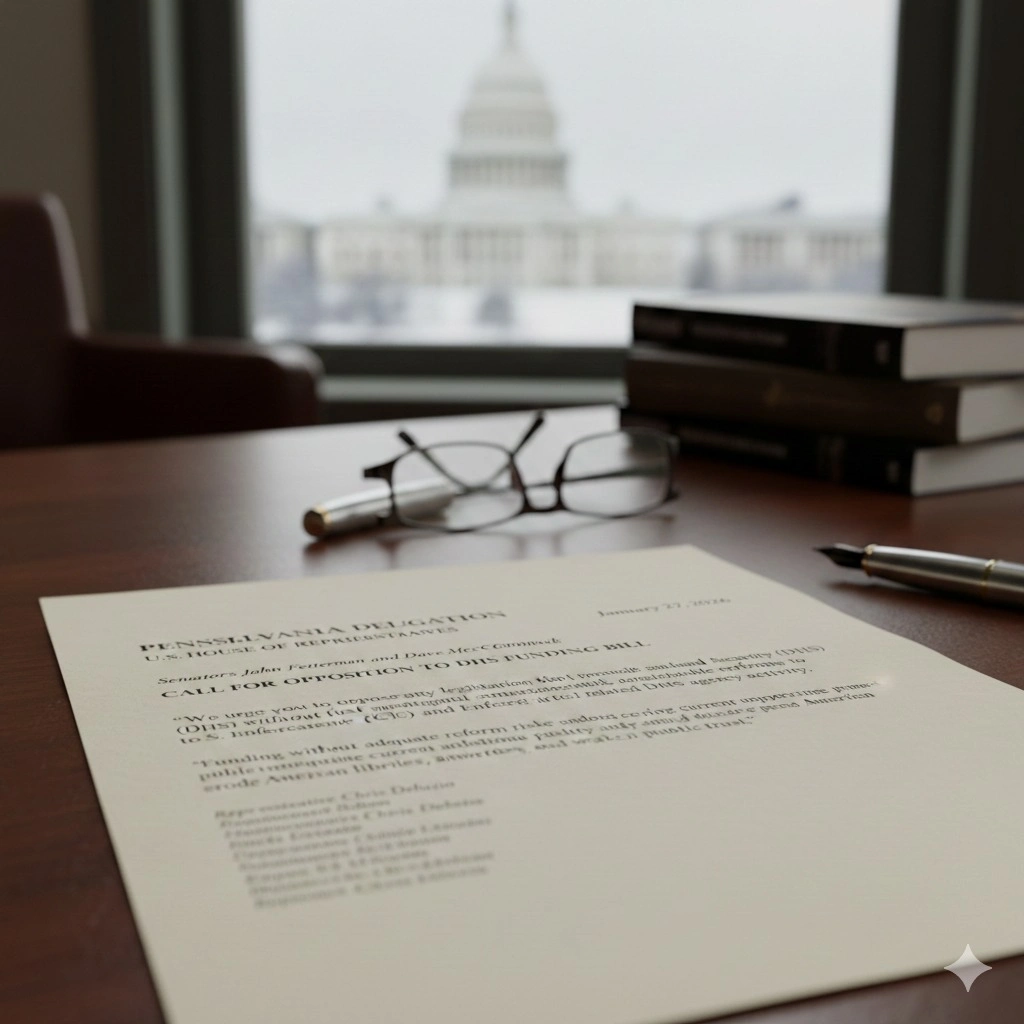
On 27 January, a group of Pennsylvania U.S. House Democrats
sent a letter to Senators John Fetterman and Dave McCormick urging them to vote
against the DHS funding bill without reforms. The signatories, including
Representative Chris Deluzio, wrote, “We urge you to oppose any legislation
that provides funding to the Department of Homeland Security (DHS) without
first securing meaningful, enforceable reforms to U.S. Immigration and Customs
Enforcement (ICE) and related DHS agency activity.”
The letter continued, “Funding without adequate reform risks
endorsing current approaches that undermine public safety and due process,
erode American liberties, and weaken public trust.” The Pennsylvania members
noted they had voted against the bill the previous week and requested the
senators do the same as the Senate considered it that week.
This position aligned with broader Democratic efforts in the
Senate, where Senator Fetterman joined others in blocking the package.
Letter to Editor Demands Specific DHS Overhauls
A letter to the editor published in the Milwaukee Journal
Sentinel on 30 January by George Perkins of Madison explicitly stated,
“Congress must vote no on DHS funding without reforms.” Perkins
argued that funding ICE and CBP enables “invasion of American communities,
resulting in disorder, turmoil, and fatalities.”
The letter listed required reforms: no unidentified officers
in masks; no chemical agents against peaceful demonstrators; elimination of
extremists and halting recruitment without background checks; extensive
de-escalation training and professional policing education; cessation of racial
profiling with written warrants required; no performance quotas or financial
incentives; full cooperation with state investigations into Renee Good, Alex
Pretti and others. Perkins concluded, “Funding should not be provided
without clear adherence to these reforms.”
The publication also noted projected ICE costs of $30
billion by 2026 and questioned the agency’s focus on separating “criminal
citizens” from “criminal non-citizens,” advocating local
handling of prosecutions.
House Republicans Warn Against Bill Changes
House Republicans have cautioned the Senate against altering
the DHS-inclusive package passed by the House. A House GOP leadership aide told
The Hill, “Any adjustments to the bipartisan agreement established with
the Senate after the House has already passed it would not be feasible.”
Members of the House Freedom Caucus warned in a letter to
President Trump that if Democrats renege, they are prepared to unilaterally
fund the government, including changing Senate rules to eliminate the 60-vote
filibuster threshold or using budget reconciliation for DHS and Defense
funding. The Caucus stated the package “will not return to House without
[funding] for the [Department] of Homeland.”
Conservatives indicated they would demand substantial
concessions if the Senate separates DHS funding and would explore independent
financing without Democratic support.
Senate Vote Dynamics and Republican Positions
The 29 January Senate vote highlighted divisions within the
Republican majority. Several GOP senators, including those listed earlier,
joined Democrats in opposition, reflecting willingness among some to consider
DHS reforms.
Senate Majority Leader Thune expressed optimism post-vote
that additional votes could occur Thursday night and emphasised avoiding a
shutdown. Some Republicans suggested detaching DHS funding from the other five
bills covering military, CDC, Head Start and cabinet departments.
President Trump commented, “We’ll work in a very bipartisan
way, I believe, not to have a shutdown. We don’t want a shutdown.”
Proposed Compromise and Short-Term Extensions
Negotiations between the White House and Senate Democrats
aim to pass the five non-DHS bills immediately while providing short-term DHS
funding to allow reform talks. Democratic leaders support this approach, with
the temporary extension buying time for oversight tightening on ICE and CBP.
Reports on 29 January indicated an agreement had been
reached on this framework, with further details forthcoming. Senate action has
been delayed by weather disruptions alongside the DHS debate.
The package requires House re-approval if modified,
complicating timelines as the House is in recess this week. Hardline House
Republicans have vowed opposition to Senate changes.
Background on DHS Funding and ICE Operations
The six-bill minibus passed by the House grouped DHS with
other priorities, necessitating Senate handling before the Saturday deadline.
Failure to act risks partial shutdown of affected agencies starting midnight
Saturday.
DHS encompasses ICE and CBP, whose enforcement actions have
drawn criticism post-Minnesota incidents. Democrats seek to bar masks, mandate
warrants and body cameras, and update conduct codes.
Schumer and others frame reforms as essential to reining in
ICE before full-year funding. House Democrats’ stance, as in the Pennsylvania
letter, underscores bipartisan chamber concerns over agency practices.
Public letters like Perkins’ amplify calls for prosecutorial
accountability for unlawful activities and cooperation with state probes.
Risks of Shutdown and Legislative Pathways
A shutdown would impact Defense, Health and Human Services
and others if bills remain bundled. Senate choices involve separating
DHS—facilitating other funding—or risking Democratic blocks.
House re-vote requirements for changes heighten shutdown
risks given recess and GOP resistance. Freedom Caucus threats of unilateral
action via rule changes or reconciliation add pressure.
Thune and Trump prioritise avoidance, with bipartisan
optimism for a deal. As of 30 January, compromise talks focus on temporary DHS
extension amid reform demands.