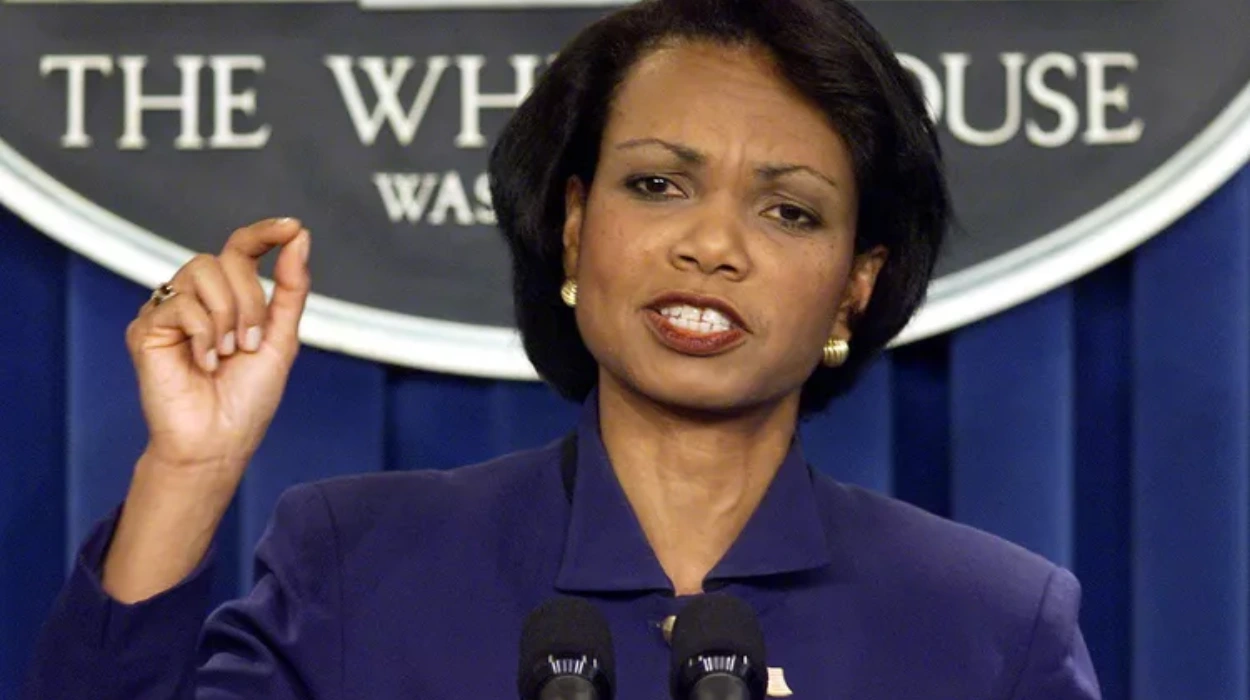

Condoleezza Rice shattered glass ceilings in American
politics, rising from a childhood in segregated Birmingham to become the first
African American woman to serve as National Security Advisor and later
Secretary of State under President George W. Bush. Her journey embodies
resilience amid adversity, blending academic rigor with high-stakes decision
making. This article explores her pivotal roles, strategic insights, and
enduring impact on global affairs, offering timeless lessons in leadership and
foreign policy.
Childhood in Segregated Birmingham
Born in Birmingham, Alabama, Condoleezza Rice grew up during
the height of the civil rights movement. Her father, a Presbyterian minister
and educator, and her mother, a music teacher, instilled values of education
and discipline. Despite racial tensions including the 1963 church bombing
blocks from her home her parents shielded her from danger while fostering
intellectual curiosity.
Academic Excellence and Mentorship
Rice excelled early, mastering piano and French before
earning a political science bachelor’s from the University of Denver at age 19.
She pursued advanced studies at Notre Dame and the University of Denver,
obtaining a Ph.D. in Soviet studies. Mentored by Josef Korbel, Madeleine
Albright’s father, her Cold War fascination honed skills that launched her
career echoing UNESCO’s view of education as key to breaking inequality.
Academic Rise and Entry into Policy Circles
Rice’s academic career took flight at Stanford University,
where she became a professor of political science and youngest ever provost.
Her expertise on the Soviet Union earned her recognition; she advised the White
House during the Reagan administration on arms control. Publications like The
Gorbachev Era showcased her predictive prowess, foreseeing the USSR’s
collapse.
By 1989, she directed Soviet and East European affairs at
the National Security Council under President George H.W. Bush. This role
immersed her in pivotal negotiations, including German reunification. Her
pragmatic approach balancing idealism with realism distinguished her among
foreign policy elites. The World Economic Forum notes that such
interdisciplinary expertise drives effective global governance, a trait Rice
exemplified.
Transitioning seamlessly from academia to government
highlighted her versatility. She co-founded Stanford’s Center for a Democratic
State and International Security, bridging theory and practice.
Appointment as National Security Advisor
In 2001, President George W. Bush tapped Rice as National
Security Advisor, making history as the first Black woman in the role. At 46,
she coordinated the National Security Council, advising on threats from
terrorism to proliferation. Her tenure began amid relative calm but pivoted
dramatically after the September 11 attacks.
Rice championed a doctrine of preemptive action,
articulating in speeches how rogue states and non-state actors endangered
global stability. She coordinated responses, including the invasion of
Afghanistan to dismantle al-Qaeda. Internally, she navigated interagency
rivalries, earning Bush’s trust as a steady counselor. Critics later
scrutinized intelligence failures leading to Iraq, but supporters credit her
with streamlining U.S. strategy.
Her influence extended to alliances. Rice bolstered NATO’s
post-9/11 solidarity and engaged rising powers like India. The IMF underscores
that strong multilateral ties mitigate economic shocks from security
crises—insights Rice applied daily.
Transformation to Secretary of State
Elevated to Secretary of State in 2005, Rice became the
principal architect of U.S. foreign policy, again as the first African American
woman. Sworn in by Bush, she shifted focus from military dominance to
diplomatic outreach, traveling over a million miles to 104 countries.
Key initiatives defined her tenure. She spearheaded the Six
Party Talks on North Korea’s nuclear program, securing temporary disarmament
pledges. In the Middle East, Rice brokered the 2007 Annapolis Conference,
laying groundwork for Israeli Palestinian dialogue. Her
“transformational diplomacy” emphasized democracy promotion,
pressuring authoritarian regimes from Burma to Zimbabwe.
Rice addressed global health crises, linking them to
security. Partnering with PEPFAR, the U.S. initiative combating HIV/AIDS, she
mobilized resources for Africa. The World Health Organization reports that such
efforts prevent millions of infections annually, stabilizing regions prone to
conflict. Economically, she advocated free trade pacts, aligning with OECD
findings that open markets foster prosperity and peace.
Challenges abounded. The Iraq War’s fallout strained
alliances, and Iran’s nuclear ambitions persisted. Yet Rice’s shuttle diplomacy
repaired transatlantic rifts, notably with Europe over Iraq. Her tenure
reflected a blend of hard power and soft influence, adapting to a multipolar
world.
Key Policies and Global Engagements
Rice’s strategies reshaped U.S.
posture on terrorism through post 9/11 intelligence reforms, establishing the
Director of National Intelligence. This addressed critical gaps exposed by
attacks, aligning with UN resolutions on counterterrorism. Energy security also
rose as a priority; she negotiated with Russia and Caspian states to diversify
supplies, viewing pipelines as geopolitical levers in line with World Bank
emphasis on energy access for development and conflict prevention.
Women’s Empowerment and Realism Debates
She elevated women’s roles in peacebuilding, launching the
U.S. Global Leadership Coalition to champion empowering initiatives echoing UN
data that gender inclusive policies reduce violence by up to 30%. In Africa,
her maternal health advocacy supported broader stability. Critics faulted her
realism for sidelining human rights in places like Saudi Arabia, but Rice
argued sustainable change demands incremental progress, as detailed in her
memoir No Higher Honor.
Legacy in Leadership and Diplomacy
Rice’s impact endures beyond the office. Pos -State
Department, she returned to Stanford, authoring bestsellers like Democracy:
Stories from the Front Lines for Leaders. She served on corporate boards,
including Dropbox and Makena Capital, applying foreign policy acumen to
business.
Philanthropically, she supports education via the Rice
Foundation, echoing her belief in opportunity’s transformative power. As a CBS
commentator, she influences discourse on Ukraine and China, urging strategic
patience.
Her style poised, articulate, piano proficient, humanized
high office. Rice modeled how intellect and grit transcend barriers. According
to the OECD, diverse leadership enhances innovation; she personifies this,
inspiring underrepresented groups in policy.
Challenges persist in her record. Iraq decisions draw
scrutiny, with debates over weapons intelligence. Yet defenders note her role
in stabilizing post Saddam elections and surge tactics that curbed violence.
Rice’s career underscores timeless principles: preparation
meets opportunity, alliances amplify strength, and moral clarity guides action.
In an era of great power competition, her emphasis on alliances and deterrence
remains relevant.
Enduring Influence on
American Foreign Policy
Rice’s doctrines inform ongoing strategies. Her focus on
Asia Pacific rebalancing prefigured the “pivot to Asia,” countering
China’s rise. Today, amid supply chain vulnerabilities, her energy
diversification warnings resonate, per IMF analyses of trade disruptions.
She advocated nuclear nonproliferation, strengthening
treaties amid Iran’s program and North Korea’s tests. UNESCO’s peace education
initiatives mirror its democracy promotion, proving cultural diplomacy’s long
term value.
Rice mentored a generation, from Susan Rice to emerging
leaders. Her path from segregated South to Foggy Bottom affirms meritocracy’s
promise, even as inequalities linger. The World Economic Forum ranks her among
the top global leaders for bridging divides.
Her story challenges aspiring policymakers: master details,
build coalitions, stay principled. As threats evolve from cyber to climate
Rice’s blueprint endures, blending resolve with realism.
In reflecting on service, Rice often quotes her mother:
“You can do anything if you’re prepared”
This ethos propelled
her through crises, leaving a legacy of poised authority in turbulent times